Red-tailed Black Cockatoo
Calyptorhynchus banksii
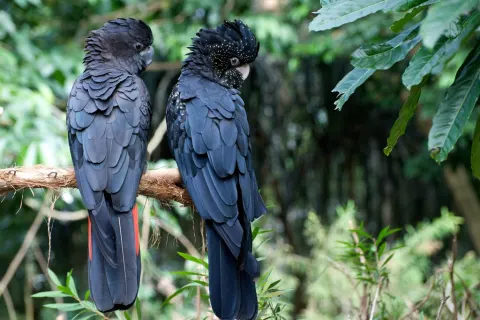
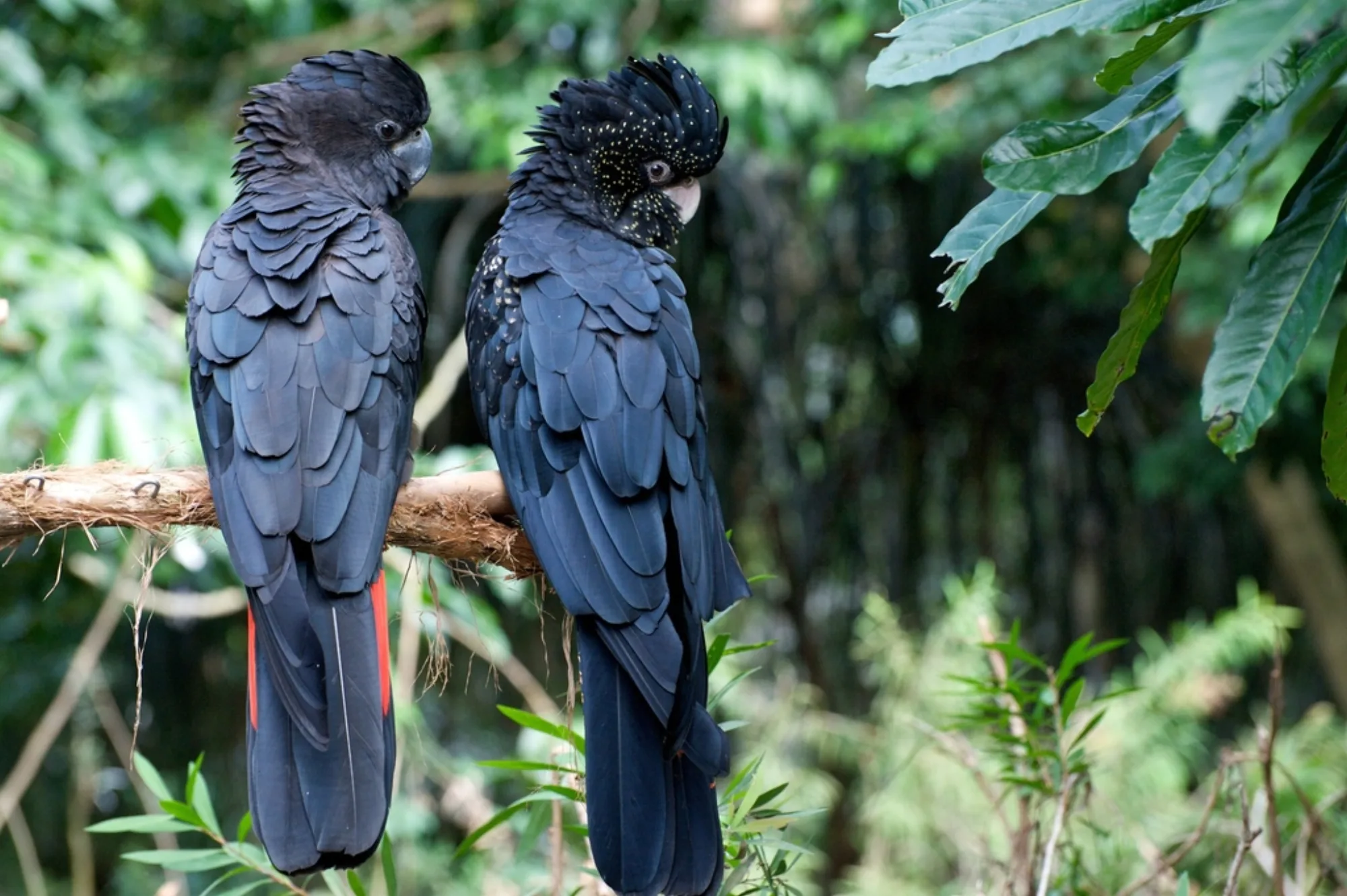
A flash of red in a black tail can reveal a male Red-tailed Black Cockatoo flying overhead. This large Australian cockatoo is around 60 centimetres long, with a prominent black crest and bright red panels in the male's tail. Females are black too, but have yellow-orange stripes on the tail and chest, with spots on the cheeks and wings that range from yellow to red. Young birds resemble females, with paler yellow barring underneath.
The species lives mainly in Australia's drier regions, with a broad northern range and more isolated populations in the south. Look for it in eucalyptus woodlands and along watercourses, as well as in habitats ranging from grasslands and shrublands to tropical rainforest. Noisy by day and often shy of people, the birds may fly high overhead in small flocks, sometimes alongside other cockatoos. Larger gatherings occur mainly in the north or where food is concentrated, and some seasonal movements follow the availability of food. Eucalyptus seeds are their staple, but they also eat other seeds and nuts, berries and fruit. They bite off seed-bearing twigs and hold them in their feet while extracting the seeds.
Breeding generally runs from May to September, although the south-eastern birds nest in summer, from December to February. Pairs nest in large hollows in tall trees, often choosing isolated trees that allow clear flight in and out. Large, old eucalypts provide nesting hollows, and birds can return to one tree over many years. In southeastern Australia, deforestation and other habitat changes threaten populations, while illegal shooting and feral honeybees are significant threats to the forest subspecies in the southwest. Illegal bird smuggling also removes birds from the wild.
Written from the English Wikipedia article Red-tailed black cockatoo (CC BY-SA 4.0).
- Records
- 64,703
- Countries
- 1
- Atlas places
- 2
These are open occurrence records, so they show where people looked for and recorded the Red-tailed Black Cockatoo as much as where it lives. Cells are up to 25 km across, and every location is generalised to its cell.
Generalised encounter areas, not exact locations. Each shape is a grid cell coloured by how likely the species is there.
- Very likelyAustralia25 km zone · high confidence · 64703 records · updated 80 days ago
Conservation status not assessed here yet, so every location is generalised to its grid cell.