Anna's Hummingbird
Calypte anna
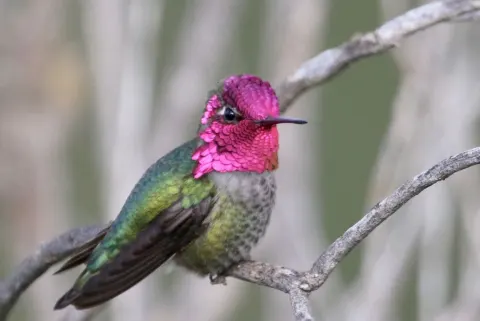
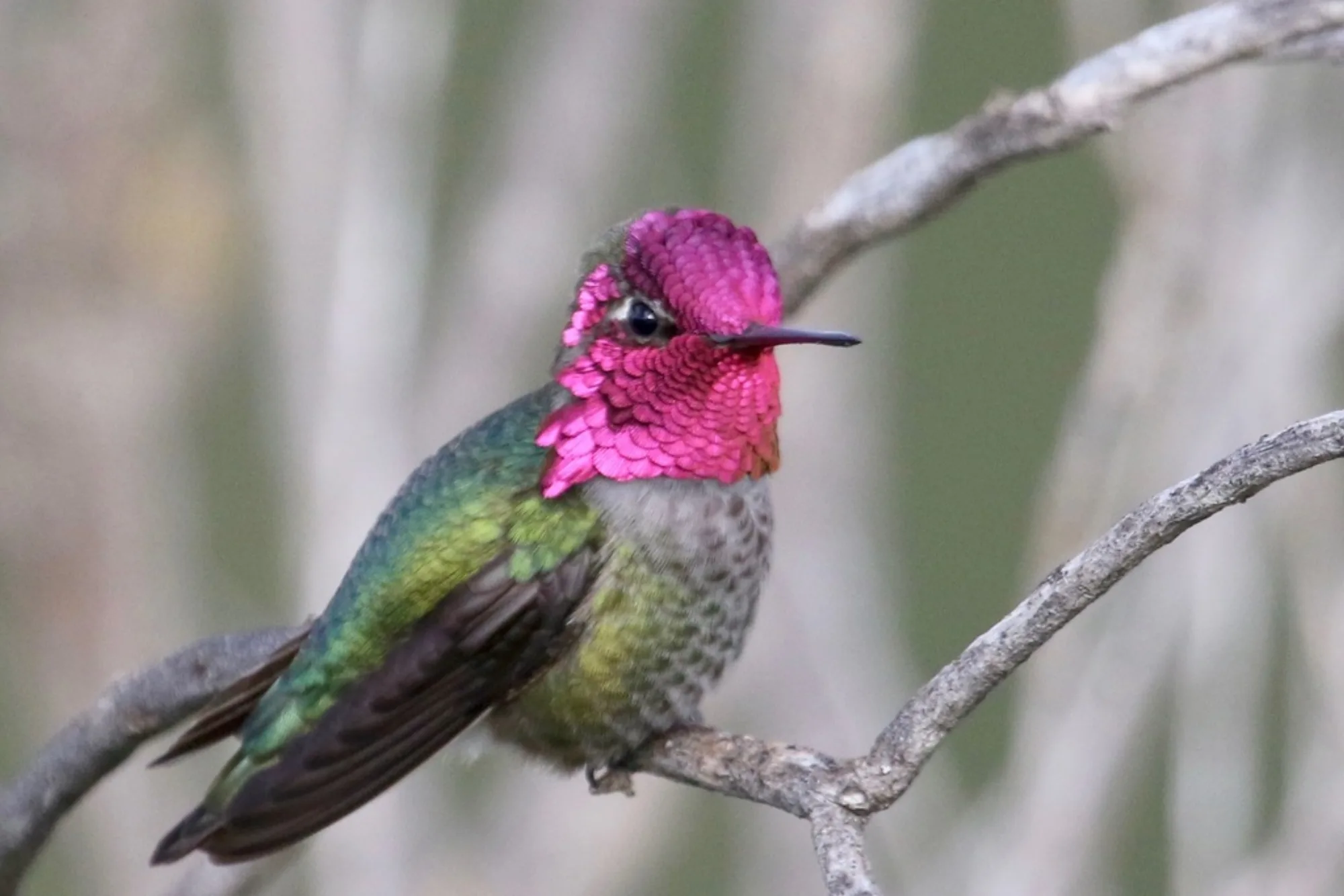
A flash of reddish-pink on the head can reveal a male Anna's Hummingbird, although the colour may look dull brown or grey without direct sunlight. Both sexes have bronze-green backs, pale grey underparts and long, slender bills. Females and young males have dull green crowns and grey throats, sometimes with a touch of iridescent red. These small birds measure 9.9 to 10.9 cm long.
Look for them from southern Canada down to northern Baja California on the Pacific side of North America, with their range extending east to western Texas. They use open woodland, scrub and mountain meadows for breeding, and are also common in urban parks and backyards. Many remain within their range year-round, including birds that endure snow and freezing conditions in Seattle. In cold weather, some survive by entering torpor, a state in which they lower their metabolic rate. Ornamental plants and feeders have helped the species expand its range, providing nectar and nesting opportunities.
Anna's Hummingbirds drink nectar and take insects, including those caught in flight or snatched from spider webs. They also visit feeders for sugar water and eat tree sap, and may even take spiders. During the breeding season, a male may sing a thin, squeaky song or perform a steep aerial dive over his territory. His tail feathers make an audible squeak near the bottom of the dive. The female builds a small round nest in vegetation or on artificial structures, binding its materials with spider silk. She raises the young alone, and nesting can begin as early as mid-December or continue as late as June, depending on location and conditions.
Written from the English Wikipedia article Anna's hummingbird (CC BY-SA 4.0).
- Records
- 3,868,120
- Countries
- 3
- Atlas places
- 2
These are open occurrence records, so they show where people looked for and recorded the Anna's Hummingbird as much as where it lives. Cells are up to 25 km across, and every location is generalised to its cell.
Generalised encounter areas, not exact locations. Each shape is a grid cell coloured by how likely the species is there.
- Very likelyUnited States25 km zone · high confidence · 3490480 records · updated 86 days ago
- Very likelyCanada25 km zone · high confidence · 369545 records · updated 86 days ago
- Very likelyMexico25 km zone · high confidence · 8095 records · updated 86 days ago
Conservation status not assessed here yet, so every location is generalised to its grid cell.