Nicobar Pigeon
Caloenas nicobarica
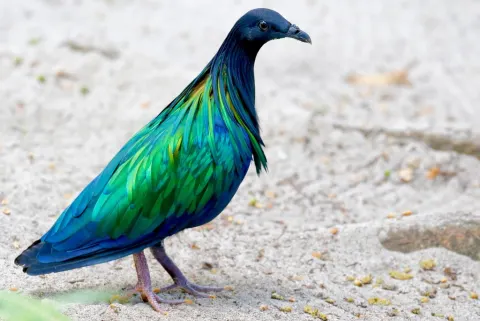
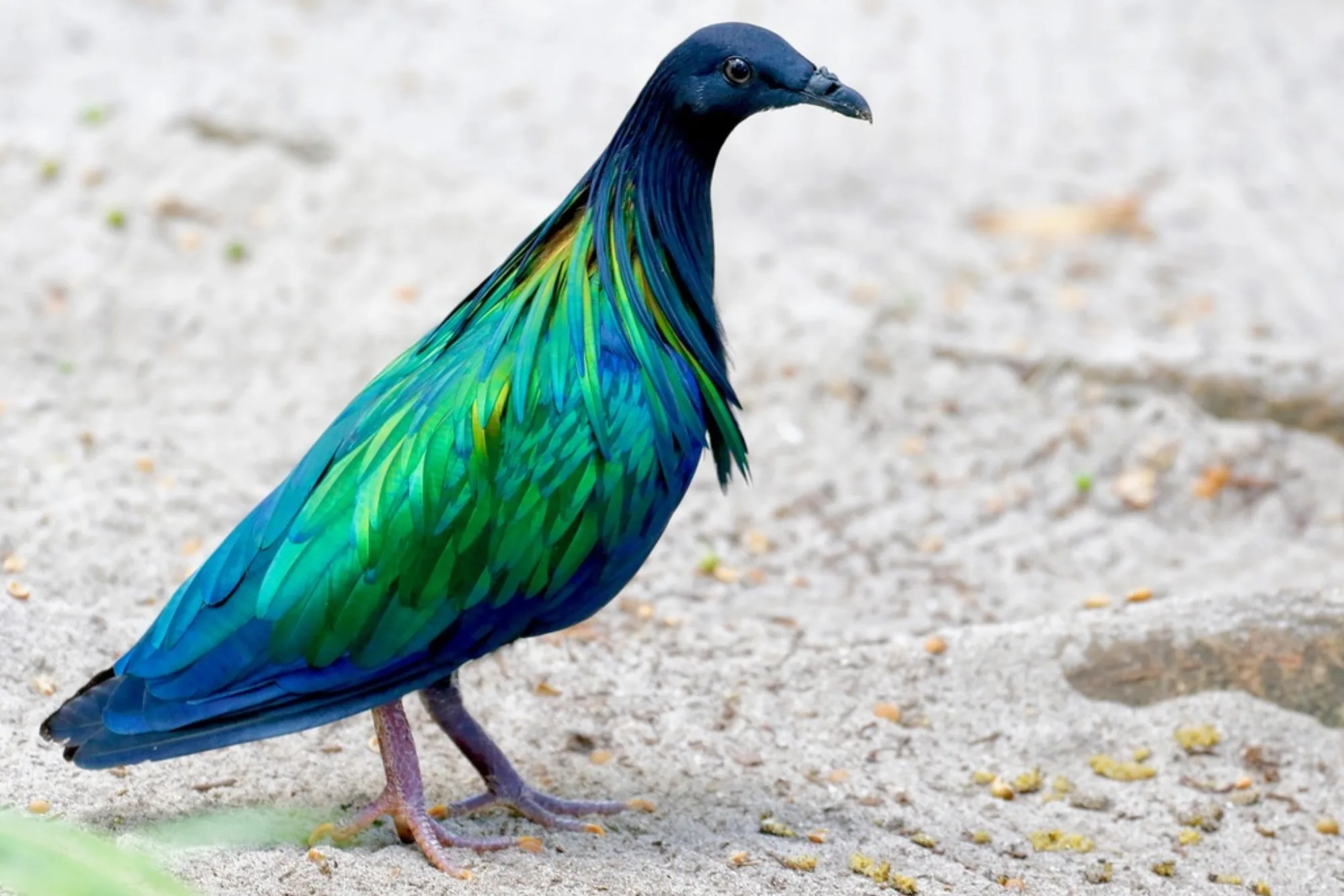
A large, ground-dwelling island pigeon, the Nicobar Pigeon measures 32 to 35 cm from end to end. Its grey head and upper neck give way to long green and copper feathers, while most of its plumage is metallic green. In dull light the body can look black, making the short white tail a useful feature to notice. Its strong legs and feet are dull red, and its low-pitched call is repetitive. Young birds look different: their tails are black and they have almost none of the adults' iridescence.
Its range stretches from India's Andaman and Nicobar Islands across the Indonesian Archipelago to Palau and the Solomons, including small islands and coastal areas. Large breeding colonies often gather in thick woodland on islets away from the coast. Flocks move from island to island, usually sleeping on predator-free offshore islets and spending the day where food is more plentiful. They do not avoid places inhabited by people, and may be drawn to areas with grain. Seeds, fruit and buds also form part of their diet. In flight, groups tend to travel in columns or single file, and typically cross between islands at least 60 metres above the sea. A loosely assembled platform of sticks in a tree holds one white egg with a faint blue tinge.
People hunt Nicobar Pigeons for food and for gizzard stones sometimes used in jewellery, and trap them for the local pet market. Nesting habitat is also shrinking as offshore islets are logged for plantations, affected by construction or polluted by nearby industry and harbours. Increased travel brings predators to more breeding sites, where colonies may be forced to leave or be destroyed.
Written from the English Wikipedia article Nicobar pigeon (CC BY-SA 4.0).
- Records
- 2,478
- Countries
- 12
No atlas park has a record of the Nicobar Pigeon in or around it yet.
These are open occurrence records, so they show where people looked for and recorded the Nicobar Pigeon as much as where it lives. Cells are up to 25 km across, and every location is generalised to its cell.
Generalised encounter areas, not exact locations. Each shape is a grid cell coloured by how likely the species is there.
- Very likelyPalau25 km zone · high confidence · 1169 records · updated 80 days ago
- Very likelyPapua New Guinea25 km zone · high confidence · 344 records · updated 80 days ago
- Very likelyThailand25 km zone · high confidence · 304 records · updated 80 days ago
- Very likelyIndia25 km zone · high confidence · 286 records · updated 80 days ago
- LikelyIndonesia25 km zone · medium confidence · 133 records · updated 80 days ago
- LikelyMalaysia25 km zone · medium confidence · 72 records · updated 80 days ago
- LikelyAustralia25 km zone · medium confidence · 42 records · updated 80 days ago
- LikelyPhilippines25 km zone · medium confidence · 42 records · updated 80 days ago
- LikelyMyanmar (Burma)25 km zone · medium confidence · 40 records · updated 80 days ago
- LikelySolomon Islands25 km zone · medium confidence · 25 records · updated 80 days ago
Conservation status not assessed here yet, so every location is generalised to its grid cell.