Gang-gang Cockatoo
Callocephalon fimbriatum
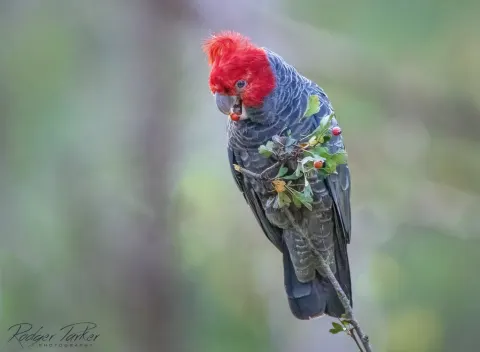
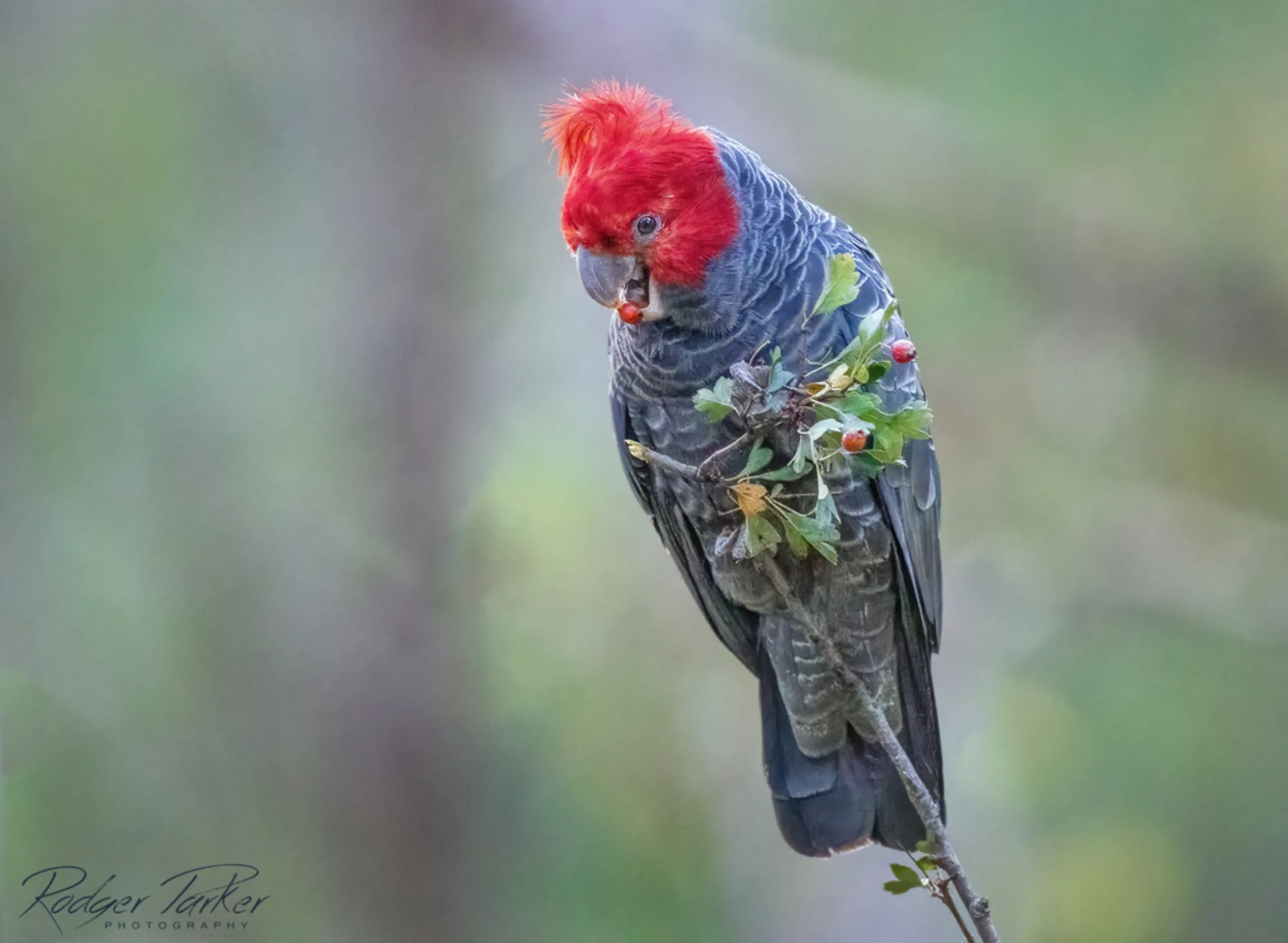
A creaky gate or a cork pulled from a bottle may announce a Gang-gang Cockatoo before it comes into view. This grey parrot has a wispy crest, and the male is easy to recognise by his bright red head and crest. The female has a grey crest and more pronounced, buff-coloured scalloping on her plumage. Adults measure 32 to 37 cm long, with a wingspan of 62 to 76 cm, and weigh 230 to 334 grams. Social but not especially noisy, these cockatoos can look like Galahs when seen in flight.
Gang-gangs live in coastal regions of south-eastern Australia, favouring cool, wet forests and mountain woodlands with dense shrubs beneath the trees. They also occur as an introduced species on Kangaroo Island, but have disappeared from King Island off Tasmania. In winter they move short distances into more open country, returning to denser forest to breed where tall trees provide nesting sites. They feed in the canopy, mainly on eucalypt flowers and buds. Pairs stay together, breeding from spring to summer and often choosing a nest site near water. The female excavates a cavity in a young, solid tree, where she lays 2 to 3 white eggs; both parents care for the young after an incubation period of 4 weeks.
Land clearing has reduced feeding habitat and the supply of older, hollow trees across south-eastern Australia, contributing to a significant fall in numbers. The 2019 to 20 bushfires killed birds and destroyed habitat, affecting 28 to 36 per cent of the area where the species occurs. An Australian government spokesperson said in July 2021 that the population had fallen by approximately 69% over the previous three generations, or 21 years.
Written from the English Wikipedia article Gang-gang cockatoo (CC BY-SA 4.0).
- Records
- 64,101
- Countries
- 1
- Atlas places
- 5
These are open occurrence records, so they show where people looked for and recorded the Gang-gang Cockatoo as much as where it lives. Cells are up to 25 km across, and every location is generalised to its cell.
Generalised encounter areas, not exact locations. Each shape is a grid cell coloured by how likely the species is there.
- Very likelyAustralia25 km zone · high confidence · 64101 records · updated 80 days ago
Conservation status not assessed here yet, so every location is generalised to its grid cell.