Common Marmoset
Callithrix jacchus
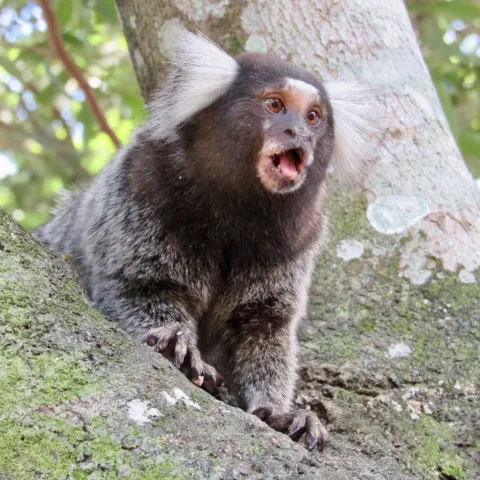
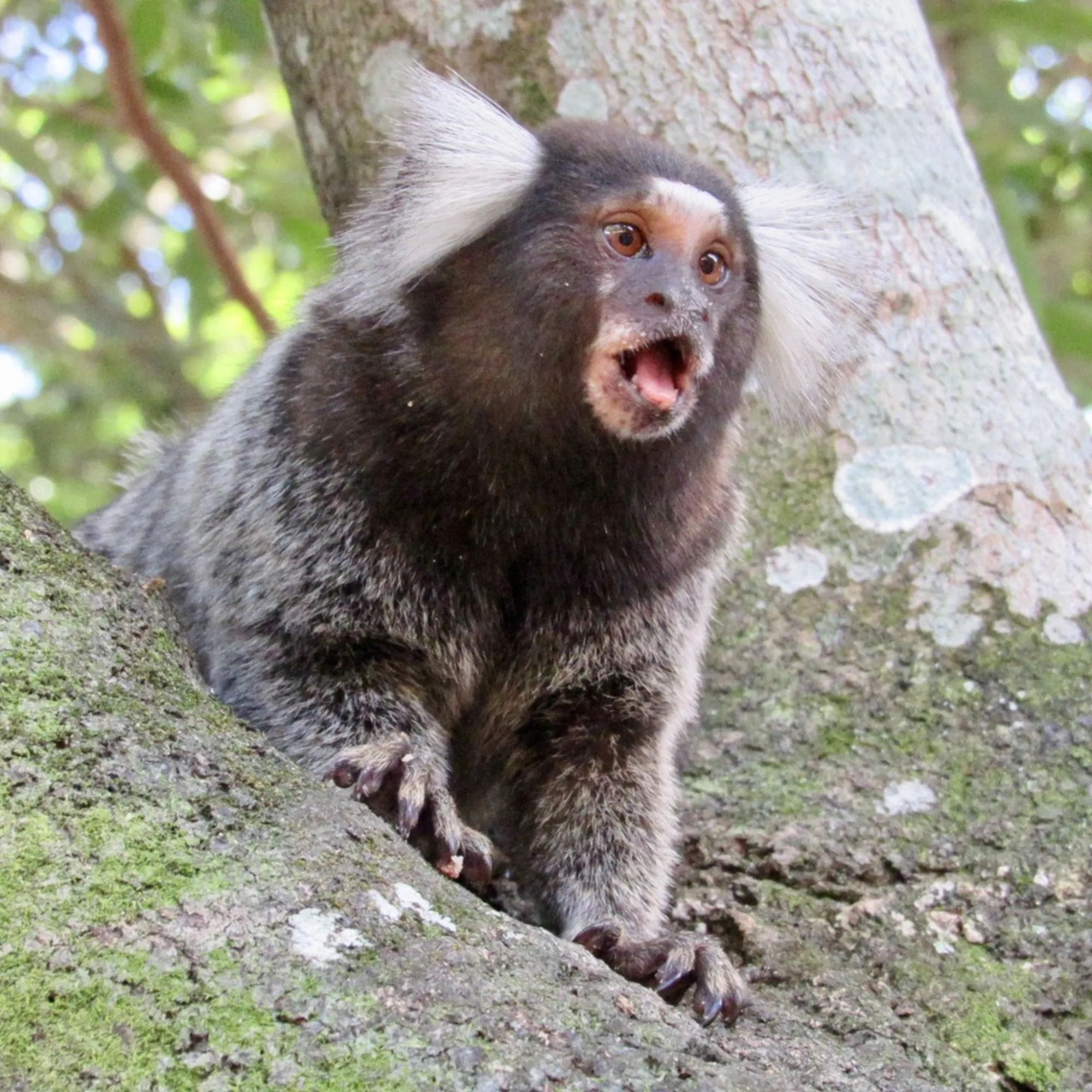
Small enough to move through trees like a squirrel, the Common Marmoset is a New World monkey with a relatively long tail. Its coat mixes brown, grey and yellow, with white ear tufts, a banded tail and a white mark on the forehead. Black skin across the nose adds another feature to its distinctive face. Infants have brown and yellow coats, but their ear tufts develop later. Marmosets can cling upright to tree trunks, leap between trees and run along branches.
Native to east-central Brazil, the species has been introduced elsewhere and now lives in Rio de Janeiro and Buenos Aires. It occupies several kinds of forest, from Atlantic coastal forest to inland semideciduous forest, as well as savanna and riverine forest. It also does well in dry secondary forest and along forest edges. Gum, sap, latex and resin form a major part of its diet, alongside insects. A marmoset chews a hole in a tree to reach its fluids and may return to the same hole several times. Its varied menu also includes fruit, flowers, fungi, snails, lizards, bird eggs and nestlings.
Common marmosets live in settled extended families, typically numbering nine, although groups can reach 15 members. Only a few group members breed, and the family helps to raise the young. Females commonly give birth to twins, which initially cling to their mother's back. As the youngsters grow, they spend more time moving and playing, and are weaned at 3 months. Habitat degradation is a concern: around 80% of the Cerrado region has been cleared for cultivation more recently. Marmosets are also captured and traded as pets, and may be abandoned or killed when they become harder to control with age.
Written from the English Wikipedia article Common marmoset (CC BY-SA 4.0).
- Records
- 296
- Countries
- 2
- Atlas places
- 1
These are open occurrence records, so they show where people looked for and recorded the Common Marmoset as much as where it lives. Cells are up to 25 km across, and every location is generalised to its cell.
Generalised encounter areas, not exact locations. Each shape is a grid cell coloured by how likely the species is there.
- Very likelyBrazil25 km zone · medium confidence · 289 records · updated 80 days ago
- LikelyUnited States25 km zone · medium confidence · 7 records · updated 80 days ago
Conservation status not assessed here yet, so every location is generalised to its grid cell.