Dunlin
Calidris alpina
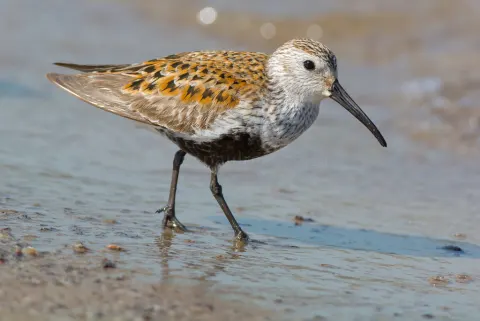
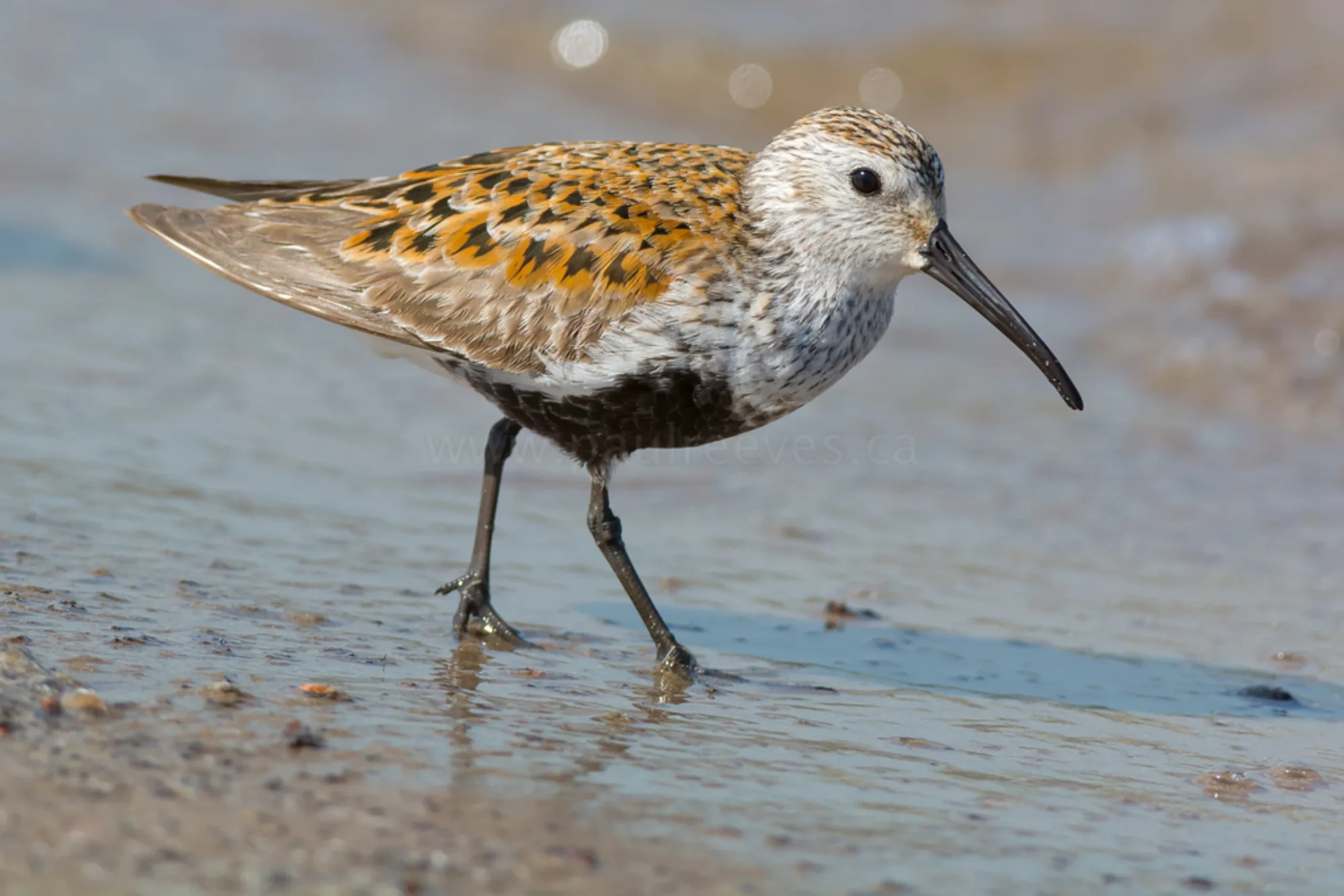
On a coastal mudflat, the Dunlin can be recognised by its steady, sewing-machine feeding action as it picks up small morsels. This small wader has black legs and a slightly downcurved black bill, and shows a narrow white stripe across each wing in flight. Breeding adults have a distinctive black belly, while winter birds are greyish-brown above and white below. Young birds are brown above, with faint whitish V shapes on the back and usually black marks on the flanks or belly. In winter, Dunlin gather on coastal mudflats and sandy beaches, sometimes in large flocks. At migration stops and in wintering areas, travellers may see them wheeling together in synchronised flight.
Dunlin breed around the Arctic and subarctic, including on alpine tundra. Their winter destinations vary: birds from western Europe mostly stay near the coasts of western and southern Europe and northwest Africa, while those from far northern Europe and Asia travel south as far as Africa and parts of Asia. Birds breeding in Alaska and the Canadian Arctic generally migrate to North American coasts, though those nesting in northern Alaska winter in Asia. On nesting grounds, insects make up most of their diet; on the coast they eat molluscs, worms and crustaceans. Both parents incubate the eggs in a shallow ground nest lined with vegetation, and the chicks begin to fly at about three weeks old. The population appears to be declining, and habitat fragmentation has left some southern Dunlin populations more isolated and susceptible to inbreeding. In Denmark, the southern subspecies fell from 50,000 pairs a century earlier to 95 pairs in 2021.
Written from the English Wikipedia article Dunlin (CC BY-SA 4.0).
- Records
- 1,196,159
- Countries
- 125
- Atlas places
- 5
These are open occurrence records, so they show where people looked for and recorded the Dunlin as much as where it lives. Cells are up to 25 km across, and every location is generalised to its cell.
Generalised encounter areas, not exact locations. Each shape is a grid cell coloured by how likely the species is there.
- Very likelyUnited States25 km zone · high confidence · 556627 records · updated 86 days ago
- Very likelySweden25 km zone · high confidence · 117439 records · updated 86 days ago
- Very likelyUnited Kingdom25 km zone · high confidence · 82132 records · updated 86 days ago
- Very likelyNorway25 km zone · high confidence · 78142 records · updated 86 days ago
- Very likelyCanada25 km zone · high confidence · 69633 records · updated 86 days ago
- Very likelyTaiwan25 km zone · high confidence · 49370 records · updated 86 days ago
- Very likelyPortugal25 km zone · high confidence · 32926 records · updated 86 days ago
- Very likelySpain25 km zone · high confidence · 29631 records · updated 86 days ago
- Very likelyFinland25 km zone · high confidence · 25104 records · updated 86 days ago
- Very likelyDenmark25 km zone · high confidence · 16865 records · updated 86 days ago
Conservation status not assessed here yet, so every location is generalised to its grid cell.