Yellow-crested Cockatoo
Cacatua sulphurea
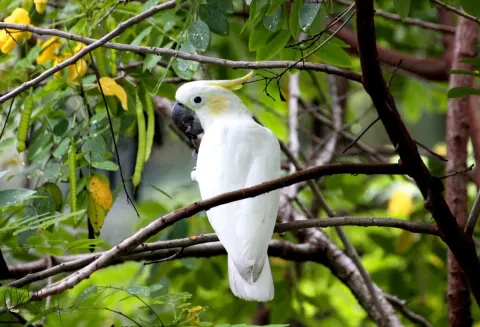
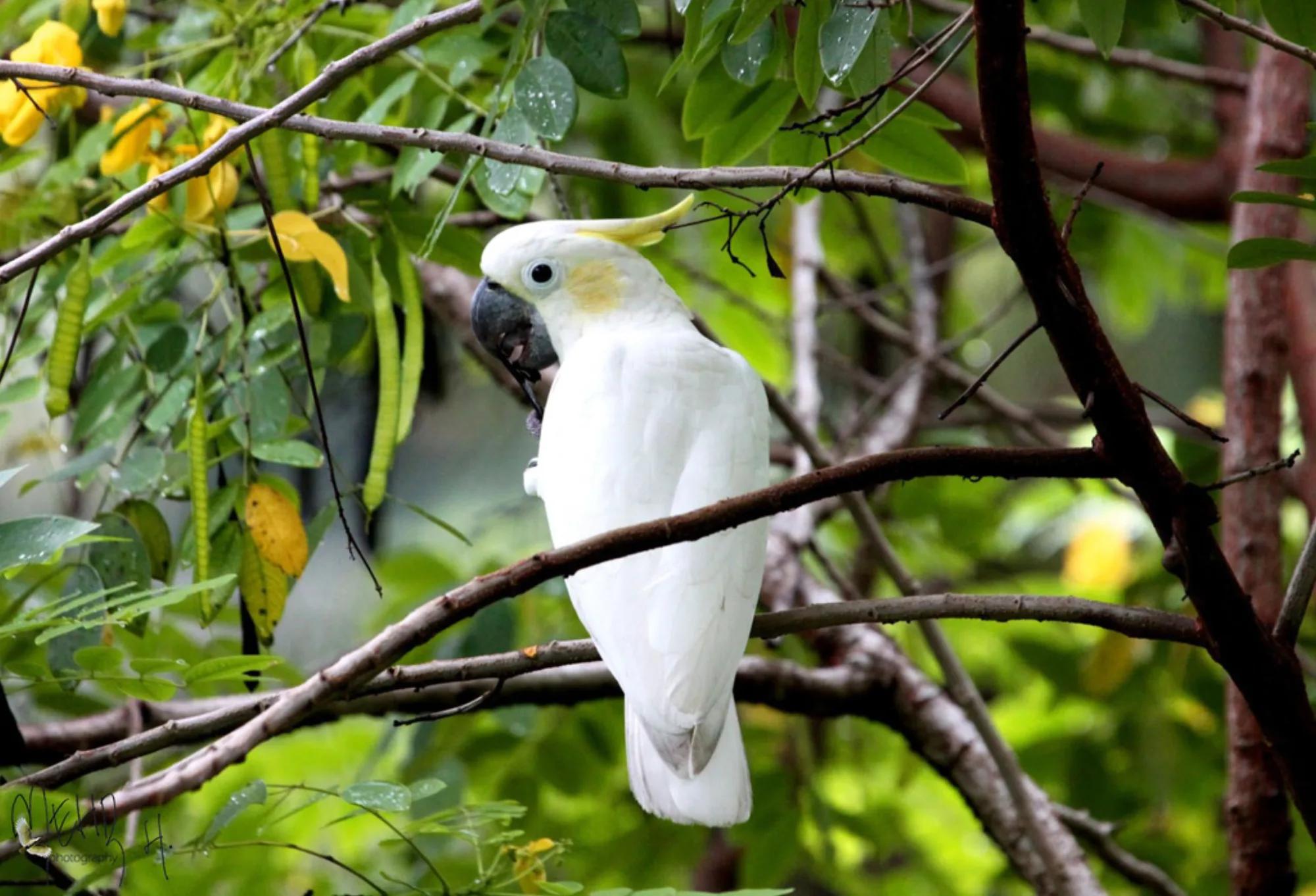
White plumage and a raised yellow or orange crest make the Yellow-crested Cockatoo a distinctive sight in the wooded and cultivated areas it inhabits. About 34 cm long, it has a black bill, grey feet and bluish-white bare skin around its eyes. Males and females look alike. Take care when identifying it: the larger, more common sulphur-crested cockatoo looks similar, although its distribution lies farther east. The Yellow-crested Cockatoo has pale yellow on its cheeks and a brighter crest, closer to orange, while the similar citron-crested cockatoo of Sumba has an orange crest.
Its range includes East Timor and the Indonesian islands of Sulawesi and the Lesser Sundas. Among its national park habitats are Rawa Aopa Watumohai in Sulawesi, Komodo on the island of the same name, and Nino Konis Santana in East Timor. An introduced population also lives in Hong Kong, where the birds are easy to spot in public parks and woodland in the northern and western parts of Hong Kong Island, as well as across densely populated areas on both sides of the harbour. Seeds, buds, fruit, nuts and herbaceous plants make up most of its diet. It nests in tree cavities, usually laying two white eggs. Both parents share incubation, and the eggs hatch after about 28 days. The young leave their nest about 75 days after hatching.
Illegal trapping for the cage-bird trade has caused a dramatic decline in numbers. Between 1980 and 1992, more than 100,000 birds were legally exported from Indonesia. On Masakambing, where Abbott's yellow-crested cockatoo occurs, trapping and logging have contributed to its decline, especially the loss of mangroves and kapok trees.
Written from the English Wikipedia article Yellow-crested cockatoo (CC BY-SA 4.0).
- Records
- 2,051
- Countries
- 5
- Atlas places
- 1
These are open occurrence records, so they show where people looked for and recorded the Yellow-crested Cockatoo as much as where it lives. Cells are up to 25 km across, and every location is generalised to its cell.
Generalised encounter areas, not exact locations. Each shape is a grid cell coloured by how likely the species is there.
- Very likelyHong Kong SAR China25 km zone · high confidence · 2031 records · updated 80 days ago
- LikelyFrance25 km zone · medium confidence · 12 records · updated 80 days ago
- PossibleIndonesia25 km zone · medium confidence · 3 records · updated 80 days ago
- PossiblePhilippines25 km zone · medium confidence · 3 records · updated 80 days ago
- PossibleSingapore25 km zone · medium confidence · 2 records · updated 80 days ago
Conservation status not assessed here yet, so every location is generalised to its grid cell.