Little Corella
Cacatua sanguinea
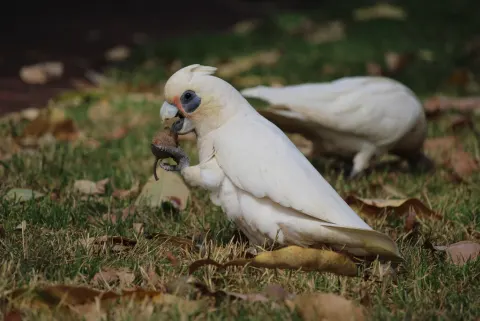
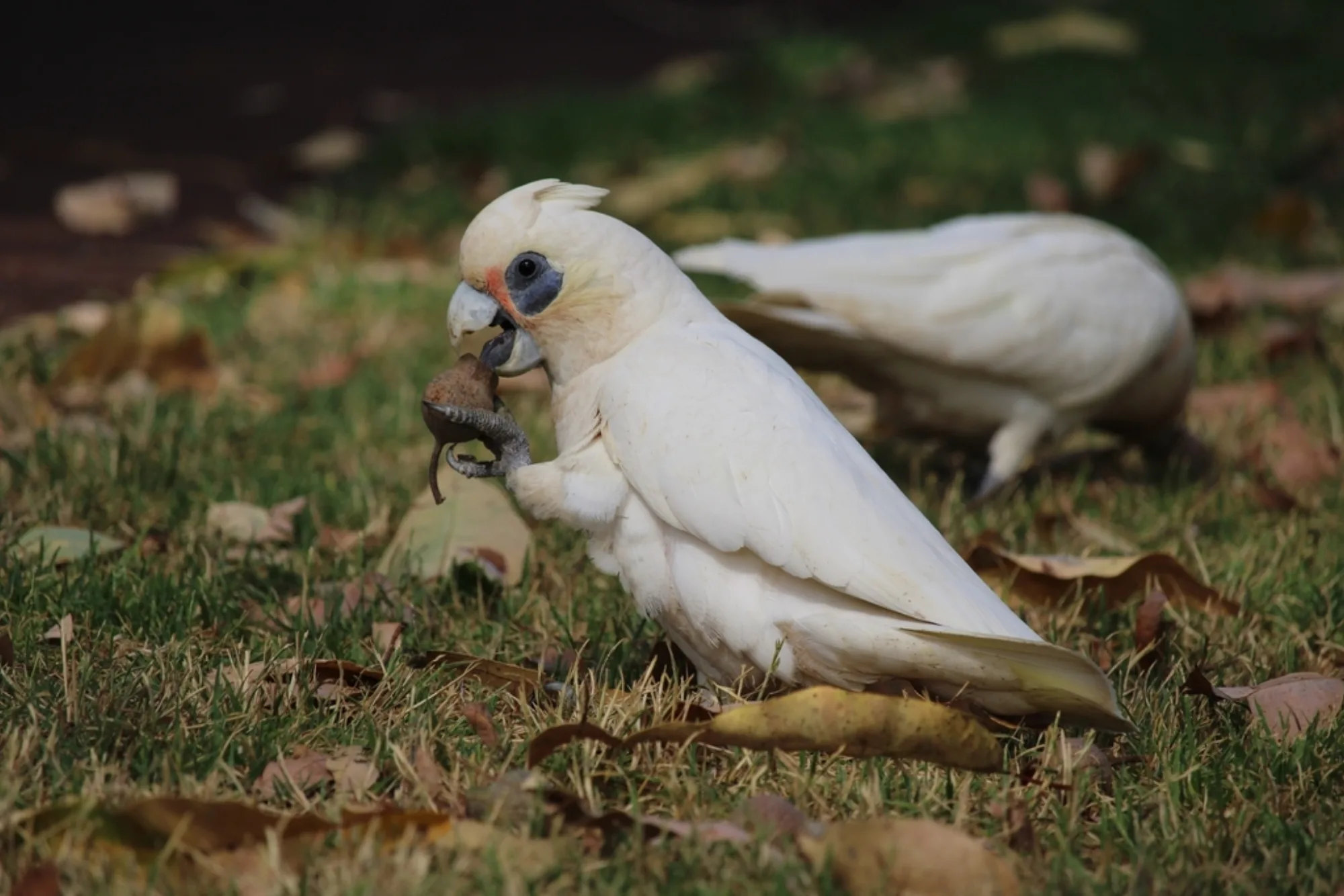
A small white cockatoo with a high-pitched, screeching call, the Little Corella measures 35 to 41 cm long. It resembles the long-billed and western corellas, but is smaller than both and lacks the orange throat bar of the long-billed bird. Some have darker blue rings around the eyes, more pronounced pink markings near the eyes and a yellow wash below the ears.
Native to mainland Australia and southern New Guinea, it has also been introduced to Tasmania. Its Australian range arcs across the eastern states and the Northern Territory, linking eastern South Australia with coastal Western Australia. Look for it in savanna, scrub and grassland, from central Australian deserts to eastern coastal plains, as well as in cities, though not in thick forest. In Melbourne, Canberra, Sydney and Brisbane, birds feed on lawns and playing fields.
Little Corellas gather in flocks of up to several thousand, sometimes alongside galahs and other cockatoos. They usually roost in trees overnight, leaving to feed early and returning late, and may travel many kilometres between feeding and roosting sites. In desert areas they also visit waterholes twice a day. They feed mostly on the ground, eating wild and cultivated seeds, lawn grasses and cereal crops. Noisy play can include flying about and hanging upside down. Breeding runs from May to October, generally earlier in the north, with nests usually in tree hollows, cliff cavities or termite mounds. In South Australia, landowners may shoot, trap or gas these birds, and a suspected poisoning in Adelaide killed some short-billed corellas.
Written from the English Wikipedia article Little corella (CC BY-SA 4.0).
- Records
- 265,728
- Countries
- 1
- Atlas places
- 4
These are open occurrence records, so they show where people looked for and recorded the Little Corella as much as where it lives. Cells are up to 25 km across, and every location is generalised to its cell.
Generalised encounter areas, not exact locations. Each shape is a grid cell coloured by how likely the species is there.
- Very likelyAustralia25 km zone · high confidence · 265728 records · updated 80 days ago
Conservation status not assessed here yet, so every location is generalised to its grid cell.