Major Mitchell's Cockatoo
Cacatua leadbeateri
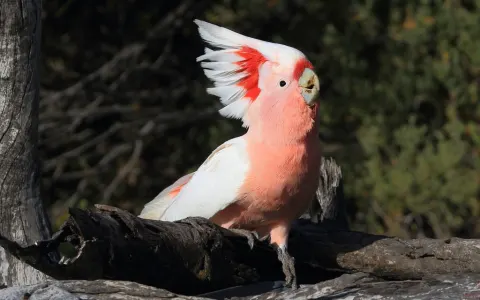
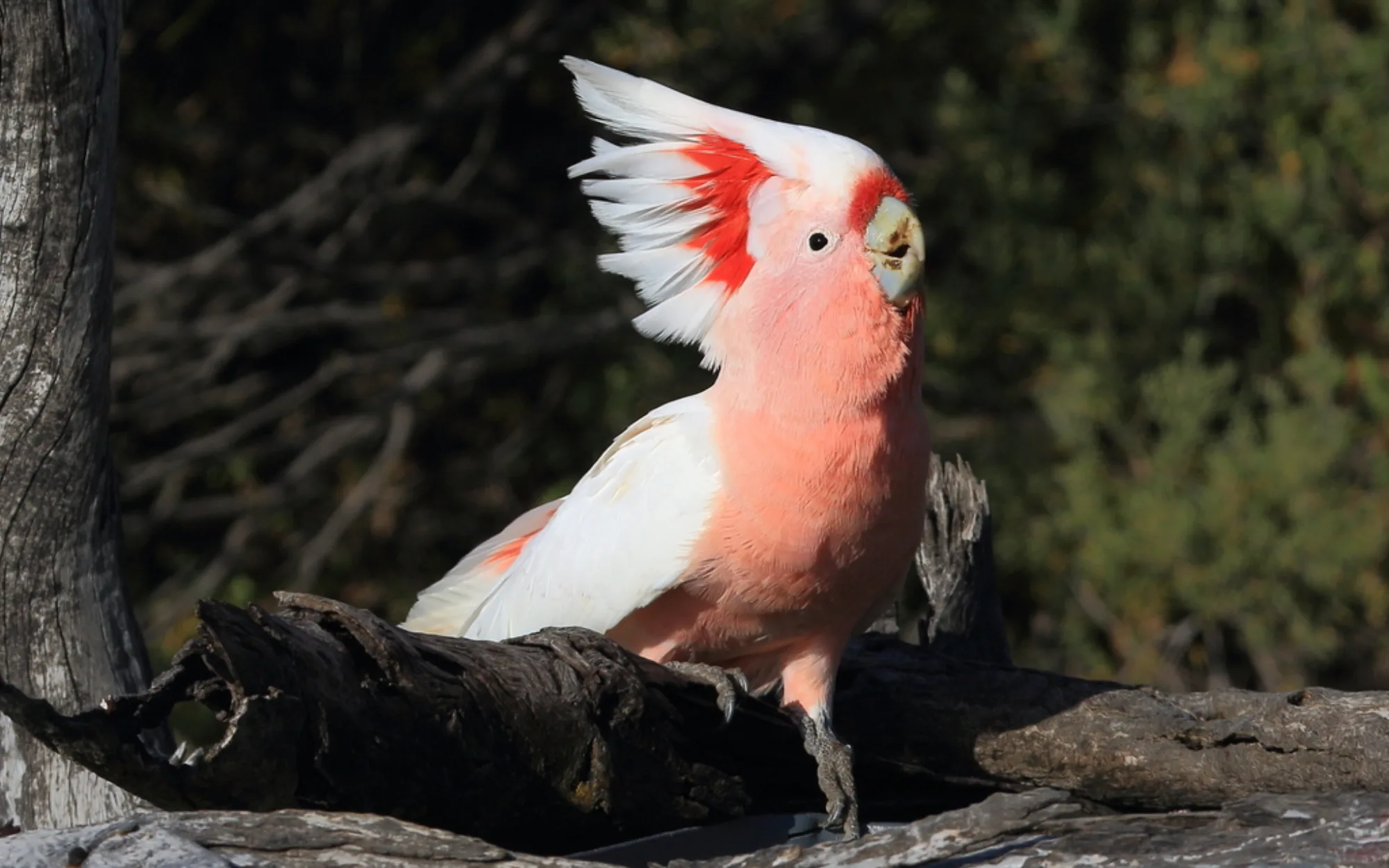
A flash of red and yellow in a large crest helps distinguish the Major Mitchell's Cockatoo, also known as the pink cockatoo. This medium-sized bird has soft-textured white and salmon-pink plumage, with pink colouring on its wings. Males and females look almost identical, though males are usually larger. A mature female has a red eye and a broader yellow stripe on her crest. Its call is a plaintive yodel, and its wings have a rounded shape.
The species inhabits arid and semiarid inland Australia, apart from the north-east. It needs extensive woodlands and particularly favours conifers, sheoaks and eucalypts. Look for it in pairs or small groups, either on the ground or among trees, where it also feeds. Pairs do not nest close to one another, a habit that makes fragmented, partly cleared habitat difficult for the species to tolerate. It reaches sexual maturity at around 3 to 4 years old. In Victoria's Mallee region, pink cockatoos and galahs sometimes nest in the same area and have occasionally produced hybrid offspring.
Changes made by people to Australia's arid interior have contributed to a decline in pink cockatoo populations. Clearing and fragmentation are a particular problem for a bird that needs extensive woodland and keeps its nesting pairs apart. Its range is contracting as a result. Galahs, by contrast, readily use cleared and partly cleared land, and their populations have increased following changes to the inland landscape.
Written from the English Wikipedia article Pink cockatoo (CC BY-SA 4.0).
- Records
- 17,421
- Countries
- 1
No atlas park has a record of the Major Mitchell's Cockatoo in or around it yet.
These are open occurrence records, so they show where people looked for and recorded the Major Mitchell's Cockatoo as much as where it lives. Cells are up to 25 km across, and every location is generalised to its cell.
Generalised encounter areas, not exact locations. Each shape is a grid cell coloured by how likely the species is there.
- Very likelyAustralia25 km zone · medium confidence · 17421 records · updated 80 days ago
Conservation status not assessed here yet, so every location is generalised to its grid cell.