Sulphur-crested Cockatoo
Cacatua galerita
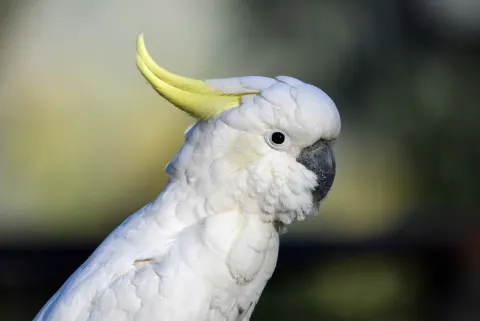
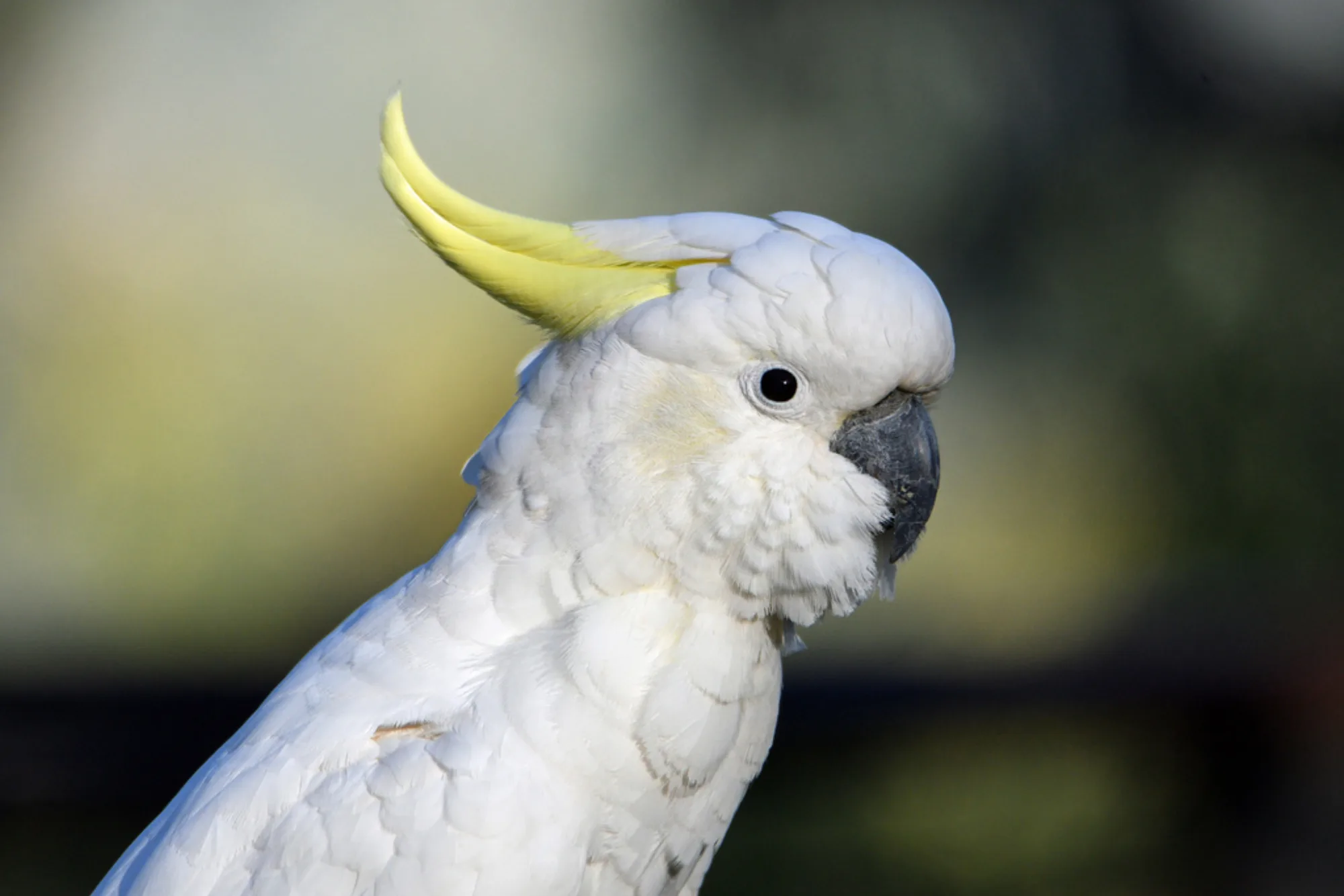
A flash of yellow above a white head can help identify the Sulphur-crested Cockatoo, a large parrot of wooded habitats. It measures 44 to 55 cm long, with a yellow crest, black bill and grey legs. Its mostly white plumage has a yellow tinge beneath the wings and tail. Australia's corellas look similar, but are smaller, with pale bills and no prominent yellow crest. Listen, too, for the cockatoo's distinctive, raucous calls, which can be very loud.
Its natural range covers much of Australia, Indonesia and Papua New Guinea, and it lives in forests including tropical and subtropical rainforests. It has adapted well to European settlement in Australia and also lives in many urban areas. In Sydney, some have learned to open rubbish bins for food, a behaviour that spreads through imitation. When a flock feeds on the ground, at least one bird keeps guard from high in a tree. In Australia, breeding is seasonal: the season runs from August to January in the south and May to September in the north. Wood chips line a hollow tree nest, and the birds compete with their own and other species for nesting sites. Both parents incubate the two to three eggs and raise the chicks; after fledging, the young stay with them for several months.
In some parts of Australia, large numbers damage cereal and fruit crops, newly planted tree seedlings and soft timber, and the birds are sometimes shot or poisoned as pests. They are also susceptible to psittacine beak and feather disease, which occurs both in the wild and in captivity and causes feather loss and misshapen beaks.
Written from the English Wikipedia article Sulphur-crested cockatoo (CC BY-SA 4.0).
- Records
- 705,539
- Countries
- 16
- Atlas places
- 7
These are open occurrence records, so they show where people looked for and recorded the Sulphur-crested Cockatoo as much as where it lives. Cells are up to 25 km across, and every location is generalised to its cell.
Generalised encounter areas, not exact locations. Each shape is a grid cell coloured by how likely the species is there.
- Very likelyAustralia25 km zone · high confidence · 699428 records · updated 86 days ago
- Very likelyPapua New Guinea25 km zone · high confidence · 2029 records · updated 86 days ago
- Very likelyPalau25 km zone · high confidence · 1961 records · updated 86 days ago
- Very likelyNew Zealand25 km zone · high confidence · 886 records · updated today
- Very likelyTaiwan25 km zone · high confidence · 719 records · updated today
- LikelySingapore25 km zone · high confidence · 328 records · updated today
- LikelyBahamas25 km zone · high confidence · 102 records · updated today
- PossibleIndonesia25 km zone · medium confidence · 26 records · updated today
- PossibleUnited States25 km zone · medium confidence · 21 records · updated today
- UncommonBermuda25 km zone · medium confidence · 15 records · updated today
Conservation status not assessed here yet, so every location is generalised to its grid cell.