White Cockatoo
Cacatua alba
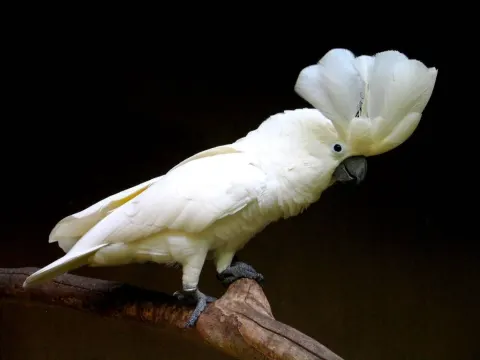
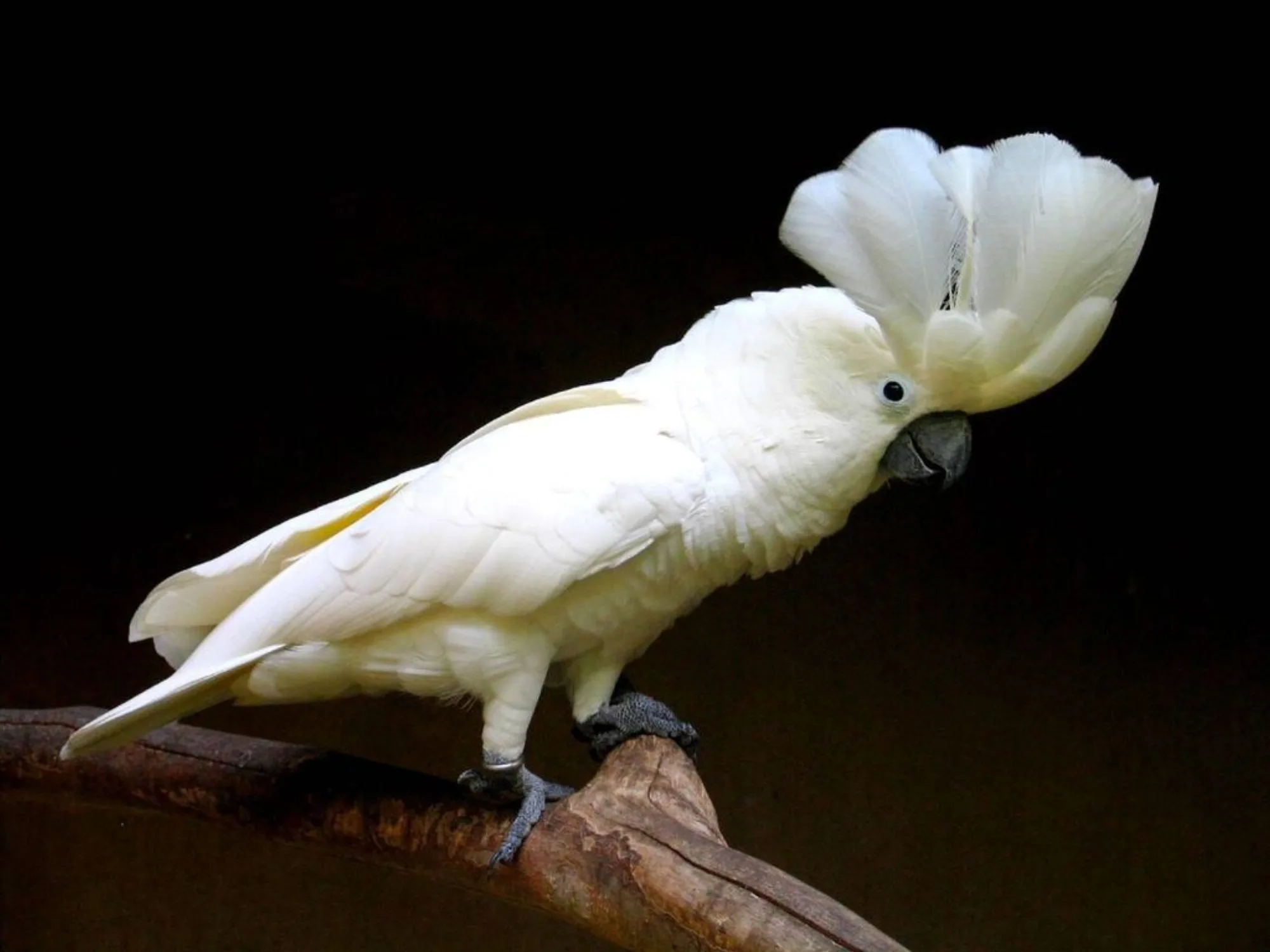
A raised crest gives the White Cockatoo its other name, the umbrella cockatoo: when startled, it spreads the large white crest into a semicircle. This medium-sized bird is around 46 cm long, with a dark grey beak and brown or black eyes. In flight, pale yellow shows on its wings and tail, a subtle flash against the otherwise white plumage. Other white cockatoos mentioned alongside it have yellow, orange or pink crest feathers, rather than white.
The species lives naturally on several Moluccan islands in North Maluku, Indonesia, including Halmahera, Bacan, Ternate and Tidore. It occurs in lowland tropical rainforest, including primary, logged and secondary forest below 900 m, as well as mangroves, coconut plantations and agricultural land. Wild birds eat berries, seeds, nuts, fruit and roots, and also take large insects and small lizards. They feed on crops too, including corn in fields, where farmers consider them pests because of the damage they cause. Nesting pairs leave their groups to find a cavity, usually in a tree, and use hollows in large trees for their nests. A clutch usually contains two white eggs, which both parents incubate for about 28 days; the chicks leave the nest roughly 84 days after hatching.
Habitat loss and capture for the cage bird trade have reduced the wild population, and recent observations indicate continuing rapid declines. Although fewer birds have lately been captured, the illegal trade persists and its scale may be underestimated. Surveys have found ongoing trade in wild-caught birds, including birds taken from north Halmahera.
Written from the English Wikipedia article White cockatoo (CC BY-SA 4.0).
- Records
- 413
- Countries
- 6
No atlas park has a record of the White Cockatoo in or around it yet.
These are open occurrence records, so they show where people looked for and recorded the White Cockatoo as much as where it lives. Cells are up to 25 km across, and every location is generalised to its cell.
Generalised encounter areas, not exact locations. Each shape is a grid cell coloured by how likely the species is there.
- Very likelyPuerto Rico25 km zone · high confidence · 179 records · updated 80 days ago
- Very likelyUnited States25 km zone · high confidence · 143 records · updated 80 days ago
- LikelyTaiwan25 km zone · medium confidence · 47 records · updated 80 days ago
- LikelyPhilippines25 km zone · medium confidence · 39 records · updated 80 days ago
- PossibleGuadeloupe25 km zone · medium confidence · 4 records · updated 80 days ago
- RareIndonesia25 km zone · medium confidence · 1 record · updated 80 days ago
Conservation status not assessed here yet, so every location is generalised to its grid cell.