Black-headed Uakari
Cacajao melanocephalus
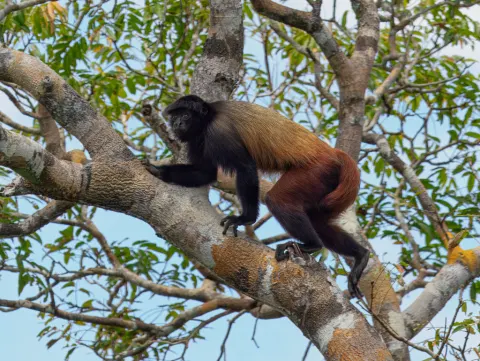
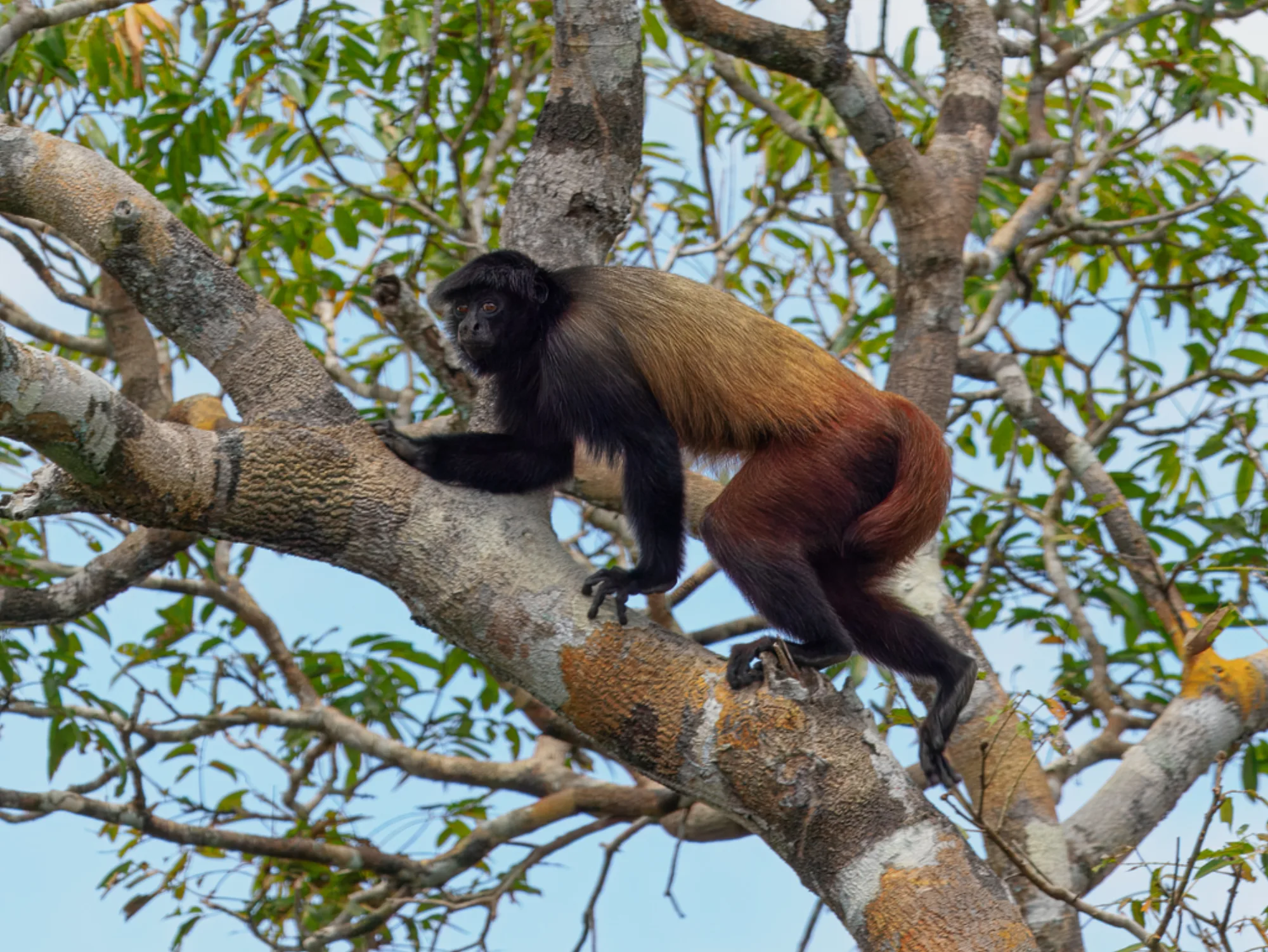
A resident of the Amazon rainforest, the Black-headed Uakari is a primate found across Brazil, Colombia, and Venezuela. These monkeys are easily identified by their bald, black faces and dark hair covering their heads and lower limbs. In contrast, their flanks, tails, and upper limbs display a reddish hue. They are notably small primates, with weights typically falling between 2.5 and 3.7 kg. Their most distinctive physical trait is a very short tail that cannot be used for gripping branches.
Travellers may spot them in seasonally flooded igapo forests, though they also roam through palm swamps and white sand forests. These diurnal animals are highly active, moving through the canopy by running on all fours or making leaps that cover 10 meters in a single bound. They usually travel in groups of 5 to 40 members, though these gatherings can swell to over 100 individuals. To find seasonal fruits, a troop might travel several kilometers at a time.
While they eat leaves and insects, their diet consists primarily of seeds and fruit. They possess specialized teeth, including large canines and incisors capable of shattering hard shells to reach the seeds inside. This unique dental adaptation means they face little competition for food from other primates. Breeding involves a long period of maternal care, as a single infant will stay with its mother for a year and a half, often clinging to her back as she moves through the trees.
Written from the English Wikipedia article Golden-backed uakari (CC BY-SA 4.0).
- Atlas places
- 0
These are open occurrence records, so they show where people looked for and recorded the Black-headed Uakari as much as where it lives. Cells are up to 25 km across, and every location is generalised to its cell.
No encounter zones yet
Where and when you can expect to see Black-headed Uakari is calculated from observation density. No zones have been computed for this species yet.
Conservation status not assessed here yet, so every location is generalised to its grid cell.