Bald Uacari
Cacajao calvus
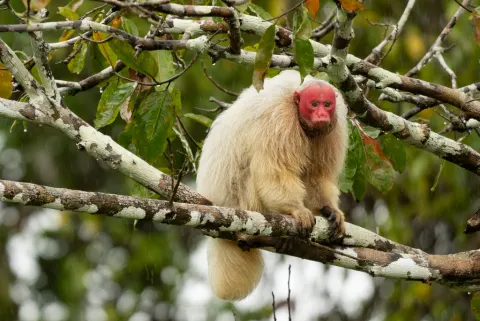
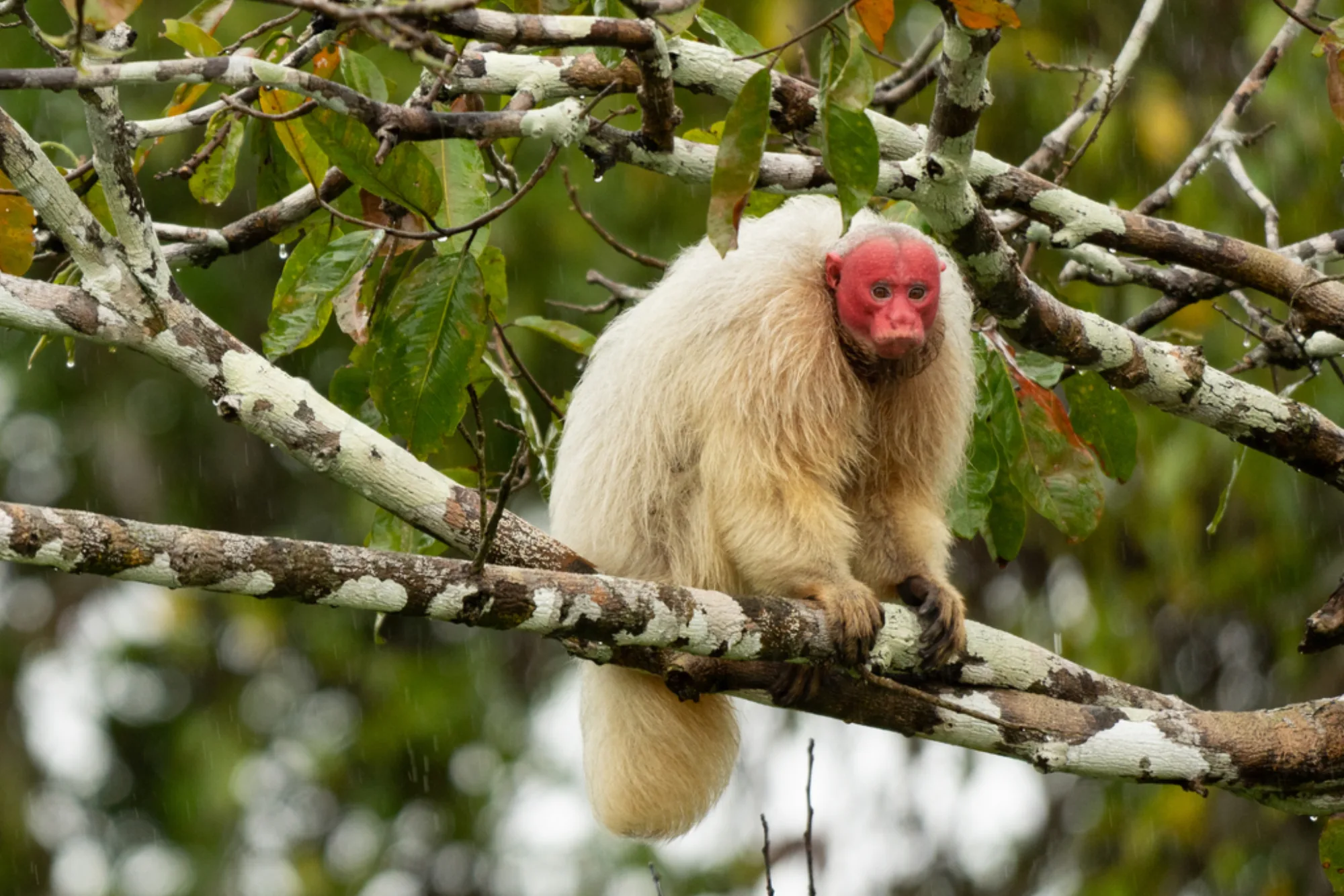
A crimson face and a bare head make the Bald Uacari easy to recognise among the trees. This small New World monkey has a long, shaggy coat that ranges from white to red, and a short, bob-like tail. It weighs 2.75 to 3.45 kg, while its tail measures about 15 cm. Its range lies in western Amazonia, across parts of Peru and Brazil, where it inhabits várzea forest and other woodland near water. It favours seasonally flooded forest and stays in the treetops as the rains raise the water level. When the forest dries out, it comes down to search for seeds and other food.
Bald Uacaris travel in groups containing both males and females, usually numbering 5 to 30, though groups can reach 100. They can cover up to 4.8 kilometres a day, and a group's home range extends over 500 to 600 hectares. Calls, tail wagging and raised hair are among their territorial displays. Seeds made up 67% of the diet in one study, with fruit, flowers, animal prey and buds also recorded. The monkey can break into unripe fruit to reach nuts that many other primates cannot open, and it eats insects encountered along the way. Breeding takes place between October and May, with pregnancy lasting approximately six months.
Forest loss and hunting are the main threats. Hardwood logging breaks up the forest canopy, affecting a monkey adapted to life in the trees and to eating seeds. Its proximity to the Amazon River also exposes it to hunting from canoes, with the animals taken for food or bait. Land conversion for agriculture and pasture adds pressure on its flooded forest habitat.
Written from the English Wikipedia article Bald uakari (CC BY-SA 4.0).
- Records
- 1
- Countries
- 1
No atlas park has a record of the Bald Uacari in or around it yet.
These are open occurrence records, so they show where people looked for and recorded the Bald Uacari as much as where it lives. Cells are up to 25 km across, and every location is generalised to its cell.
Generalised encounter areas, not exact locations. Each shape is a grid cell coloured by how likely the species is there.
- Very likelyBrazil25 km zone · medium confidence · 1 record · updated 80 days ago
Conservation status not assessed here yet, so every location is generalised to its grid cell.