Swainson's Hawk
Buteo swainsoni
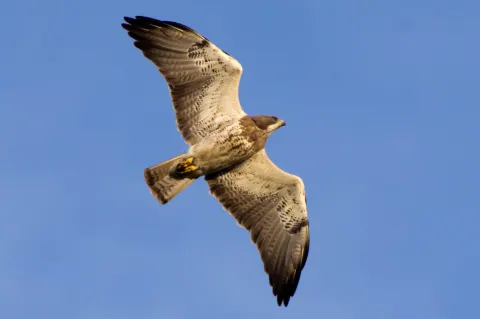
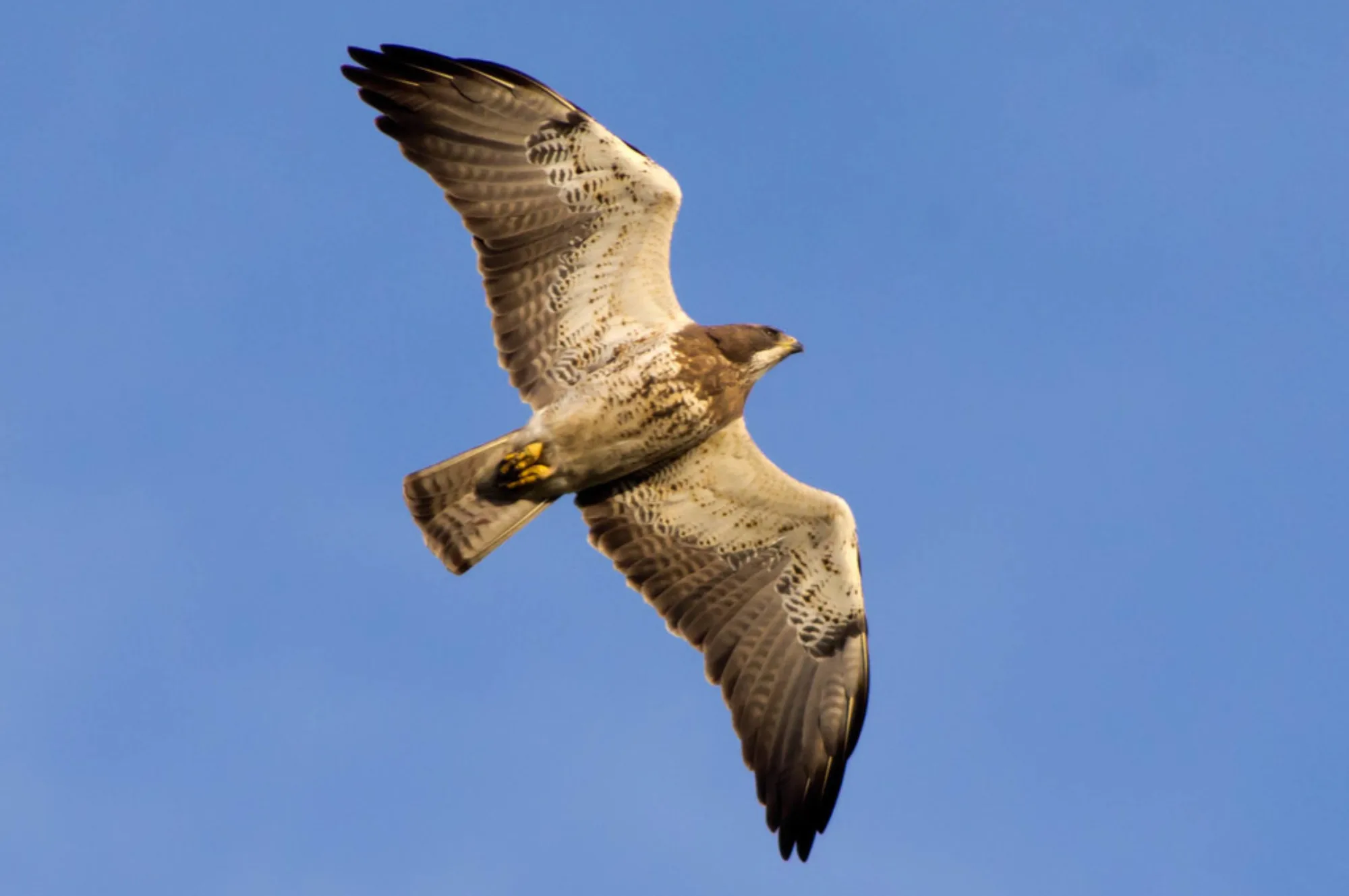
Watch for Swainson's Hawk soaring over open country, its long, slender wings held slightly raised as it rocks gently from side to side. Most adults have white underparts, a dark reddish chest and a white throat and face patch. From below, the wings show a striking contrast between pale leading edges and dark flight feathers, while a less common dark form is brown with a light patch under the tail.
The hawk breeds across western North America, from parts of Alaska and Canada south to California and Texas. It favours open or partly open landscapes, including prairie, grassland and desert, and often hunts from raised perches. Most spend the northern winter on South American pampas, including parts of Argentina, Uruguay and southern Brazil. During migration, birds rise on warm air in circles, then glide towards the next rising current, sometimes travelling in groups across the sky. In Uruguay, groups gather on open plains and low hills broken by rocks or woodland.
Grasshoppers, crickets and locusts feature in its diet, and the hawk may pursue insects on the ground or catch them in flight. Breeding birds bring mostly vertebrate prey to their young, including small mammals such as young ground squirrels. Pairs build or repair nests of twigs and grasses, often in isolated trees or bushes, and usually lay two or three eggs. Pesticides used against insects in Argentina have caused population declines, while habitat loss and unsuitable farming practices have contributed to declines in some western populations. Traffic collisions, illegal shooting, electrocution and severe prairie weather also kill these hawks, and disturbance can cause some to abandon their nests.
Written from the English Wikipedia article Swainson's hawk (CC BY-SA 4.0).
- Records
- 380,531
- Countries
- 6
- Atlas places
- 3
These are open occurrence records, so they show where people looked for and recorded the Swainson's Hawk as much as where it lives. Cells are up to 25 km across, and every location is generalised to its cell.
Generalised encounter areas, not exact locations. Each shape is a grid cell coloured by how likely the species is there.
- Very likelyUnited States25 km zone · high confidence · 316930 records · updated 80 days ago
- Very likelyCanada25 km zone · high confidence · 48326 records · updated 80 days ago
- Very likelyMexico25 km zone · high confidence · 9854 records · updated 80 days ago
- Very likelyPanama25 km zone · high confidence · 2804 records · updated 80 days ago
- Very likelyCosta Rica25 km zone · high confidence · 1897 records · updated 80 days ago
- Very likelyColombia25 km zone · high confidence · 720 records · updated 80 days ago
Conservation status not assessed here yet, so every location is generalised to its grid cell.