Ferruginous Hawk
Buteo regalis
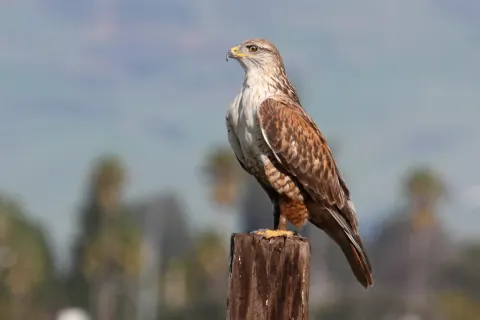
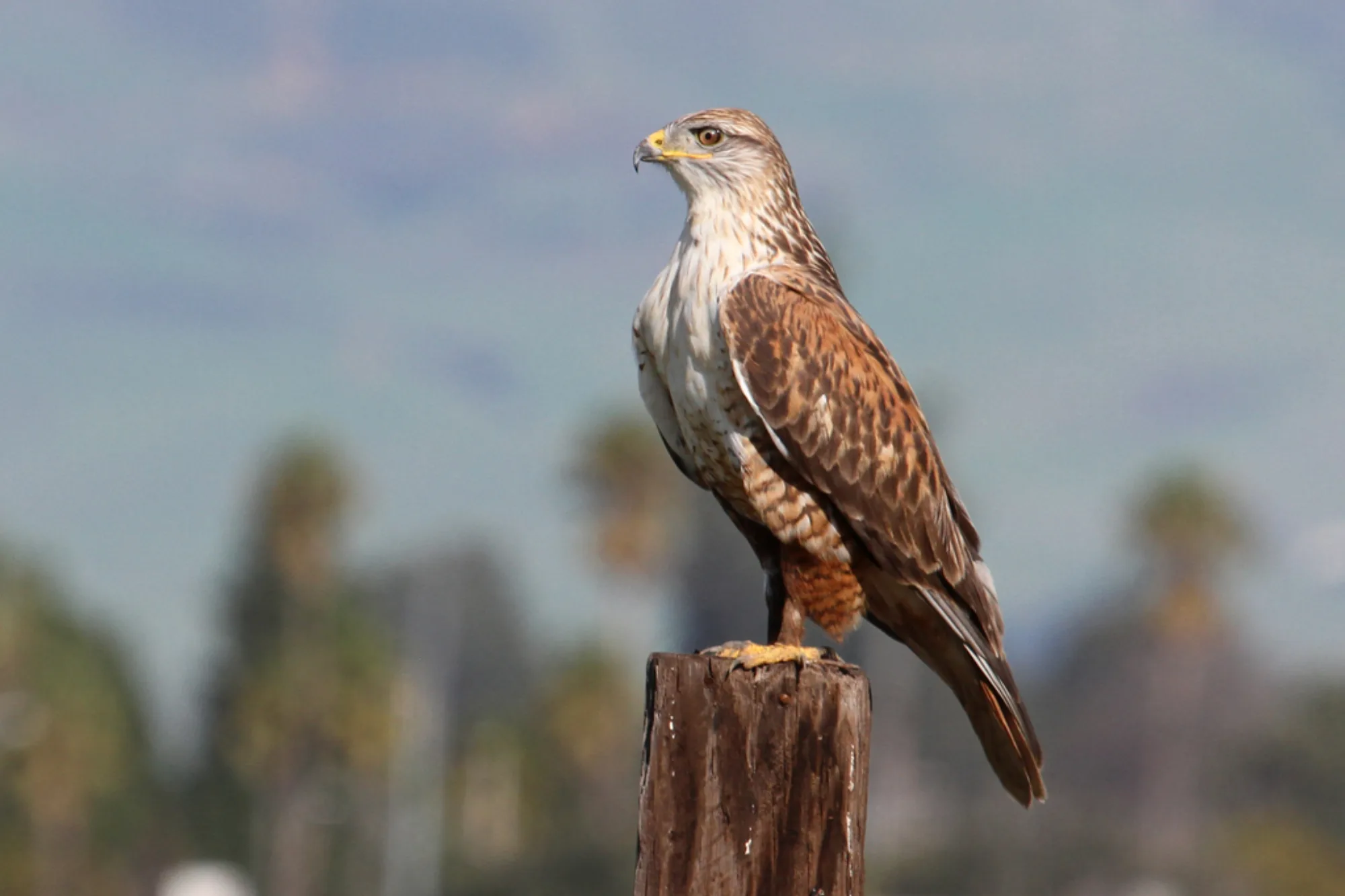
Broad wings and a powerful build can make the Ferruginous Hawk look like an eagle. This large bird of prey ranges from 51 to 71 cm long, with a wingspan of 122 to 158 cm. Light-coloured birds have rusty brown backs, pale heads and underparts, and rust markings on their legs and underwings. Dark birds are brown above and below, with lighter areas on their wings. In flight, look for pale windows on the outer wings and a rusty patch on the rump.
The hawk lives in the interior of North America, favouring open, dry grasslands, prairie and shrub country. Its habitat includes rolling plains, foothills and plateaus with few trees, often with a fence post, boulder or lone tree available as a perch. During the breeding season it favours grassland and sagebrush, while in winter it may also use cultivated fields, particularly those with stubble that shelters small mammals. It searches for prey from a perch or in flight, sometimes hovering, cruising low or waiting beside a burrow. Rabbits, hares, ground squirrels and pocket gophers are important foods where their ranges overlap with the hawk's; birds, reptiles and insects are also taken.
Pairs use many kinds of nest sites, from isolated trees and rocky outcrops to the ground, nest platforms and power poles. Both adults help build the nest, and both share incubation. The average clutch contains three to four eggs, and the young may depend on their parents for several weeks after leaving the nest. Loss of good habitat, cultivation of native prairie, reduced prey supplies, shooting and human interference all threaten the hawk. Ground nests are vulnerable to mammalian predators, and nestlings can starve when food is scarce.
Written from the English Wikipedia article Ferruginous hawk (CC BY-SA 4.0).
- Records
- 105,365
- Countries
- 3
- Atlas places
- 2
These are open occurrence records, so they show where people looked for and recorded the Ferruginous Hawk as much as where it lives. Cells are up to 25 km across, and every location is generalised to its cell.
Generalised encounter areas, not exact locations. Each shape is a grid cell coloured by how likely the species is there.
- Very likelyUnited States25 km zone · high confidence · 100517 records · updated 80 days ago
- Very likelyCanada25 km zone · high confidence · 4578 records · updated 80 days ago
- Very likelyMexico25 km zone · high confidence · 270 records · updated 80 days ago
Conservation status not assessed here yet, so every location is generalised to its grid cell.