Red-shouldered Hawk
Buteo lineatus
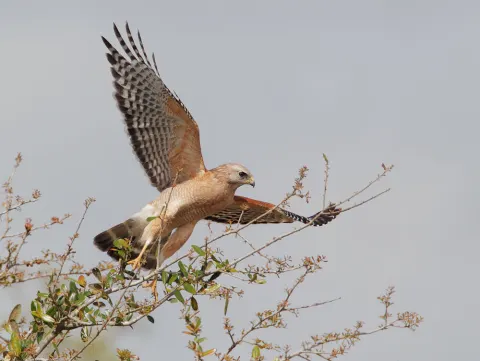
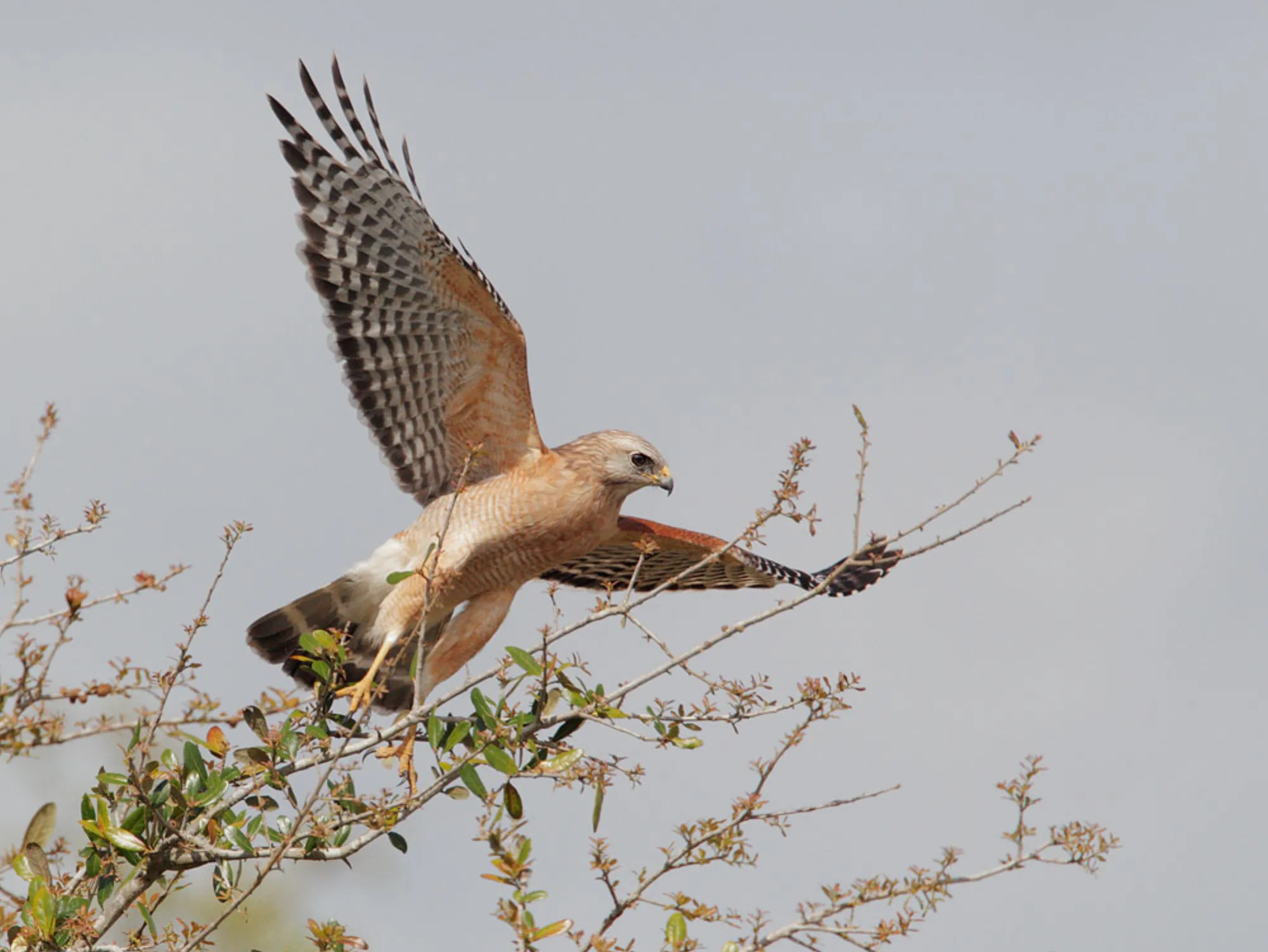
A reddish chest and barred pale belly help identify the adult Red-shouldered Hawk, a medium-sized forest raptor with a brownish head and dark, pale-spotted upperparts. When perched, it shows the red shoulders that give it its name; its long tail has narrow white bars. Western birds can look redder, while those in Florida are generally paler. Listen, too, for a screaming kee-aah call, often repeated three to four times when the birds are courting or defending territory.
Its breeding range includes eastern North America, the California coast and parts of Mexico, while a western population has also expanded into Oregon and Arizona. Most birds remain in their range year-round, although northern birds migrate, mostly to central Mexico. In the east, look for them in hardwood stands, wooded swamps and mixed forests; in the west, they use streamside and oak woodlands, eucalyptus groves and some residential areas. They hunt from treetop perches or while soaring over woodland, dropping onto prey that includes rodents, amphibians, small snakes and large insects. Food may be stored near the nest for later.
Pairs build stick nests in large trees, often near water, and may return to the same nest each year, adding fresh sticks in spring. A typical clutch contains three to four eggs; young hawks depart the nest at roughly six weeks old but rely on their parents for 17 to 19 weeks. Loss of habitat is the greatest threat: clearing mature forests has reduced population densities, and logging remains a danger. Hawks are also harmed by hunting, collisions with power lines and vehicles, and poisoning from insecticides and industrial pollutants.
Written from the English Wikipedia article Red-shouldered hawk (CC BY-SA 4.0).
- Records
- 2,252,664
- Countries
- 3
- Atlas places
- 2
These are open occurrence records, so they show where people looked for and recorded the Red-shouldered Hawk as much as where it lives. Cells are up to 25 km across, and every location is generalised to its cell.
Generalised encounter areas, not exact locations. Each shape is a grid cell coloured by how likely the species is there.
- Very likelyUnited States25 km zone · high confidence · 2207015 records · updated 80 days ago
- Very likelyCanada25 km zone · high confidence · 30689 records · updated 80 days ago
- Very likelyMexico25 km zone · high confidence · 14960 records · updated 80 days ago
Conservation status not assessed here yet, so every location is generalised to its grid cell.