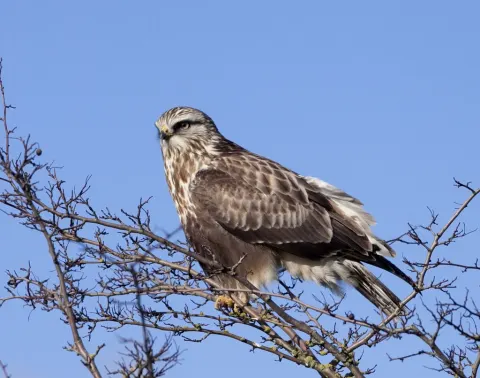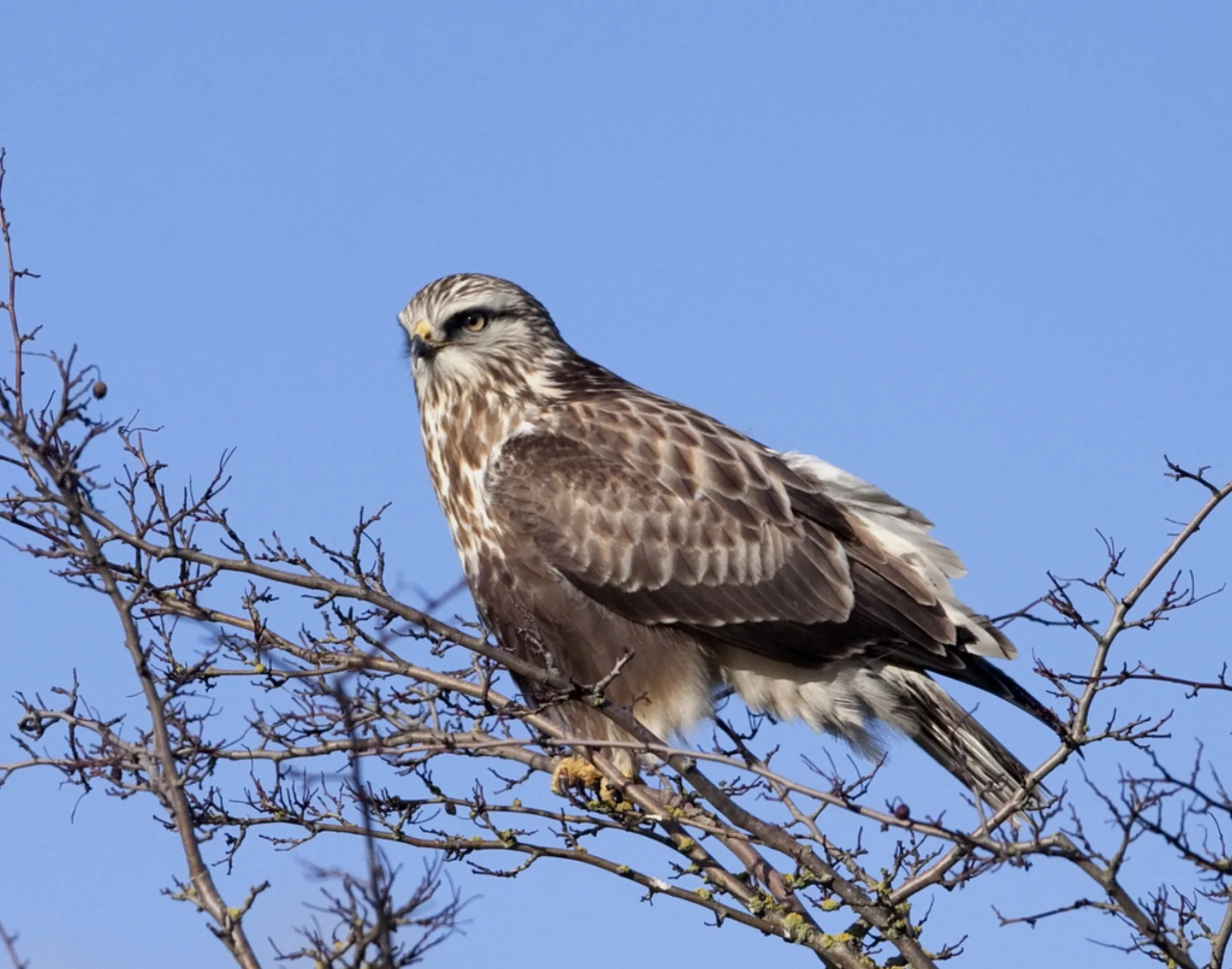
Rough-legged Buzzard
Buteo lagopus
Over open country, the Rough-legged Buzzard can be seen hovering in place, beating its wings quickly as it searches for prey. This medium-large bird of prey is 46 to 68 cm long, with a wingspan of 120 to 153 cm. Its plumage is mainly brown and white, often speckled, and most plumages show a broad brown band across the chest. Light birds have a distinctive dark patch at the wrist against the white underside of the wing. Plumage varies widely, however, and some variations take considerable field experience to distinguish. Its long white tail has one or more dark bands near the tip, and its legs are feathered down to the toes.
It breeds in the tundra and taiga of North America and Eurasia, usually choosing areas with plenty of open, unforested ground. North American birds winter in southern Canada and the central United States, while birds from Eurasia head towards Asia and central Europe; a few reach eastern Great Britain. Marshes, moorland, prairies and farmland are favoured winter habitats where rodents are plentiful. The buzzard hunts by day, watching from a perch or searching in flight, and feeds mainly on small mammals, especially lemmings and voles. When rodents are scarce, it can turn to other prey, including ptarmigan and hares. Nests are often on cliffs or rocky outcrops, and a typical clutch contains three to five eggs. Young birds can face starvation, harsh cold and predators at the nest, including Arctic foxes and ravens. Older birds may be killed by collisions with power lines, buildings or vehicles, by poison or lead in prey, and by illegal hunting and trapping.
Written from the English Wikipedia article Rough-legged buzzard (CC BY-SA 4.0).
- Records
- 261,041
- Countries
- 8
- Atlas places
- 1
These are open occurrence records, so they show where people looked for and recorded the Rough-legged Buzzard as much as where it lives. Cells are up to 25 km across, and every location is generalised to its cell.
Generalised encounter areas, not exact locations. Each shape is a grid cell coloured by how likely the species is there.
- Very likelyUnited States25 km zone · high confidence · 157999 records · updated 80 days ago
- Very likelyCanada25 km zone · high confidence · 83471 records · updated 80 days ago
- Very likelyNorway25 km zone · high confidence · 16044 records · updated 80 days ago
- Very likelyFinland25 km zone · high confidence · 1237 records · updated 80 days ago
- Very likelySweden25 km zone · high confidence · 923 records · updated 80 days ago
- Very likelyDenmark25 km zone · high confidence · 788 records · updated 80 days ago
- Very likelyCzechia25 km zone · high confidence · 579 records · updated 80 days ago
Conservation status not assessed here yet, so every location is generalised to its grid cell.