Red-tailed Hawk
Buteo jamaicensis
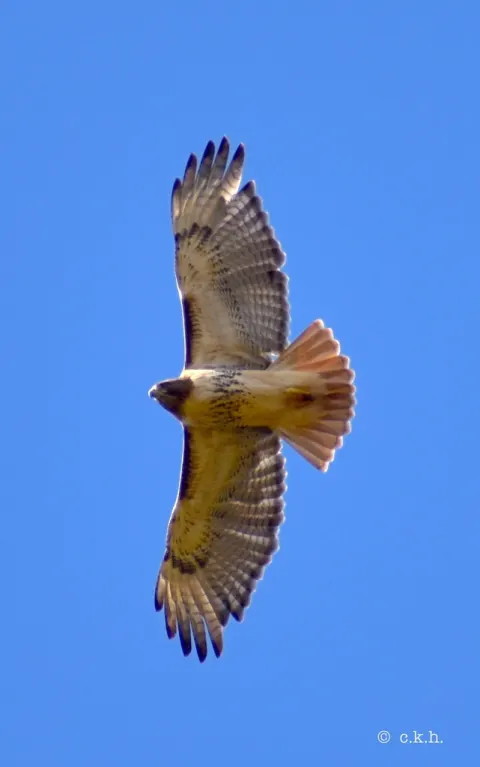
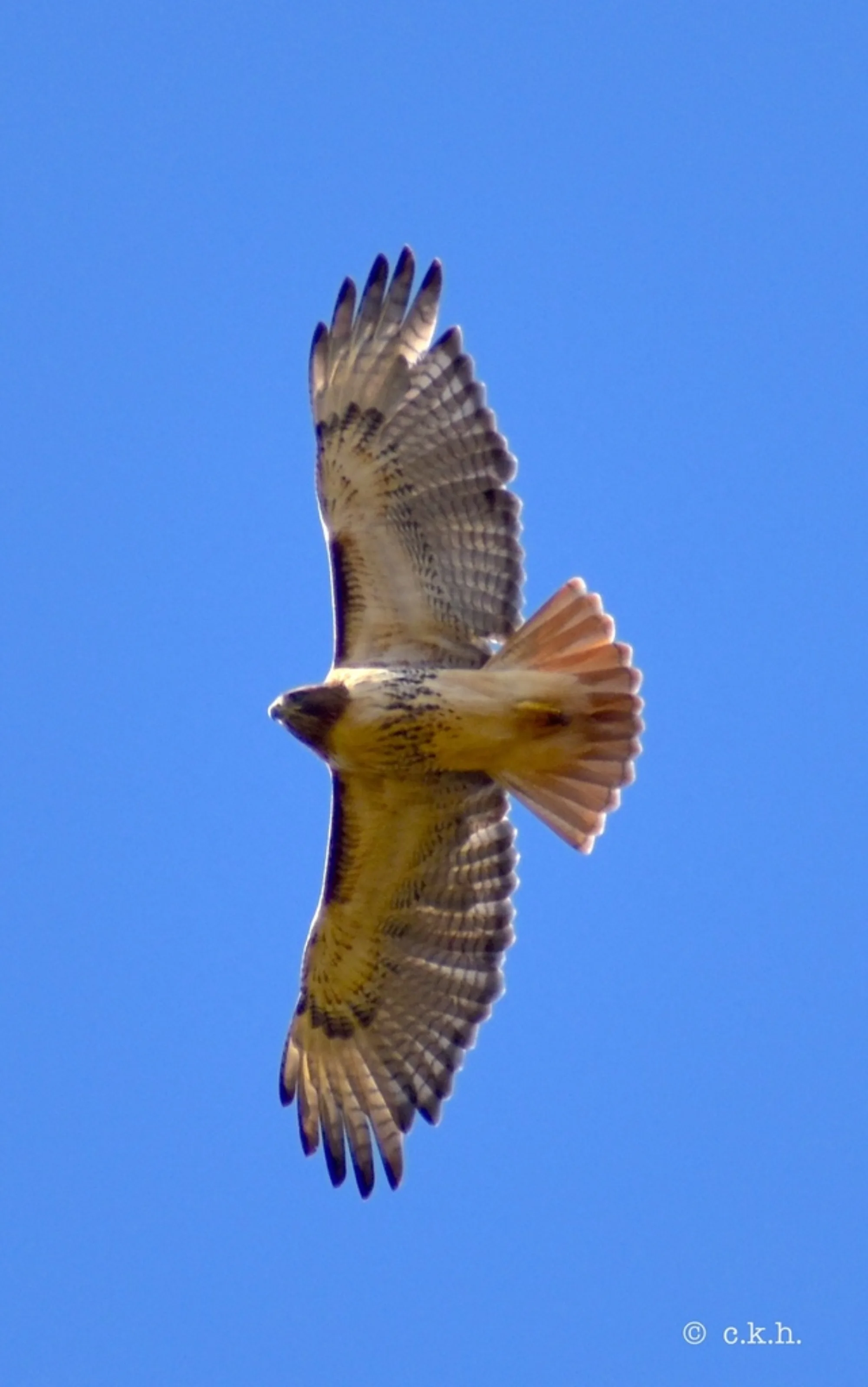
Broad wings and a stocky outline make the Red-tailed Hawk a conspicuous bird of prey across much of North America. Adults usually have a brick-red tail above, pale buff-orange below, with a single black band at the end. Younger birds are harder to identify: their tails carry several darker bars, and their undersides may have dark brown spots. Plumage varies by region, but most colour forms have a whitish belly crossed by a dark brown band.
The hawk breeds from Alaska and northern Canada south to Panama and the West Indies. It favours a mixture of forest and fields, with tall trees or bluffs for perching, but also lives in deserts, grasslands, mountains, farmland and cities. It is absent from unbroken forest and the high Arctic. Watch for it soaring with few wingbeats, or hovering on beating wings in the wind. Its hoarse, rasping scream often carries while it hunts or soars. Some northern birds migrate south in autumn, usually travelling individually when winds are favourable.
From a high perch, the hawk scans for prey before swooping down, though it also hunts on the wing. Rodents make up much of its diet, alongside other small mammals, birds and reptiles, with prey varying by season and region. Pairs generally remain together for life and build stick nests in trees, on cliffs or on human-made structures. Both parents incubate the eggs, and the young begin leaving the nest after 42 to 46 days. Adults have few natural predators, but owls, corvids and raccoons take eggs and nestlings. In cities, rat traps and poisoned bait threaten hawks, which can be affected when they eat poisoned rodents.
Written from the English Wikipedia article Red-tailed hawk (CC BY-SA 4.0).
- Records
- 3,898,013
- Countries
- 24
No atlas park has a record of the Red-tailed Hawk in or around it yet.
These are open occurrence records, so they show where people looked for and recorded the Red-tailed Hawk as much as where it lives. Cells are up to 25 km across, and every location is generalised to its cell.
Generalised encounter areas, not exact locations. Each shape is a grid cell coloured by how likely the species is there.
- Very likelyUnited States25 km zone · high confidence · 3564620 records · updated 86 days ago
- Very likelyCanada25 km zone · high confidence · 261906 records · updated 86 days ago
- Very likelyMexico25 km zone · high confidence · 18198 records · updated 86 days ago
- Very likelyPuerto Rico25 km zone · high confidence · 17826 records · updated today
- Very likelyCosta Rica25 km zone · high confidence · 14322 records · updated today
- Very likelyGuatemala25 km zone · high confidence · 5021 records · updated today
- Very likelyJamaica25 km zone · high confidence · 2861 records · updated today
- Very likelyBahamas25 km zone · high confidence · 1719 records · updated today
- Very likelyPanama25 km zone · high confidence · 1484 records · updated today
- LikelyCuba25 km zone · high confidence · 1992 records · updated today
Conservation status not assessed here yet, so every location is generalised to its grid cell.