Common Buzzard
Buteo buteo
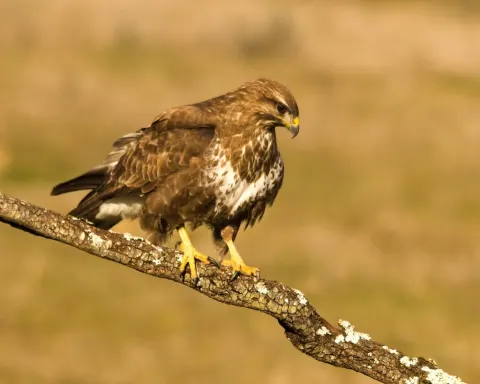
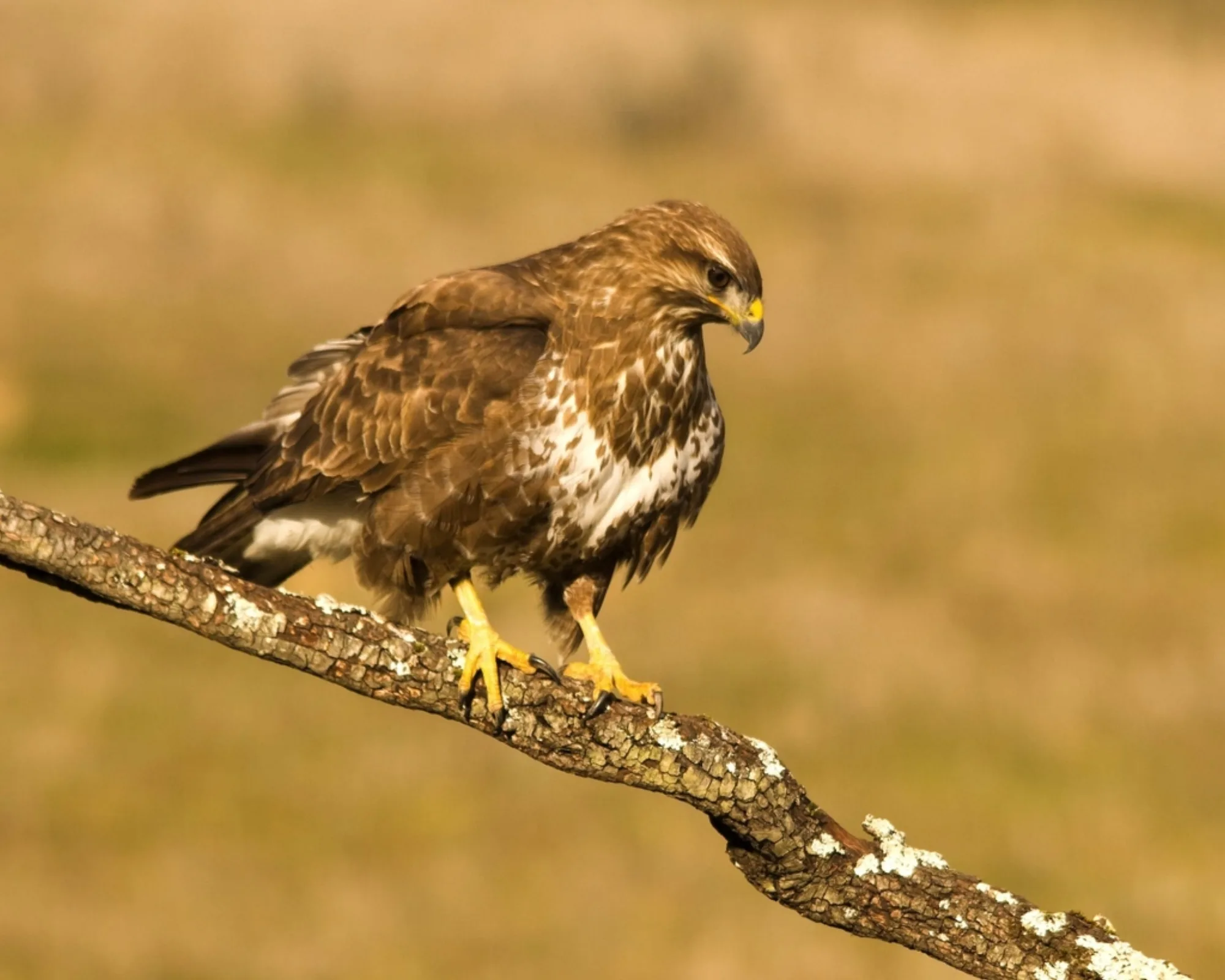
Look for the Common Buzzard soaring overhead or sitting prominently on a treetop, fence post or telegraph pole. This medium-sized bird of prey has broad wings, a rounded head and a fairly short tail, but its plumage varies widely. In Europe, many are dark brown above, with a pale U across the breast and a dark edge along the back of each wing in flight. Some birds are almost black-brown, while others are mainly white, with many shades in between.
The species lives across most of Europe and breeds eastwards as far as northwestern China, far western Siberia and northwestern Mongolia. It favours the meeting place of woodland and open ground, including forest edges and small woods beside grassland or farmland. It also uses open moorland where trees provide places to hunt and nest, and can live in both mountainous and flat country. Many remain in their range throughout the year, while birds from colder northern areas and the east typically travel south for winter, some reaching South Africa.
Buzzards often hunt from a perch, taking a wide range of prey but feeding mostly on small mammals, particularly voles and other rodents. They usually build their nests in trees and raise a relatively small brood. Changes in farming have reduced populations in parts of western France, where hedgerows, woodlots and grassland have been lost. Extensive urbanisation also appears to affect buzzards, with more deaths, nest disturbance and degradation of nesting habitat in areas around cities.
Written from the English Wikipedia article Common buzzard (CC BY-SA 4.0).
- Records
- 1,196,568
- Countries
- 114
- Atlas places
- 27
- Volcanoes National Park· Rwanda
- Lake Manyara National Park· Tanzania
- Ngorongoro Conservation Area· Tanzania
- Chobe National Park· Botswana
- Okavango Delta· Botswana
- Queen Elizabeth National Park· Uganda
- Zambezi National Park· Zimbabwe
- Akagera National Park· Rwanda
- Arusha National Park· Tanzania
- Bwabwata National Park· Namibia
- Eravikulam National Park· India
- Kgalagadi Transfrontier Park· South Africa
- Kibale National Park· Uganda
- Lake Mburo National Park· Uganda
- Lake Nakuru National Park· Kenya
- Liuwa Plain National Park· Zambia
- Maasai Mara National Reserve· Kenya
- Murchison Falls National Park· Uganda
- Nairobi National Park· Kenya
- Nyungwe National Park· Rwanda
- Rwenzori Mountains National Park· Uganda
- Table Mountain National Park· South Africa
- Taman Negara National Park· Malaysia
- Tsavo East National Park· Kenya
- Tsavo West National Park· Kenya
- Udawalawe National Park· Sri Lanka
- uKhahlamba-Drakensberg Park· South Africa
These are open occurrence records, so they show where people looked for and recorded the Common Buzzard as much as where it lives. Cells are up to 25 km across, and every location is generalised to its cell.
Generalised encounter areas, not exact locations. Each shape is a grid cell coloured by how likely the species is there.
- Very likelyBelgium25 km zone · high confidence · 297868 records · updated 86 days ago
- Very likelyUnited Kingdom25 km zone · high confidence · 255710 records · updated 86 days ago
- Very likelyFrance25 km zone · high confidence · 147236 records · updated 86 days ago
- Very likelyNorway25 km zone · high confidence · 94052 records · updated 86 days ago
- Very likelyNetherlands25 km zone · high confidence · 79281 records · updated 86 days ago
- Very likelySpain25 km zone · high confidence · 58233 records · updated 86 days ago
- Very likelyPortugal25 km zone · high confidence · 42437 records · updated 86 days ago
- Very likelySwitzerland25 km zone · high confidence · 28143 records · updated 86 days ago
- Very likelyGermany25 km zone · high confidence · 23324 records · updated 86 days ago
- Very likelyCzechia25 km zone · high confidence · 17613 records · updated 86 days ago
Conservation status not assessed here yet, so every location is generalised to its grid cell.