Augur Buzzard
Buteo augur
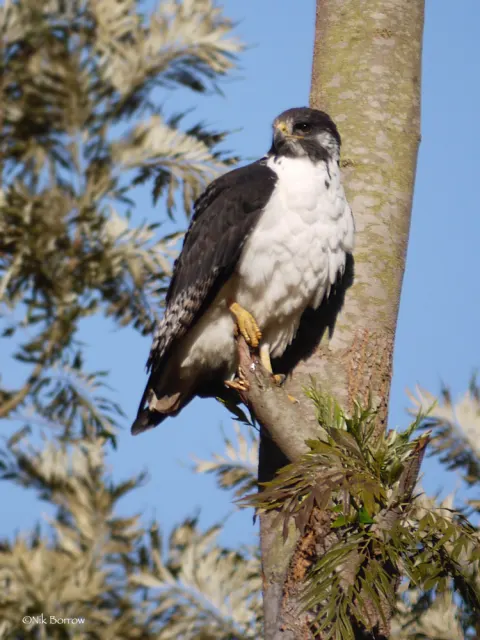
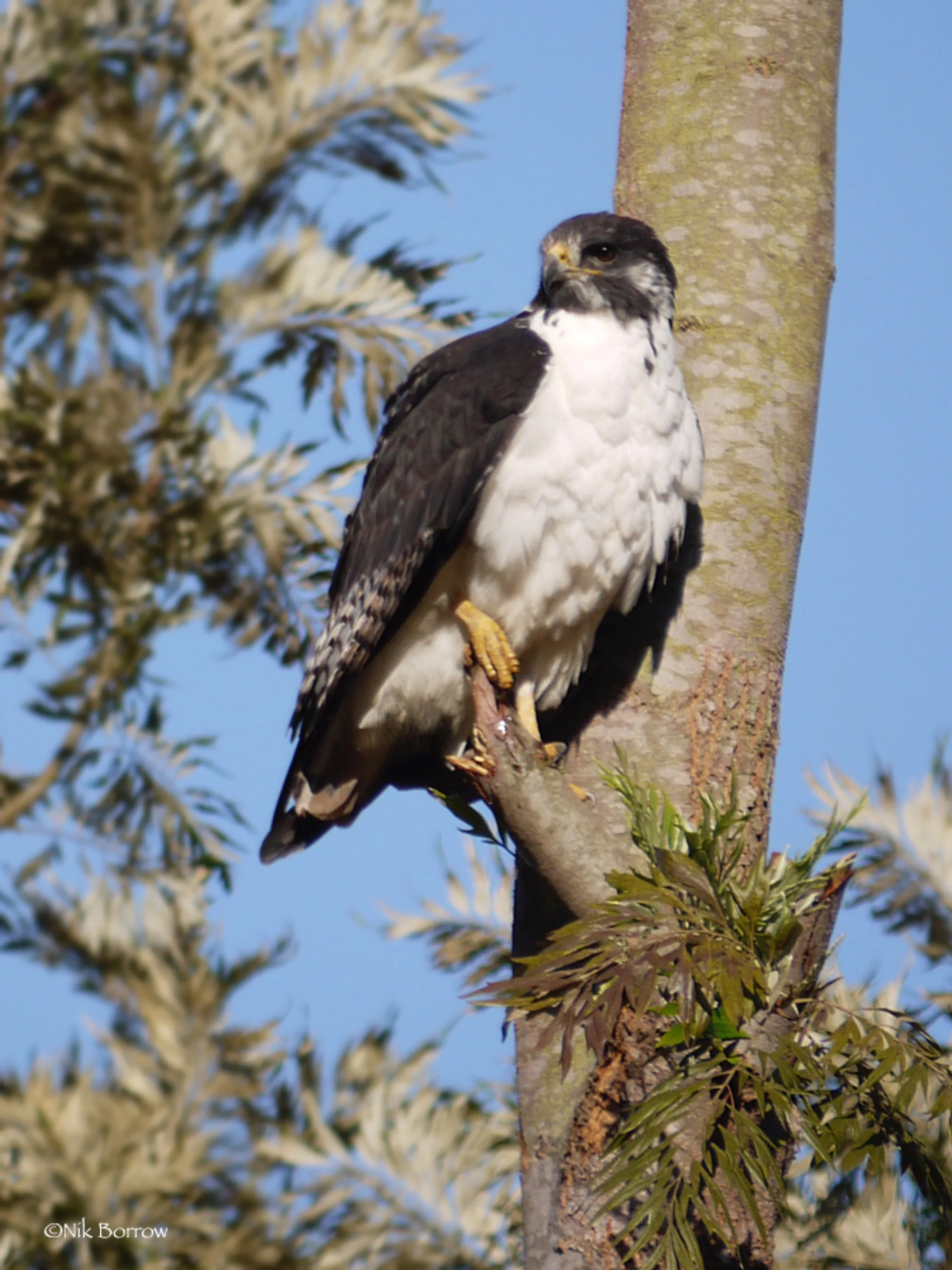
Look for an orange-red tail against a dark back when an adult Augur Buzzard passes overhead. This fairly large African bird of prey typically has a whitish underside, while young birds are generally brown. Some are much darker: about 10% have a dark form, rising to as much as 50% in some wet, forested areas. Adults measure about 48 to 60 cm long, with a wingspan of 120 to 150 cm. A young bird can resemble a steppe buzzard, but the augur has a bigger, stockier body, wider wings and a heavier style of flight.
The species lives year-round across parts of eastern and southwestern Africa, from Ethiopia south to Angola and central Namibia. It favours open or lightly wooded uplands, but also reaches desert edges and lowland deserts. Hunting grounds include elevated savannah grasslands, open moorland, inland cliffs and cropland. Pairs make noisy aerial displays even outside the breeding season, calling with a harsh, crow-like sound. Most prey is caught on the ground, either from a perch or after a swoop from soaring flight. Small mammals, snakes and lizards are important foods, alongside birds, insects and road-kill.
A pair builds a large stick nest in a tree or on a crag, often returning to enlarge it in later seasons. Usually two eggs are laid, and they hatch after about 40 days. Young birds can attempt flight after a further 56 to 60 days and become independent of the nest at 70 days, though they may stay with the adults for longer. Around Lake Naivasha in Kenya, local numbers have fallen amid rapid urban and agricultural expansion. Persecution, reduced prey and electrocution may contribute to the abandonment of territories.
Written from the English Wikipedia article Augur buzzard (CC BY-SA 4.0).
- Records
- 32,576
- Countries
- 14
- Atlas places
- 31
- Ngorongoro Conservation Area· Tanzania
- Serengeti National Park· Tanzania
- Aberdare National Park· Kenya
- Mount Kenya National Park· Kenya
- Tsavo West National Park· Kenya
- Volcanoes National Park· Rwanda
- Maasai Mara National Reserve· Kenya
- Tsavo East National Park· Kenya
- Lake Manyara National Park· Tanzania
- Bwindi Impenetrable National Park· Uganda
- Kilimanjaro National Park· Tanzania
- Mkomazi National Park· Tanzania
- Tarangire National Park· Tanzania
- Hell's Gate National Park· Kenya
- Lake Nakuru National Park· Kenya
- Nairobi National Park· Kenya
- Nyungwe National Park· Rwanda
- Samburu National Reserve· Kenya
- Akagera National Park· Rwanda
- Kunene / Kaokoveld· Namibia
- Lake Mburo National Park· Uganda
- Queen Elizabeth National Park· Uganda
- Skeleton Coast· Namibia
- South Luangwa National Park· Zambia
- Zambezi National Park· Zimbabwe
- Amboseli National Park· Kenya
- Arusha National Park· Tanzania
- Etosha National Park· Namibia
- Mount Elgon National Park· Uganda
- Namib-Naukluft· Namibia
- Ruaha National Park· Tanzania
These are open occurrence records, so they show where people looked for and recorded the Augur Buzzard as much as where it lives. Cells are up to 25 km across, and every location is generalised to its cell.
Generalised encounter areas, not exact locations. Each shape is a grid cell coloured by how likely the species is there.
- Very likelyKenya25 km zone · high confidence · 13110 records · updated 86 days ago
- Very likelyTanzania25 km zone · high confidence · 9810 records · updated 86 days ago
- Very likelyEthiopia25 km zone · high confidence · 2987 records · updated 86 days ago
- Very likelyRwanda25 km zone · high confidence · 2465 records · updated 86 days ago
- Very likelyUganda25 km zone · high confidence · 2465 records · updated 86 days ago
- Very likelyZimbabwe25 km zone · high confidence · 561 records · updated 86 days ago
- Very likelyNamibia25 km zone · high confidence · 450 records · updated 86 days ago
- Very likelyMalawi25 km zone · high confidence · 196 records · updated 86 days ago
- Very likelyZambia25 km zone · high confidence · 159 records · updated 86 days ago
- Very likelyCongo - Kinshasa25 km zone · high confidence · 141 records · updated 86 days ago
Conservation status not assessed here yet, so every location is generalised to its grid cell.