Bush Stone-curlew
Burhinus grallarius
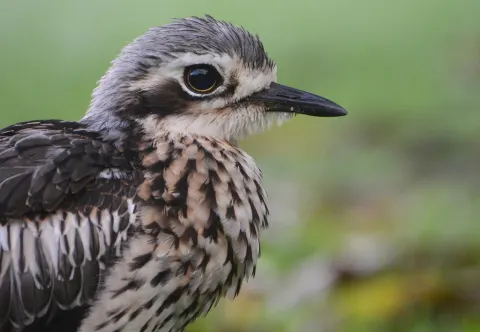
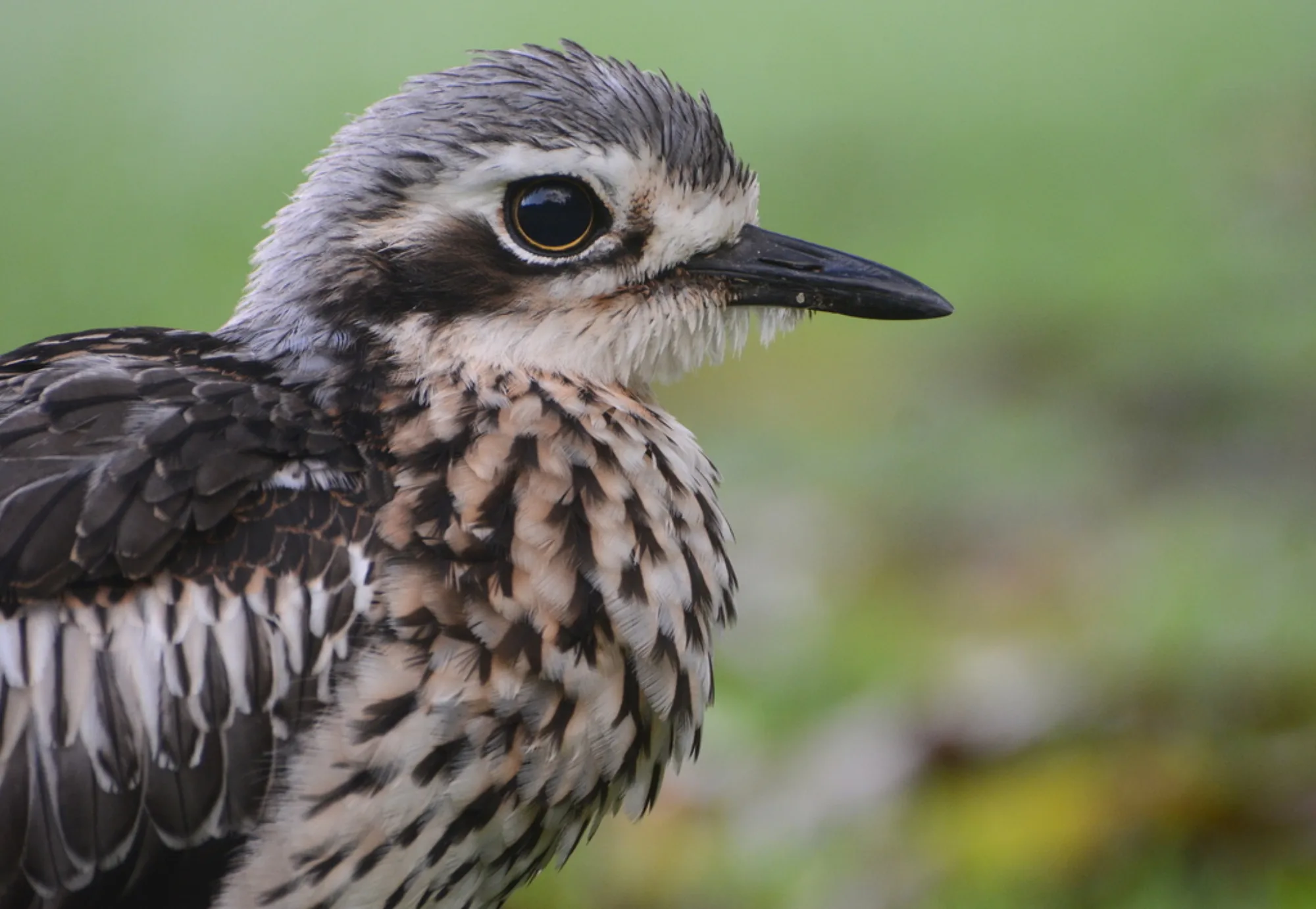
A loud, eerie wail after dark may be the first sign of a Bush Stone-curlew. This large, ground-dwelling Australian bird has a slender shape, long olive-green legs and bright yellow eyes. Dark streaks break up its grey-brown plumage, and a dark band runs above the eye and down the neck. Its wingspan approaches 1 m, but it seldom flies during daylight hours.
Found across much of Australia and on offshore islands, it is absent from Tasmania and the West Australian coast. A very small population also breeds in southern New Guinea. Look for it in open forest and eucalyptus woodland, as well as dry scrub, grassland and beside inland streams. It remains common in the north, including around Brisbane, Cairns and Townsville, but has become rare in the less fertile south. By day it shelters in tall grass or beneath shrubs and trees, freezing when disturbed and relying on its camouflage. If it moves away, it may crouch and walk quietly into vegetation.
At night, birds usually forage alone or in pairs, especially by moonlight. They take insects, spiders, frogs, molluscs, crustaceans, snakes, lizards and small mammals, often picking or probing for food in soft soil or rotting wood. They also eat some seeds or tubers, particularly in drought years. Both parents care for two eggs laid on bare ground, usually in shade near a bush or beside a fallen branch. Fox predation is thought to be a major cause of decline, while habitat destruction and fragmentation have also played an important part. Rabbit-control measures, including poisoned water and traps, have threatened the birds too.
Written from the English Wikipedia article Bush stone-curlew (CC BY-SA 4.0).
- Records
- 66,836
- Countries
- 1
- Atlas places
- 6
These are open occurrence records, so they show where people looked for and recorded the Bush Stone-curlew as much as where it lives. Cells are up to 25 km across, and every location is generalised to its cell.
Generalised encounter areas, not exact locations. Each shape is a grid cell coloured by how likely the species is there.
- Very likelyAustralia25 km zone · high confidence · 66836 records · updated 80 days ago
Conservation status not assessed here yet, so every location is generalised to its grid cell.