Many-banded Krait
Bungarus multicinctus
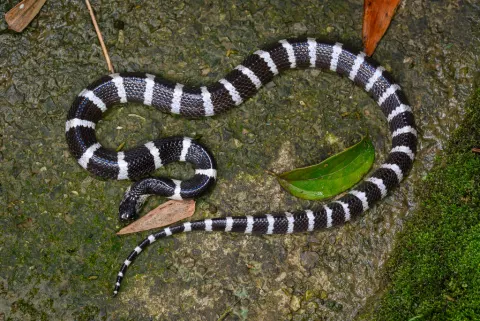
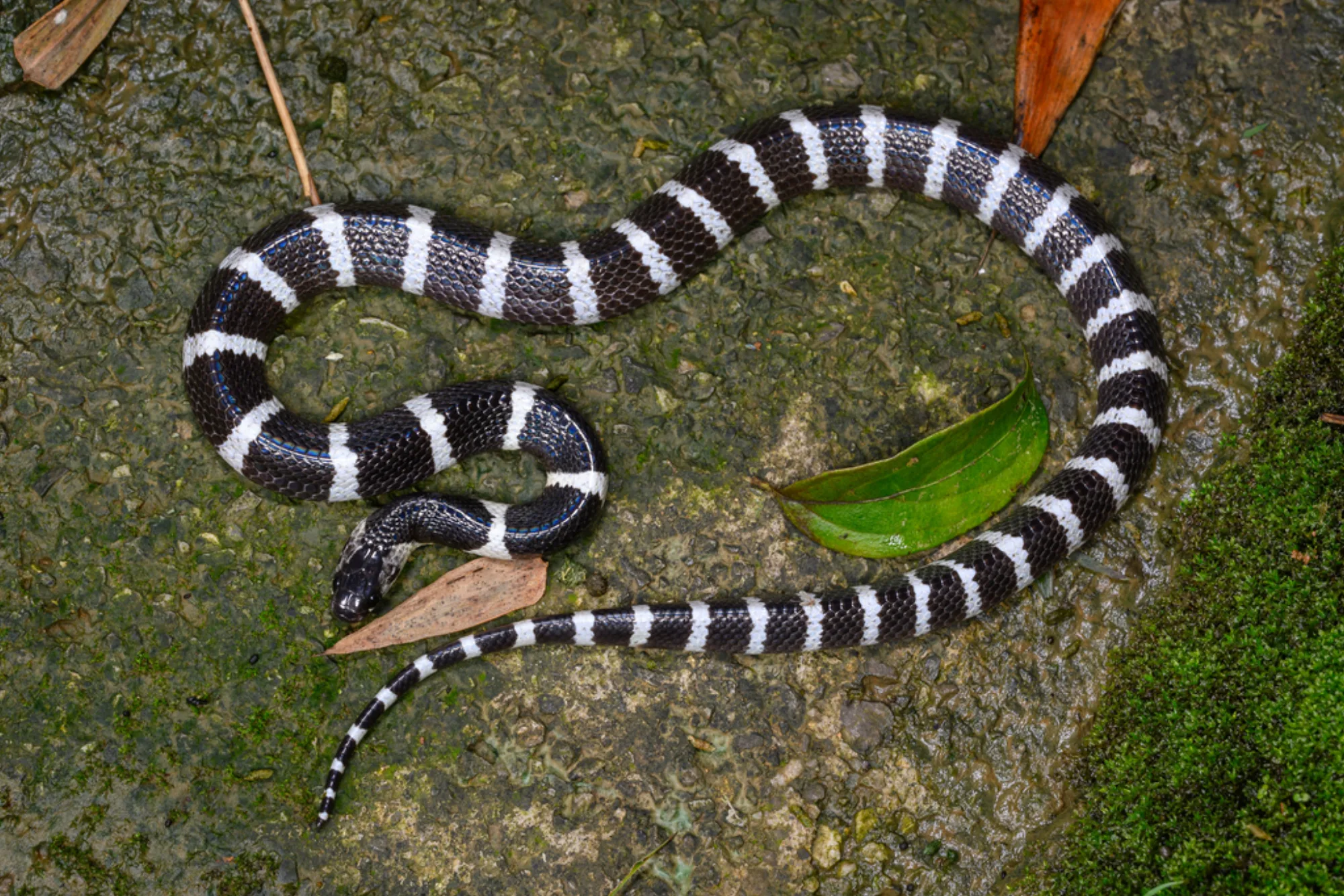
Glossy black or bluish-black, the Many-banded Krait carries white or creamy bands across its slender body and a short, pointed tail. It averages 1 to 1.5 m long, though some reach 1.85 m, and its head is black, broad and oval. Young snakes usually have pale blotches beneath the head. This extremely venomous snake occurs in Taiwan, Hong Kong, Laos, northern Vietnam and parts of southern China, as well as Myanmar, and may also occur in Thailand. Identification across the region is not always straightforward: a genetic study found that many Chinese museum specimens labelled as this species were Malayan kraits, and raised questions about specimens from Vietnam, Thailand and Myanmar.
Humid lowlands and subtropical marshes are favoured places, although the snake also occurs in woodland, shrubland, farmland and mangroves, often near water. It can turn up in villages and suburbs and has been found as high as about 1,500 m. Active at night, it spends the day concealed beneath stones or in holes, appearing from April and retreating into hibernation in November. It is described as timid and placid, but can be more defensive at night and may thrash when handled. Fish are its usual food, supplemented by other snakes, rodents, eels, frogs and occasionally lizards. Females generally lay 3 to 15 eggs in late spring or early summer, often in June; the young typically emerge around a month and a half after laying. A serious bite can suppress breathing and lead to death.
Written from the English Wikipedia article Many-banded krait (CC BY-SA 4.0).
- Records
- 330
- Countries
- 5
No atlas park has a record of the Many-banded Krait in or around it yet.
These are open occurrence records, so they show where people looked for and recorded the Many-banded Krait as much as where it lives. Cells are up to 25 km across, and every location is generalised to its cell.
Generalised encounter areas, not exact locations. Each shape is a grid cell coloured by how likely the species is there.
- Very likelyTaiwan25 km zone · medium confidence · 248 records · updated 80 days ago
- Very likelyChina25 km zone · medium confidence · 54 records · updated 80 days ago
- Very likelyHong Kong SAR China25 km zone · medium confidence · 23 records · updated 80 days ago
- LikelyVietnam25 km zone · medium confidence · 5 records · updated 80 days ago
- UncommonMacao SAR China25 km zone · low confidence · 0 records · updated 80 days ago
Conservation status not assessed here yet, so every location is generalised to its grid cell.