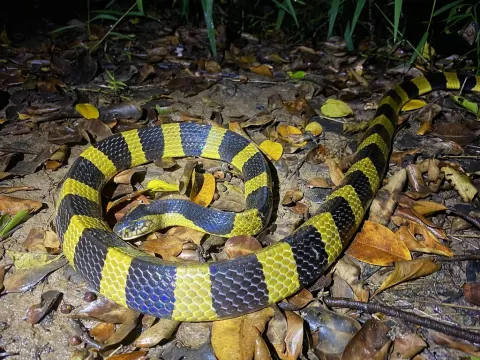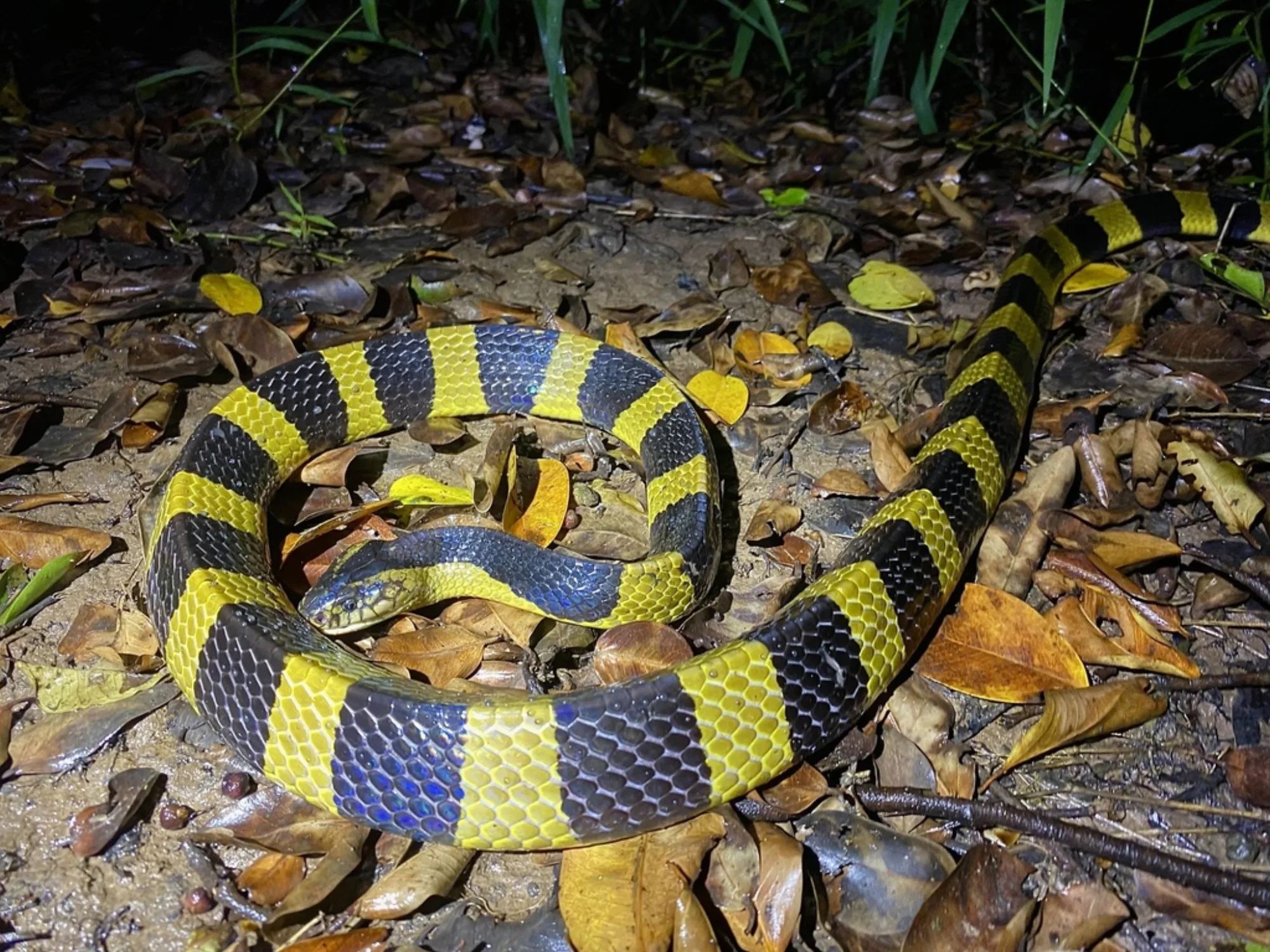
Banded Krait
Bungarus fasciatus
Black and yellow bands encircle the Banded Krait from end to end, giving this venomous snake a striking pattern. Its black head carries yellow arrowhead markings, with yellow lips, chin and throat. The head is broad and flattened, the eyes are black, and the tail is short with a blunt end. Most individuals encountered measure about 1.8 m, although the longest recorded specimen reached 2.25 m. Its venom is highly neurotoxic and can be lethal to people.
Across Asia, the snake ranges from the Indian subcontinent eastwards to southern China, including Southeast Asia. It has been recorded in places including Nepal, Bangladesh, Myanmar, Thailand, Vietnam, Malaysia and Singapore, as well as the Indonesian islands. It occupies habitats from forest to farmland, favouring the open plains of the countryside. Termite mounds and rodent holes near water provide places to live, and villages can offer a supply of rodents and water. In Myanmar, it has been found at elevations up to 1,500 m.
Shy and mainly nocturnal, the Banded Krait is not often seen, although sightings are most common during the rains. By day it rests in grass, pits or drains; when harassed, it usually tucks its head beneath its coils. It is more active at night and is widely considered more dangerous then. Other snakes make up most of its diet, but it also eats fish, frogs, skinks and snake eggs. Little is known about its breeding: in Myanmar, a female was found incubating a clutch of eight, with four young emerging in May. Hatchlings have been recorded at 298 to 311 mm long.
Written from the English Wikipedia article Banded krait (CC BY-SA 4.0).
- Records
- 41
- Countries
- 9
- Atlas places
- 1
These are open occurrence records, so they show where people looked for and recorded the Banded Krait as much as where it lives. Cells are up to 25 km across, and every location is generalised to its cell.
Generalised encounter areas, not exact locations. Each shape is a grid cell coloured by how likely the species is there.
- Very likelyMyanmar (Burma)25 km zone · medium confidence · 12 records · updated 82 days ago
- Very likelyVietnam25 km zone · medium confidence · 8 records · updated 82 days ago
- Very likelyChina25 km zone · medium confidence · 7 records · updated 82 days ago
- Very likelyMalaysia25 km zone · medium confidence · 6 records · updated 82 days ago
- LikelyIndonesia25 km zone · medium confidence · 4 records · updated 82 days ago
- LikelyHong Kong SAR China25 km zone · medium confidence · 2 records · updated 82 days ago
- LikelyIndia25 km zone · medium confidence · 1 record · updated 82 days ago
- LikelyThailand25 km zone · medium confidence · 1 record · updated 82 days ago
- RareSingapore25 km zone · low confidence · 0 records · updated 82 days ago
Conservation status not assessed here yet, so every location is generalised to its grid cell.