Common Krait
Bungarus caeruleus
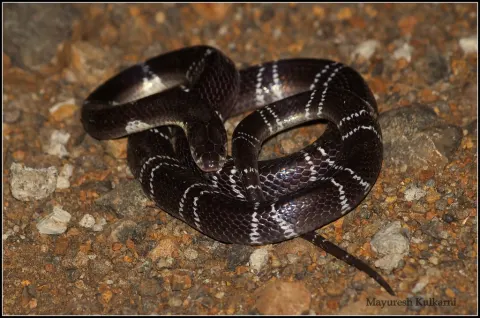
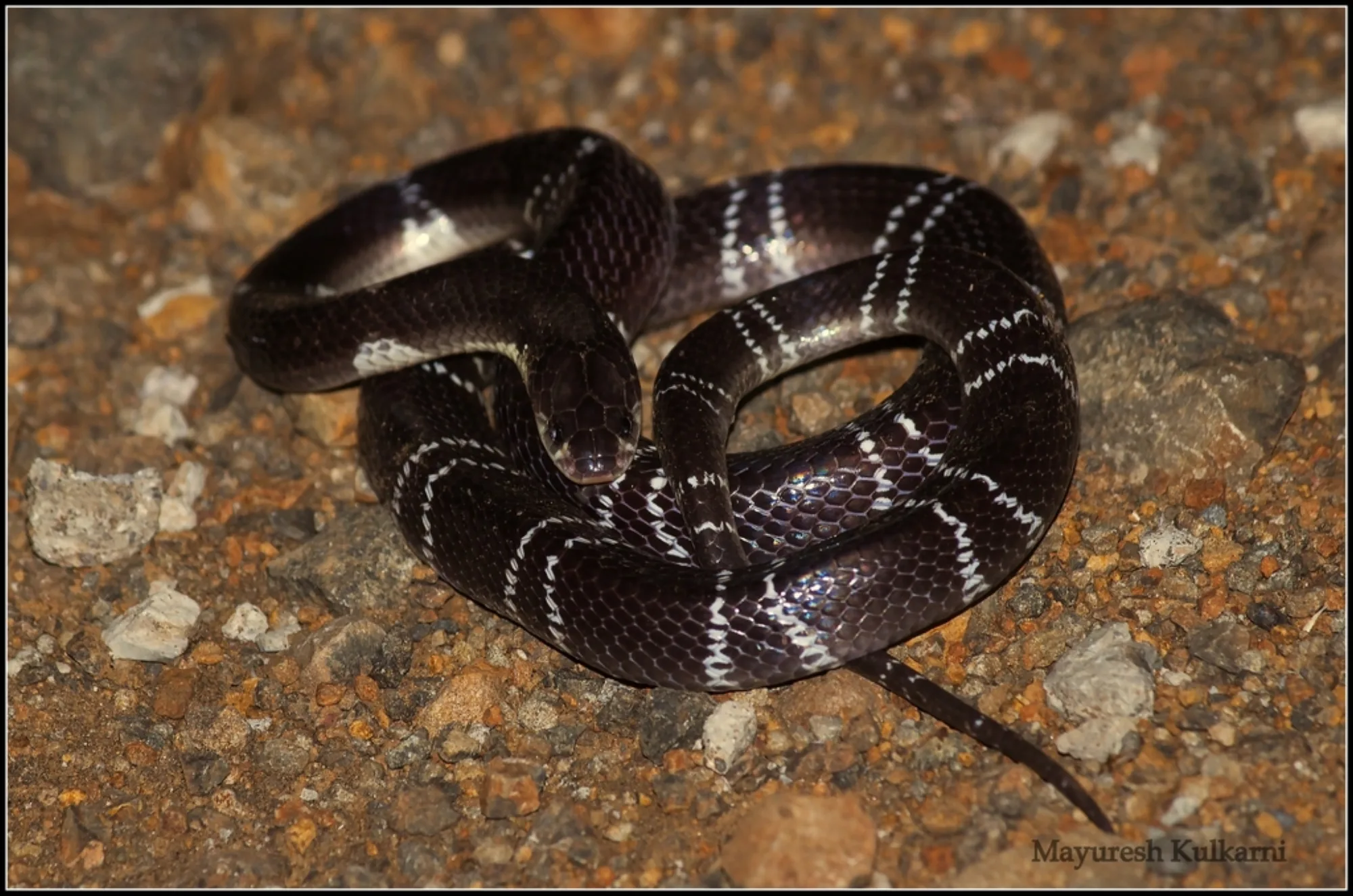
Glossy black or bluish-black, the Common Krait carries narrow white bands across its body and typically measures 0.91 to 1.22 m long. Young snakes have clearly defined bands, while those of older individuals may appear as connected spots. Its head is flat, its neck barely distinct, and its upper lips and belly are white. This highly venomous snake is generally reluctant to confront a threat, but may bite if provoked and can become more aggressive when disturbed at night.
The Common Krait occurs across much of South Asia, from Afghanistan through India, Pakistan, Bangladesh, Sri Lanka and Nepal, with possible records in Bhutan and parts of Iran. In India its range includes the Andaman and Nicobar Islands. It occupies grasslands, scrub, farmland, rocky terrain and semi-desert, as well as suburban gardens and other places altered by people. Often found near streams, canals and ponds, it shelters in rat burrows, termite mounds or beneath debris. During the monsoon it may enter houses looking for shelter or prey.
Most active after dark, the krait hunts chiefly for other snakes, including kraits and vipers, but also eats small rodents, lizards, birds and frogs. By day it stays hidden, making it difficult to see. When threatened, it may coil tightly with its head tucked underneath, flatten its body or make sudden warning movements. Females lay 5 to 15 eggs in secluded places such as burrows or leaf litter and guard them until they hatch after about 60 days. Habitat fragmentation and persecution pose localised threats, although the snake's adaptability has helped its population remain stable.
Written from the English Wikipedia article Common krait (CC BY-SA 4.0).
- Records
- 113
- Countries
- 2
- Atlas places
- 1
These are open occurrence records, so they show where people looked for and recorded the Common Krait as much as where it lives. Cells are up to 25 km across, and every location is generalised to its cell.
Generalised encounter areas, not exact locations. Each shape is a grid cell coloured by how likely the species is there.
- Very likelyIndia25 km zone · medium confidence · 110 records · updated 80 days ago
- LikelySri Lanka25 km zone · medium confidence · 3 records · updated 80 days ago
Conservation status not assessed here yet, so every location is generalised to its grid cell.