Common Toad
Bufo bufo
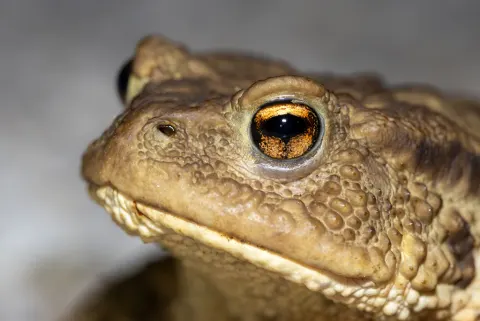
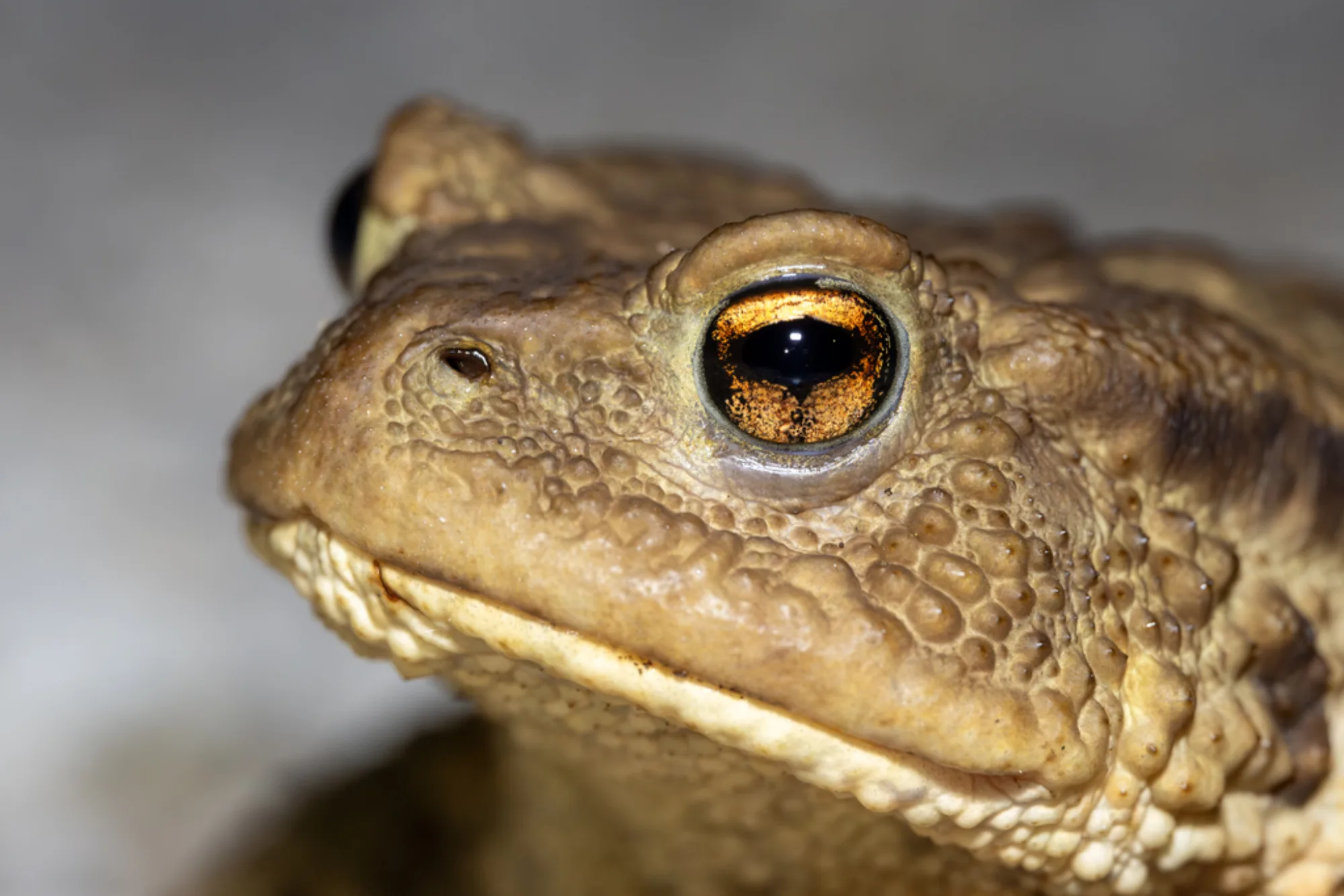
Squat and close to the ground, the Common Toad (Bufo bufo) can reach around 15 cm in length. Its dry, warty skin ranges from brown and olive-brown to greyish-brown, sometimes with darker patches or bands. Look for prominent eyes with yellow or copper-coloured irises, and a slow walk or short, shuffling jumps.
This toad lives across much of Europe, with its range extending east to Siberia and south into parts of northwestern Africa. It is absent from Iceland, the cold north of Scandinavia and several Mediterranean islands, but has been introduced in parts of Ireland. Woodland, especially in wet places, is a favoured habitat, although toads also use fields, parks and gardens and can be found far from standing water. During the day, one may shelter beneath foliage, a root or a stone, its colouring helping it stay inconspicuous. It emerges at dusk to hunt and is most active in wet weather. Its varied diet includes slugs, beetles, spiders and earthworms, as well as occasional small mice. In spring, normally solitary toads gather at favoured breeding ponds, often returning to the same sites each year. Females lay eggs in jelly-like strings in the water; the tadpoles that hatch eventually develop into tiny toads and leave the pond. Common toads spend winter in holes in the ground, sometimes alongside other amphibians.
Habitat loss, drainage of breeding wetlands, agriculture and pollution all pose threats, and many toads are killed on roads during migration. Some populations appear to be declining, while an infectious amphibian disease has been reported in common toads in Spain and the United Kingdom.
Written from the English Wikipedia article Common toad (CC BY-SA 4.0).
- Records
- 232,847
- Countries
- 43
No atlas park has a record of the Common Toad in or around it yet.
These are open occurrence records, so they show where people looked for and recorded the Common Toad as much as where it lives. Cells are up to 25 km across, and every location is generalised to its cell.
Generalised encounter areas, not exact locations. Each shape is a grid cell coloured by how likely the species is there.
- Very likelySwitzerland25 km zone · high confidence · 133260 records · updated 86 days ago
- Very likelyFrance25 km zone · high confidence · 56782 records · updated 86 days ago
- Very likelyGermany25 km zone · high confidence · 9974 records · updated 86 days ago
- Very likelyUnited Kingdom25 km zone · high confidence · 8809 records · updated 86 days ago
- Very likelyDenmark25 km zone · high confidence · 8202 records · updated 86 days ago
- Very likelyLiechtenstein25 km zone · high confidence · 6531 records · updated 86 days ago
- Very likelyAustria25 km zone · high confidence · 2592 records · updated 86 days ago
- Very likelyNorway25 km zone · high confidence · 1735 records · updated 86 days ago
- Very likelyRussia25 km zone · high confidence · 1492 records · updated 86 days ago
- Very likelyItaly25 km zone · high confidence · 475 records · updated 86 days ago
Conservation status not assessed here yet, so every location is generalised to its grid cell.