Southern Ground-Hornbill
Bucorvus leadbeateri
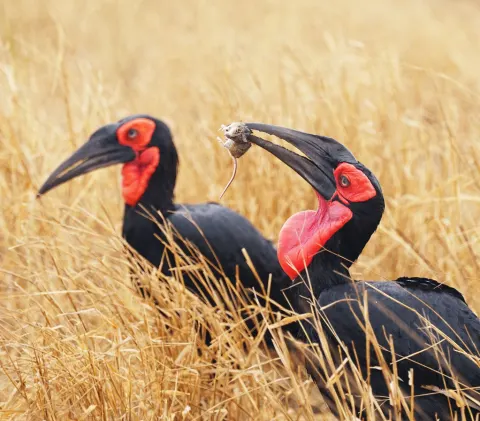
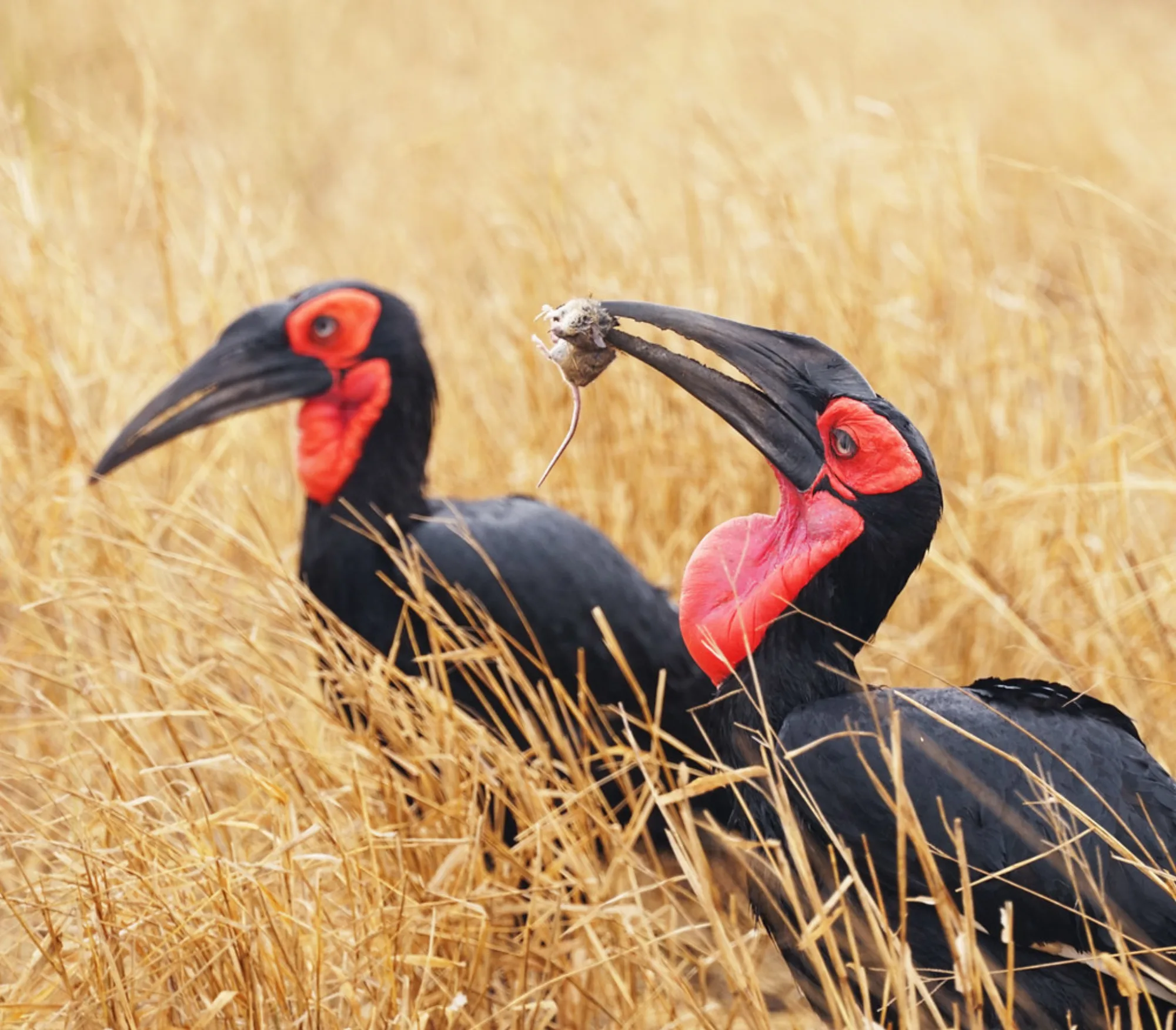
Black plumage, a long curved black bill and patches of bare red skin on the face and throat make the Southern Ground-Hornbill hard to mistake. Females are smaller than males and have violet-blue throat skin, while young birds have duller grey in place of the prominent red pouch. In flight, white wing tips stand out against the dark plumage. This large hornbill measures 90 to 129 cm in length, with a wingspan of 1.2 to 1.8 m. It ranges across southern Africa, from northern Namibia and Angola through to Burundi and Kenya, and occurs in woodlands and savannas. Savanna birds need large nesting trees and grass that is dense but short enough for foraging.
Groups of 5 to 10 adults and juveniles travel together, calling in chorus to maintain territories. Their voices can carry up to 3 kilometres, and neighbouring groups often chase one another in the air. Most hunting takes place on the ground, where their prey includes insects, snails, frogs, reptiles and mammals as large as hares. A breeding pair has help from at least two other birds, and nests are usually in hollows in old trees. A clutch contains one to three eggs, laid as the wet season begins, but only one chick fledges. Young birds depend on their parents and helpers for one to two years, and successful breeding normally happens only every third year.
Habitat loss is a serious threat, especially when large trees are cleared for farming and wood. Power lines, accidental poisoning and persecution also affect populations. Some birds are killed after damaging windows, while hunting has been recorded even in protected areas.
Written from the English Wikipedia article Southern ground hornbill (CC BY-SA 4.0).
- Records
- 37,453
- Countries
- 13
- Atlas places
- 35
- Kruger National Park· South Africa
- Okavango Delta· Botswana
- Serengeti National Park· Tanzania
- Chobe National Park· Botswana
- Ngorongoro Conservation Area· Tanzania
- Hwange National Park· Zimbabwe
- Kafue National Park· Zambia
- Maasai Mara National Reserve· Kenya
- Mana Pools National Park· Zimbabwe
- uKhahlamba-Drakensberg Park· South Africa
- Lake Manyara National Park· Tanzania
- South Luangwa National Park· Zambia
- Tarangire National Park· Tanzania
- Tsavo East National Park· Kenya
- Zambezi National Park· Zimbabwe
- Gonarezhou National Park· Zimbabwe
- Lower Zambezi National Park· Zambia
- Ruaha National Park· Tanzania
- Tsavo West National Park· Kenya
- Bwabwata National Park· Namibia
- Hluhluwe-iMfolozi Park· South Africa
- Nkasa Rupara National Park· Namibia
- Nyerere National Park· Tanzania
- Mapungubwe National Park· South Africa
- Aberdare National Park· Kenya
- Amboseli National Park· Kenya
- Arusha National Park· Tanzania
- Golden Gate Highlands National Park· South Africa
- Hell's Gate National Park· Kenya
- iSimangaliso Wetland Park· South Africa
- Kilimanjaro National Park· Tanzania
- Lake Nakuru National Park· Kenya
- Mikumi National Park· Tanzania
- Mudumu National Park· Namibia
- Udzungwa Mountains National Park· Tanzania
These are open occurrence records, so they show where people looked for and recorded the Southern Ground-Hornbill as much as where it lives. Cells are up to 25 km across, and every location is generalised to its cell.
Generalised encounter areas, not exact locations. Each shape is a grid cell coloured by how likely the species is there.
- Very likelySouth Africa25 km zone · high confidence · 22726 records · updated 86 days ago
- Very likelyTanzania25 km zone · high confidence · 5819 records · updated 86 days ago
- Very likelyBotswana25 km zone · high confidence · 2277 records · updated 86 days ago
- Very likelyZimbabwe25 km zone · high confidence · 2077 records · updated 86 days ago
- Very likelyZambia25 km zone · high confidence · 1871 records · updated 86 days ago
- Very likelyKenya25 km zone · high confidence · 1363 records · updated 86 days ago
- Very likelyMozambique25 km zone · high confidence · 559 records · updated 86 days ago
- Very likelyNamibia25 km zone · high confidence · 366 records · updated 86 days ago
- Very likelyMalawi25 km zone · high confidence · 351 records · updated 86 days ago
- PossibleEswatini25 km zone · medium confidence · 27 records · updated today
Conservation status not assessed here yet, so every location is generalised to its grid cell.