Great Hornbill
Buceros bicornis
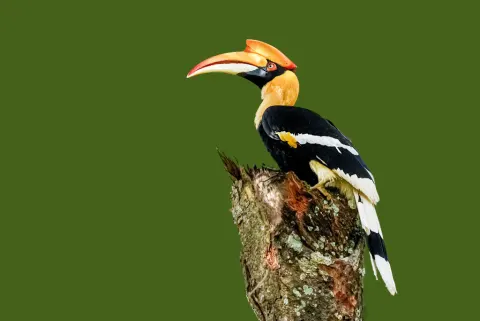
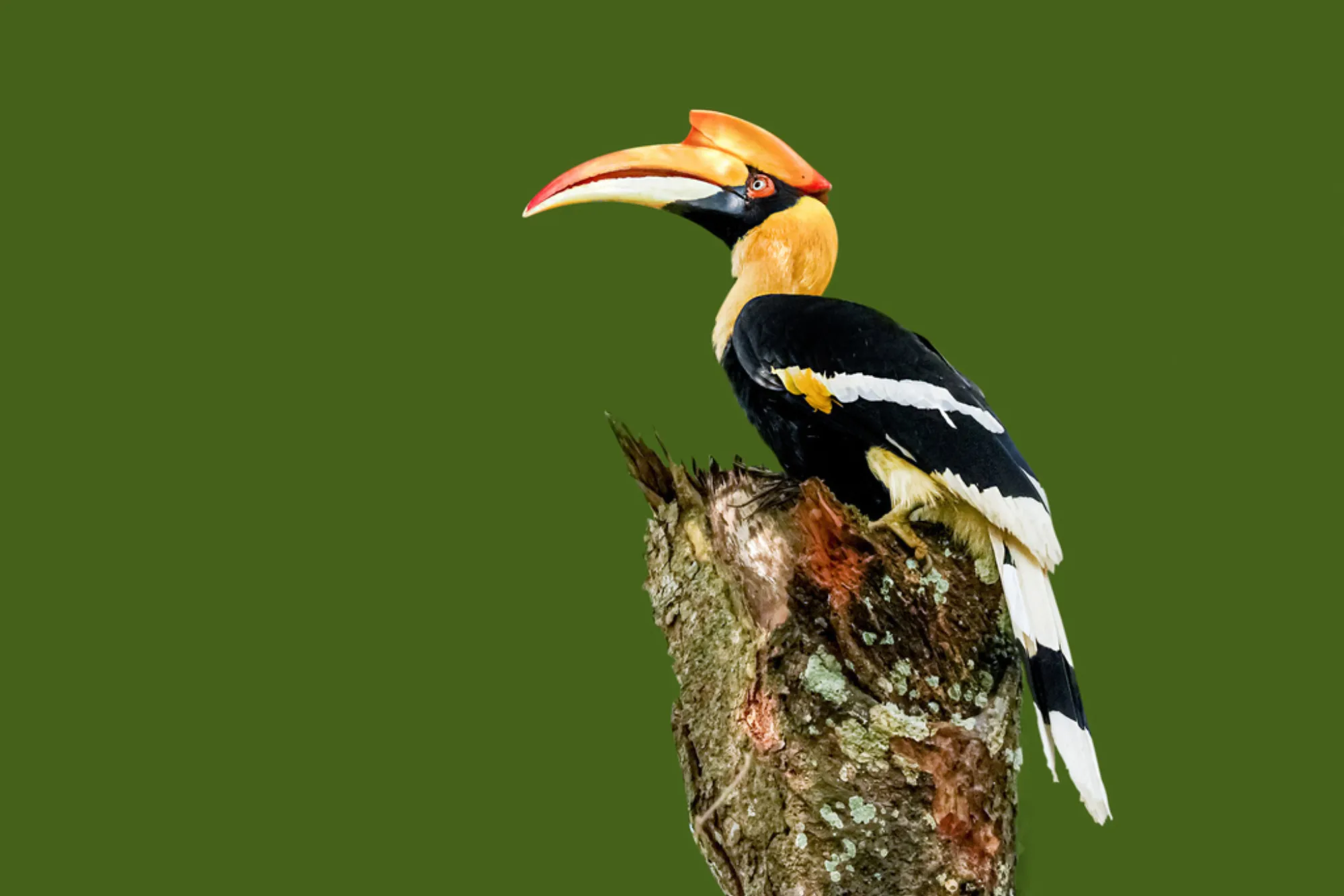
A massive bill topped by a bright yellow and black casque makes the Great Hornbill hard to mistake. This large hornbill measures 95 to 130 cm long, with a 152 cm wingspan. The smaller females have bluish-white eyes, while the males have red eyes. Listen, too, for the heavy wingbeats, audible from far away, as the bird alternates stiff flaps with glides.
Great Hornbills live in forests across the Indian subcontinent and Southeast Asia, including Sumatra and Ujung Kulon in Java. They favour dense, unlogged old-growth forest in hilly country and appear to depend on extensive rainforest. Usually seen in small parties, they sometimes gather in larger groups at fruit trees. Fruit makes up most of their wild diet, with figs especially important, but they also eat small mammals, birds, reptiles, amphibians and large insects. As they move along branches, they hop and search for prey, tearing at bark as they forage. At sunset, birds return to regular roosts, often choosing high branches with little foliage.
From January to April, breeding pairs become very vocal, joining in loud calls that build into a rapid mix of roars and barks. They favour mature forest and large, old trees for nesting. The female nests in a hollow trunk and seals the entrance with a plaster made mainly of faeces, leaving a slit through which her mate feeds her. She stays inside until the chicks are half developed. Deforestation is the main threat, and the birds are also hunted for meat, fat, casques and tail feathers.
Written from the English Wikipedia article Great hornbill (CC BY-SA 4.0).
- Records
- 26,133
- Countries
- 11
- Atlas places
- 9
These are open occurrence records, so they show where people looked for and recorded the Great Hornbill as much as where it lives. Cells are up to 25 km across, and every location is generalised to its cell.
Generalised encounter areas, not exact locations. Each shape is a grid cell coloured by how likely the species is there.
- Very likelyIndia25 km zone · high confidence · 10184 records · updated 80 days ago
- Very likelyThailand25 km zone · high confidence · 9131 records · updated 80 days ago
- Very likelyBhutan25 km zone · high confidence · 2845 records · updated 80 days ago
- Very likelyMalaysia25 km zone · high confidence · 1458 records · updated 80 days ago
- Very likelyCambodia25 km zone · high confidence · 1187 records · updated 80 days ago
- Very likelyNepal25 km zone · high confidence · 480 records · updated 80 days ago
- Very likelyVietnam25 km zone · high confidence · 456 records · updated 80 days ago
- Very likelyChina25 km zone · high confidence · 252 records · updated 80 days ago
- LikelyIndonesia25 km zone · medium confidence · 31 records · updated 80 days ago
- LikelySingapore25 km zone · medium confidence · 25 records · updated 80 days ago
Conservation status not assessed here yet, so every location is generalised to its grid cell.