Common Goldeneye
Bucephala clangula
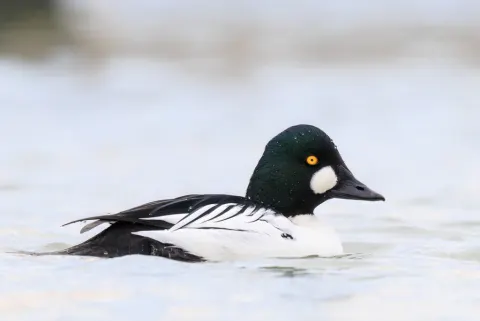
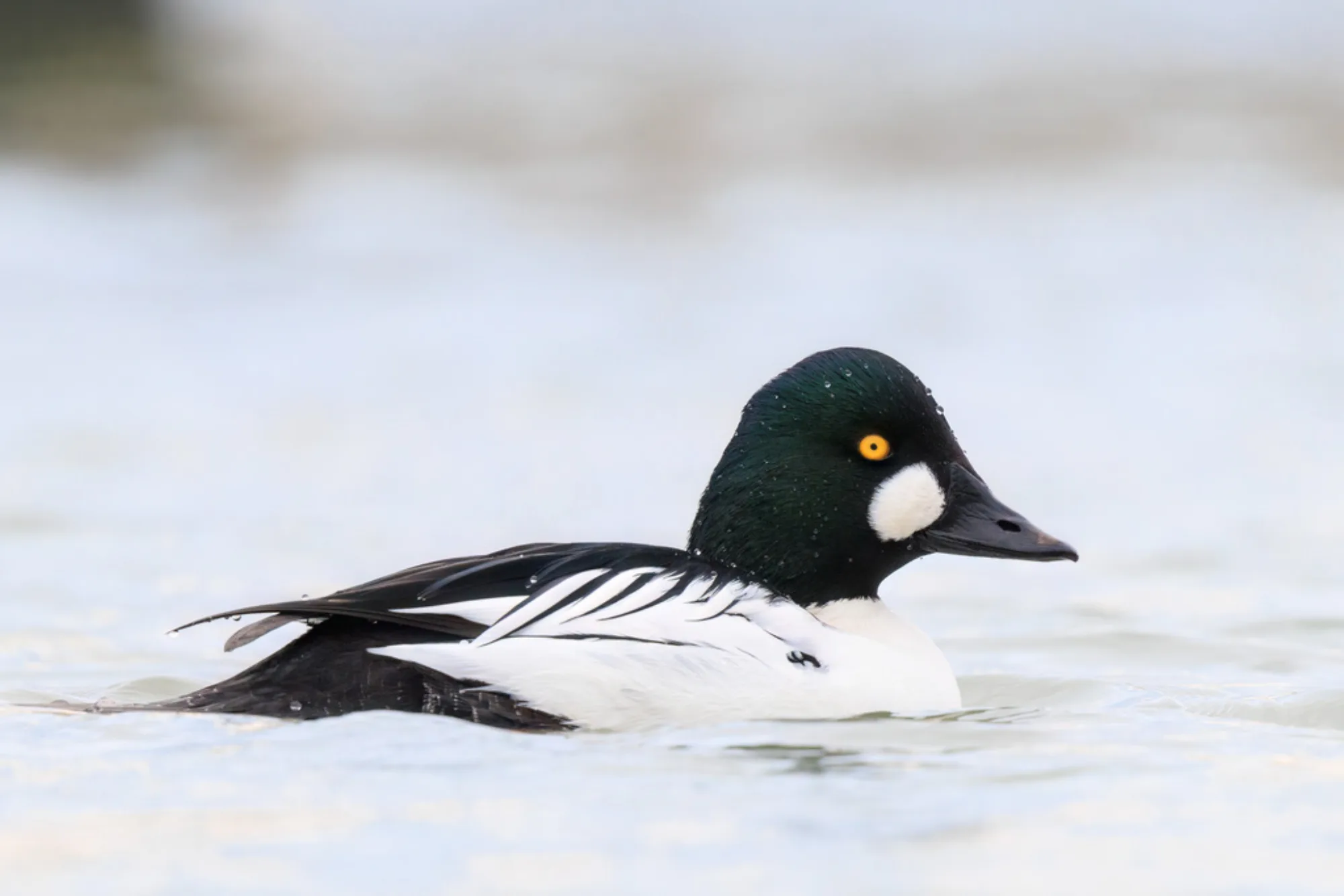
Golden-yellow eyes give the Common Goldeneye its name and offer a useful clue to this medium-sized sea duck. Adult males have a green-glossed dark head, marked with a round white spot beneath each eye; their backs are dark, and their necks and bellies white. Females have a brown head and mostly grey body, while both sexes have orange-yellow legs and feet. Males measure 45 to 51 cm in length, and females 40 to 50 cm.
Look for these ducks on forest lakes and rivers across Canada and the northern United States, and from Scotland east through Scandinavia and the Baltic States to northern Russia. They breed in the taiga and migrate, mostly wintering in sheltered coastal areas or on open water inland at more temperate latitudes. Common Goldeneyes dive beneath the surface to find food, taking mainly insects during nesting and crustaceans during migration and winter. Fish eggs and aquatic plants can also be important locally. The ducks can be aggressive and territorial, and their courtship displays are elaborate.
For nesting, they naturally use holes in large trees, returning to the same cavities year after year, but they readily accept nest boxes. The female incubates the eggs for 28 to 32 days, and the young leave the nest after about 24 to 36 hours. Broods often mix as ducklings gain independence or their mothers leave them. Hawks, owls and eagles prey on goldeneyes, while females and their broods also face predators including bears, mink and raccoons. Clearance and pollution have degraded both breeding and winter habitats; hunting has also taken a toll, with around 188,300 killed annually in North America during the 1970s.
Written from the English Wikipedia article Common goldeneye (CC BY-SA 4.0).
- Records
- 1,700,991
- Countries
- 67
- Atlas places
- 3
These are open occurrence records, so they show where people looked for and recorded the Common Goldeneye as much as where it lives. Cells are up to 25 km across, and every location is generalised to its cell.
Generalised encounter areas, not exact locations. Each shape is a grid cell coloured by how likely the species is there.
- Very likelyUnited States25 km zone · high confidence · 743360 records · updated 86 days ago
- Very likelyCanada25 km zone · high confidence · 461725 records · updated 86 days ago
- Very likelyNorway25 km zone · high confidence · 360680 records · updated 86 days ago
- Very likelyFinland25 km zone · high confidence · 41874 records · updated 86 days ago
- Very likelyBelgium25 km zone · high confidence · 18078 records · updated 86 days ago
- Very likelyUnited Kingdom25 km zone · high confidence · 14136 records · updated today
- Very likelySweden25 km zone · high confidence · 6528 records · updated today
- Very likelyDenmark25 km zone · high confidence · 6030 records · updated today
- Very likelyAustria25 km zone · high confidence · 5135 records · updated today
- Very likelyPoland25 km zone · high confidence · 4406 records · updated today
Conservation status not assessed here yet, so every location is generalised to its grid cell.