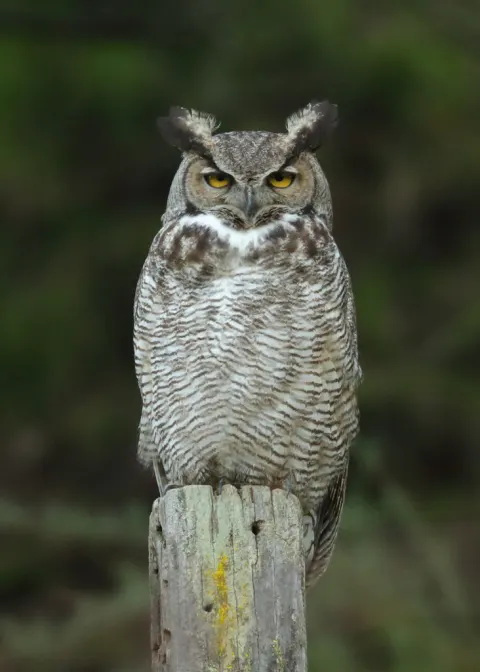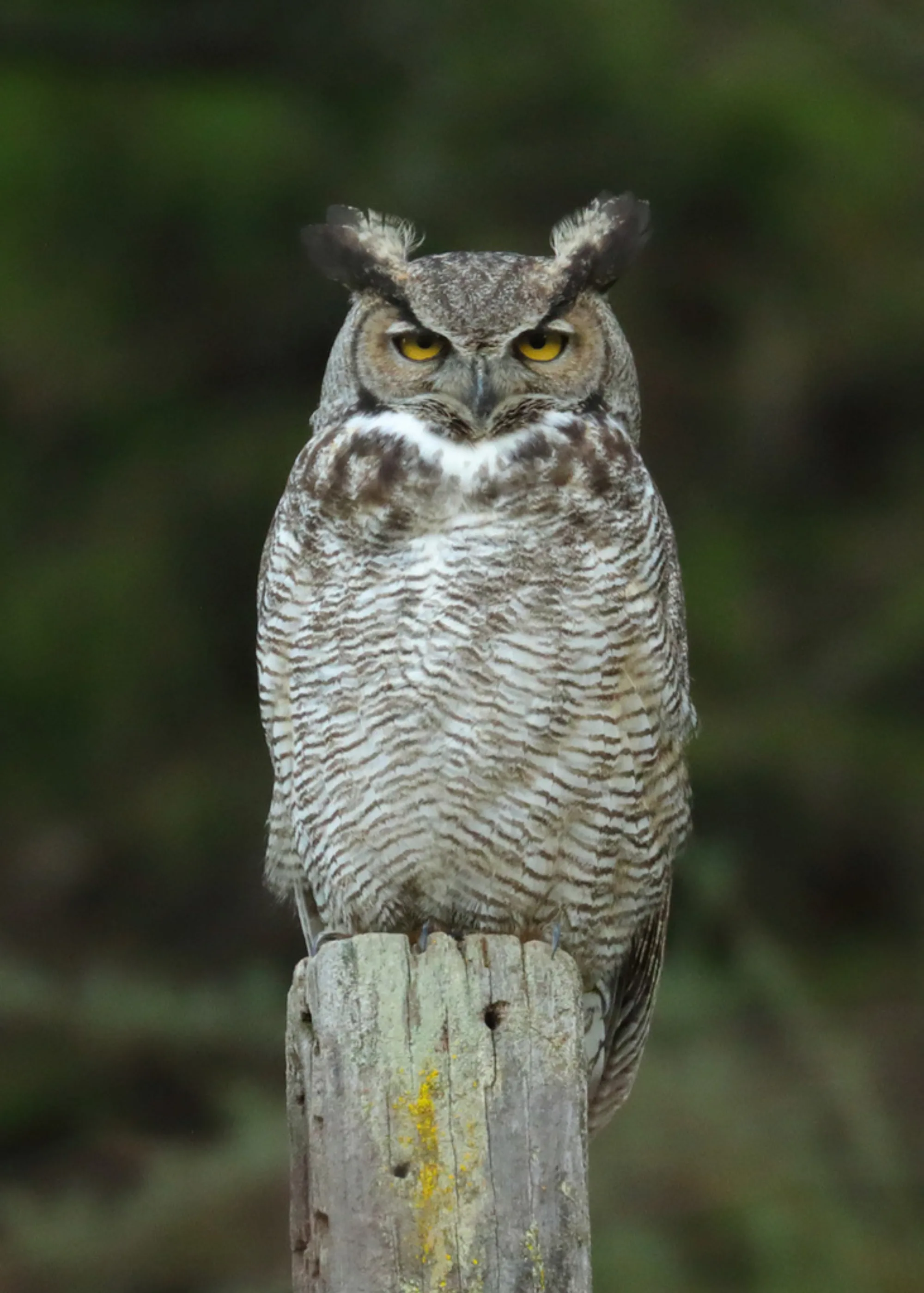
Great Horned Owl
Bubo virginianus
With its broad wings, large head and prominent feather tufts, the Great Horned Owl cuts a distinctive shape. This heavily built owl has mottled brown upperparts, lighter underparts marked with brown bars, and a white patch on its throat. Its colour varies across its range, from pale buff in the subarctic to dark brown with blackish blotches along the Pacific coast. Adults measure 43 to 64 cm long, and females are somewhat larger than males.
Native to the Americas, it occurs throughout most of North America and patchily in Central America. It uses a wide range of habitats, including forest edges, prairie, mountains, deserts and some urban areas. It favours places where open hunting ground lies close to woods used for roosting and nesting. By day it usually rests in large trees, where its colouring helps conceal it, though it may also shelter among rocks or in dense shrubs. Generally active at night, it can sometimes be seen hunting in the late afternoon or early morning, and flies with almost no discernible noise.
Rabbits, hares, rats, mice and voles make up much of its diet, but it also takes birds, reptiles, amphibians and invertebrates. It often hunts from a high perch, watching for prey before moving on. Mated pairs hold territories year-round, advertising them with hoots, and nest early, sometimes laying weeks or months before other birds of prey. Food shortages can send northern birds south, while territorial clashes with other Great Horned Owls can turn physical and have been recorded killing owls.
Written from the English Wikipedia article Great horned owl (CC BY-SA 4.0).
- Records
- 540,472
- Countries
- 3
- Atlas places
- 2
These are open occurrence records, so they show where people looked for and recorded the Great Horned Owl as much as where it lives. Cells are up to 25 km across, and every location is generalised to its cell.
Generalised encounter areas, not exact locations. Each shape is a grid cell coloured by how likely the species is there.
- Very likelyUnited States25 km zone · high confidence · 485152 records · updated 80 days ago
- Very likelyCanada25 km zone · high confidence · 53025 records · updated 80 days ago
- Very likelyMexico25 km zone · high confidence · 2295 records · updated 80 days ago
Conservation status not assessed here yet, so every location is generalised to its grid cell.