Snowy Owl
Bubo scandiacus
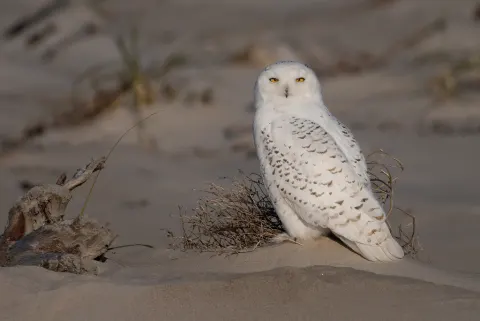
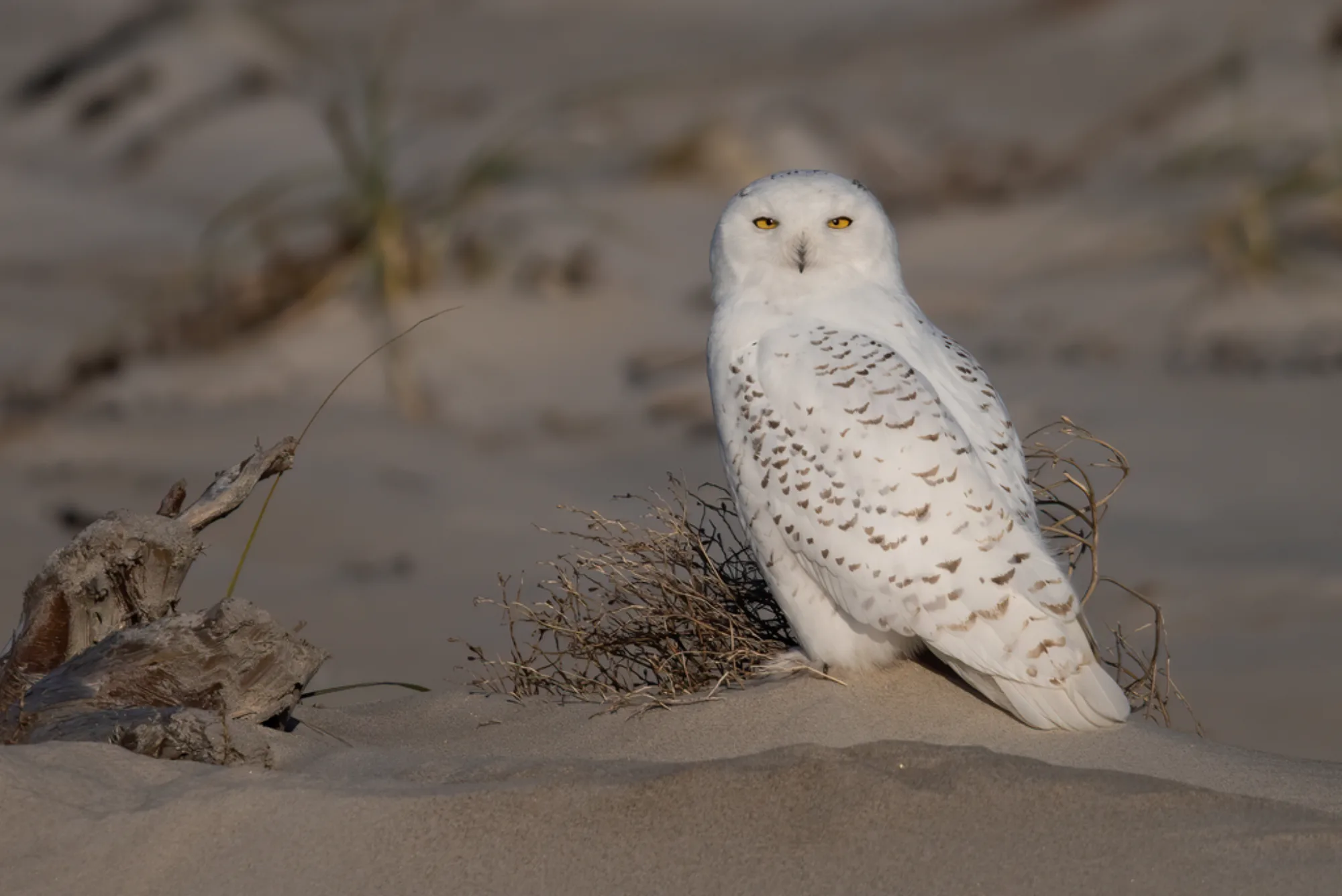
On the open tundra, a Snowy Owl resting on the ground can be mistaken for a light-coloured stone or a patch of snow. This large owl has bright yellow eyes and mostly white plumage, with males generally whiter and females more heavily marked in dark brown. Young males also have dark markings and may resemble females until they mature. In flight, the owl usually moves steadily and directly, alternating wingbeats with glides.
Snowy Owls breed mostly on Arctic tundra across northern North America and Eurasia. They often favour raised ground, including knolls, ridges and rocky outcrops, and may also breed on coastal tidal flats. Their movements are nomadic and hard to predict: many travel south for winter, while others remain in the Arctic. Outside the breeding season they use a wide range of open places, from coastal dunes and grasslands to agricultural fields and airports. Some spend time on sea ice, using it as a perch. Unlike many owls, they are often active by day, especially in summer.
Lemmings are closely linked to breeding success, but Snowy Owls also take other small mammals and northern waterbirds, and will sometimes eat carrion. They usually nest on a small rise on the tundra ground, laying about 5 to 11 eggs that hatch at different times. The young develop relatively slowly through the short Arctic summer and seek independence in autumn. When prey is unavailable, the owls often do not breed at all. Their population appears to be declining sharply; the causes are poorly understood, but environmental changes associated with global warming are thought to be among the leading pressures.
Written from the English Wikipedia article Snowy owl (CC BY-SA 4.0).
- Records
- 173,584
- Countries
- 3
No atlas park has a record of the Snowy Owl in or around it yet.
These are open occurrence records, so they show where people looked for and recorded the Snowy Owl as much as where it lives. Cells are up to 25 km across, and every location is generalised to its cell.
Generalised encounter areas, not exact locations. Each shape is a grid cell coloured by how likely the species is there.
- Very likelyUnited States25 km zone · high confidence · 87681 records · updated 80 days ago
- Very likelyCanada25 km zone · high confidence · 85133 records · updated 80 days ago
- Very likelyBelgium25 km zone · high confidence · 770 records · updated 80 days ago
Conservation status not assessed here yet, so every location is generalised to its grid cell.