Tamarau
Bubalus mindorensis
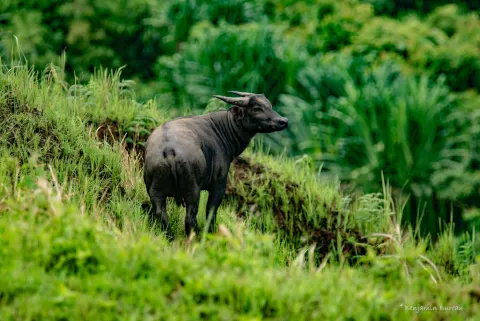
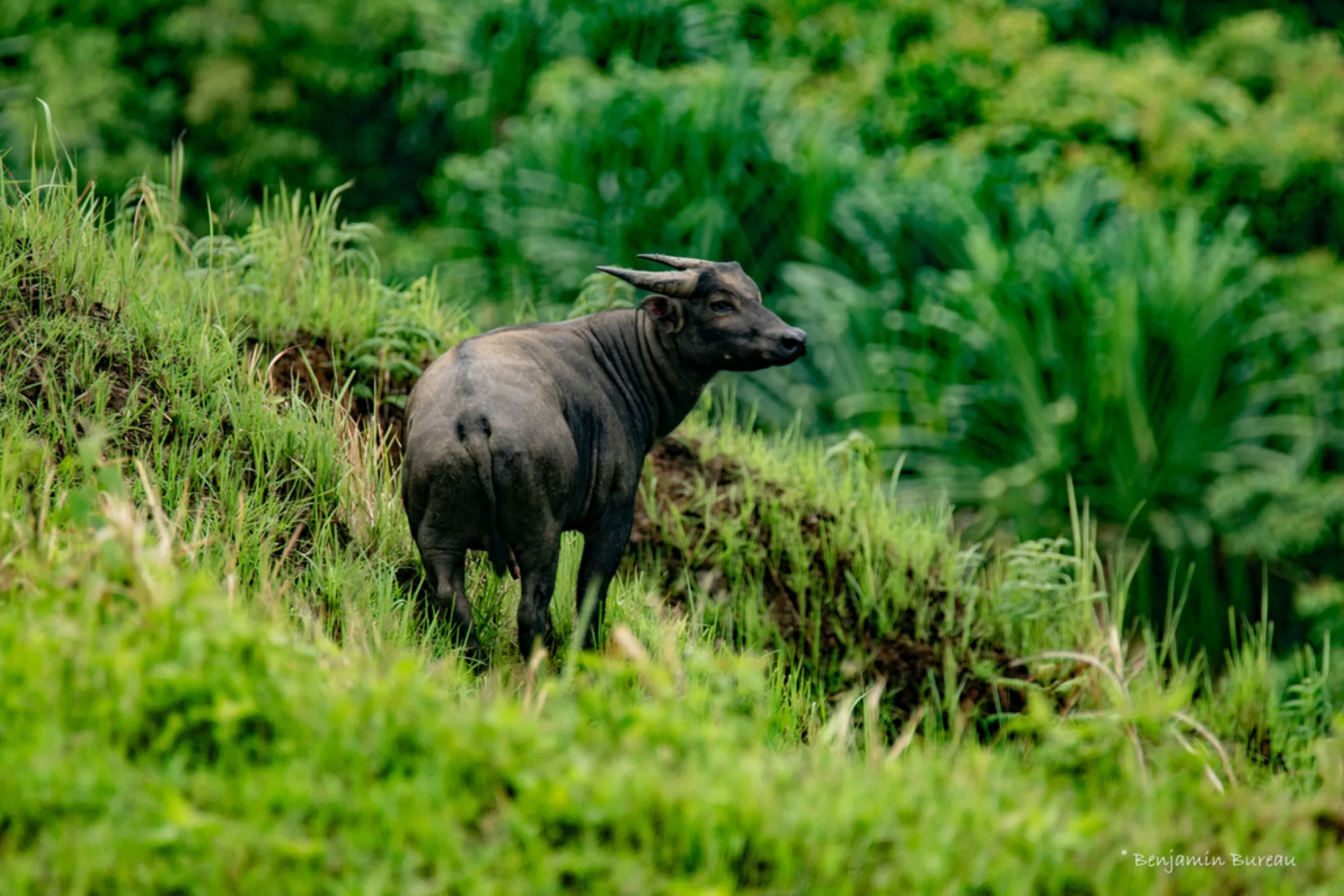
On the Philippine island of Mindoro, the Tamarau moves through thick brush and grassy clearings, often close to water in the mountains. This small, stocky buffalo has a heavyset body, short legs and a small horned head. Adults are dark brown to greyish, with white marks on the hooves and inner lower forelegs. Most also have grey-white stripes running from the inner corners of their eyes towards the horns. Both males and females carry short black horns that form a V shape.
Tamarau are shy of people, and adults are usually encountered alone rather than in herds. They favour tropical highland forest, particularly thick brush near open-canopied glades, where they may graze on grasses. Their diet also includes young bamboo shoots, with cogon grass and wild sugarcane among their preferred foods. Although naturally active by day, some have shifted to feeding at night to avoid people. Females give birth to one calf after a pregnancy of around 300 days, and the calf remains with its mother for 2 to 4 years before becoming independent. Tamarau also wallow in mud pits, possibly to avoid biting insects.
Once found across Mindoro from the coast to the mountains, the buffalo is now confined to a few remote grassy plains. Human settlement and the fragmentation of forests have also expanded its habitat use into lower-altitude grassland. Habitat loss from infrastructure development, logging and agriculture is described as the greatest threat to its survival. Hunting for food has also reduced its numbers, while an outbreak of rinderpest followed the introduction of non-native cattle in the 1930s.
Written from the English Wikipedia article Tamaraw (CC BY-SA 4.0).
- Records
- 0
- Countries
- 1
No atlas park has a record of the Tamarau in or around it yet.
These are open occurrence records, so they show where people looked for and recorded the Tamarau as much as where it lives. Cells are up to 25 km across, and every location is generalised to its cell.
Generalised encounter areas, not exact locations. Each shape is a grid cell coloured by how likely the species is there.
- Very likelyPhilippines25 km zone · low confidence · 0 records · updated 80 days ago
Conservation status not assessed here yet, so every location is generalised to its grid cell.