Asiatic Buffalo
Bubalus arnee
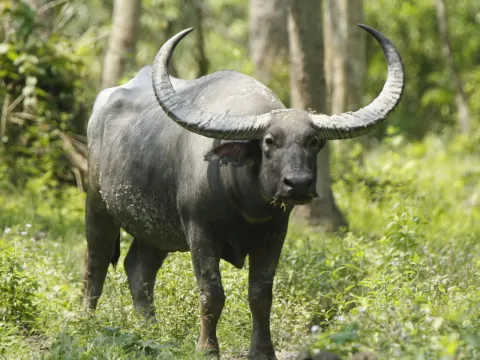
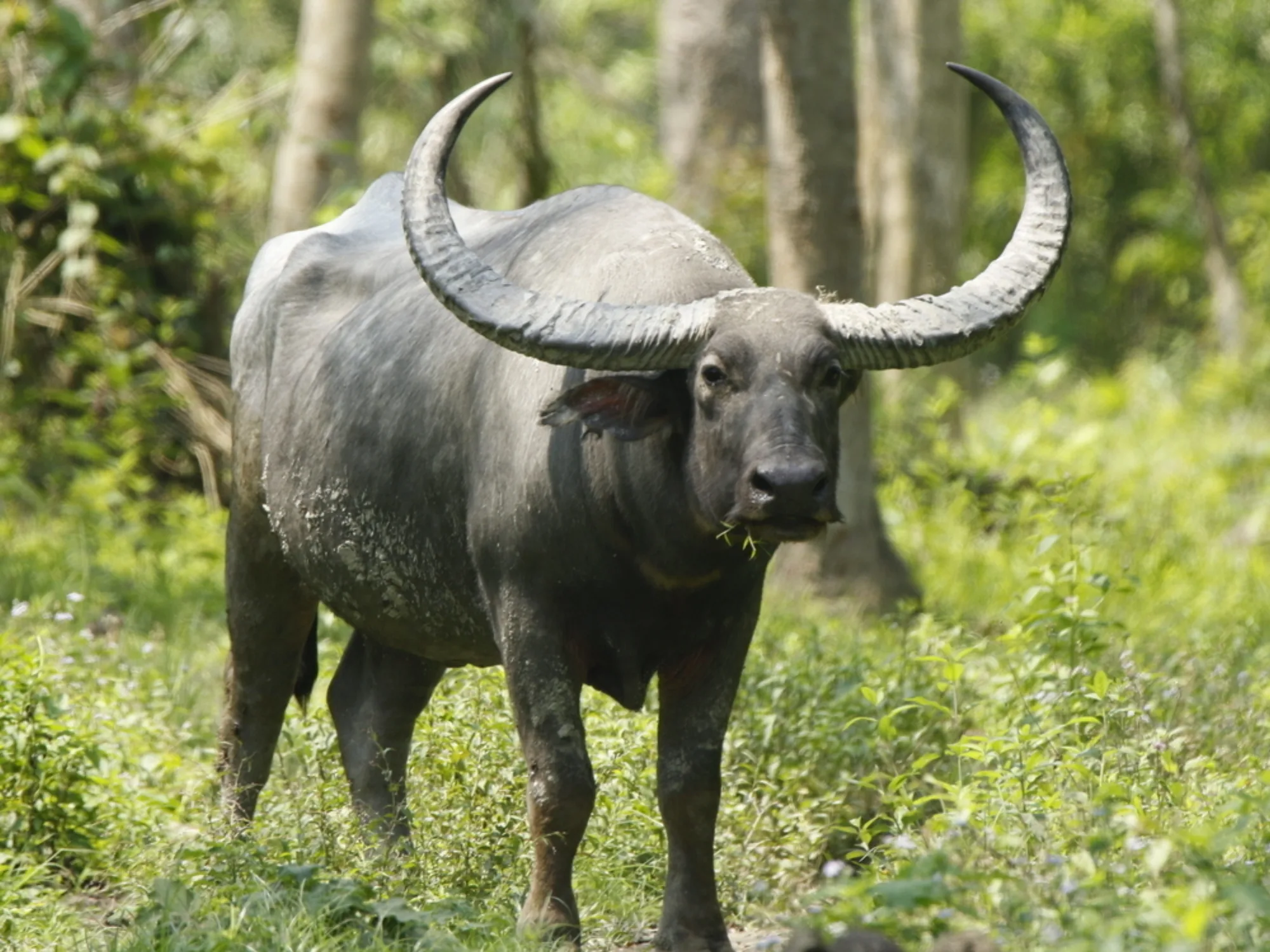
With its massive, widely spreading horns and dark skin, the Asiatic Buffalo is a large wild bovine of the Indian subcontinent and Southeast Asia. Its skin ranges from ash-grey to black, and its coarse, sparse hair grows forward towards a long, narrow head. Both sexes carry broad-based horns that can span 2 m along the outer edges. A bushy tail tip and large, splayed hooves add to its distinctive appearance. It stands 150 to 190 cm at the shoulder and weighs 600 to 1,200 kg.
Wild populations are found in Bhutan, Cambodia, India, Nepal and Thailand; their presence in Myanmar remains unconfirmed. Look for them in wet grasslands, swamps, floodplains and river valleys thick with vegetation. They are active by day and night, grazing mainly on grasses and sedges when these are available, but also eating herbs, fruit and bark and browsing trees and shrubs. They sometimes feed on crops, including rice, sugarcane and jute. Females and their young form stable clans led by older cows, while adult males form bachelor groups and older males often live alone. In most of their range, breeding is seasonal, typically in October and November; some populations breed throughout the year. A single calf is usual, although twins are possible.
Interbreeding with domestic and feral buffaloes is a major threat, including around protected areas. Hunting, the conversion of floodplains to agriculture and hydropower development, and the degradation of wetlands by invasive plants also put pressure on the species. Diseases and parasites from livestock, as well as competition with livestock for food and water, add to these threats.
Written from the English Wikipedia article Wild water buffalo (CC BY-SA 4.0).
- Records
- 99
- Countries
- 5
- Atlas places
- 7
These are open occurrence records, so they show where people looked for and recorded the Asiatic Buffalo as much as where it lives. Cells are up to 25 km across, and every location is generalised to its cell.
Generalised encounter areas, not exact locations. Each shape is a grid cell coloured by how likely the species is there.
- Very likelyIndia25 km zone · medium confidence · 58 records · updated 80 days ago
- Very likelySri Lanka25 km zone · medium confidence · 41 records · updated 80 days ago
- UncommonColombia25 km zone · low confidence · 0 records · updated 80 days ago
- UncommonNepal25 km zone · low confidence · 0 records · updated 80 days ago
Conservation status not assessed here yet, so every location is generalised to its grid cell.