Desert Rain Frog
Breviceps macrops
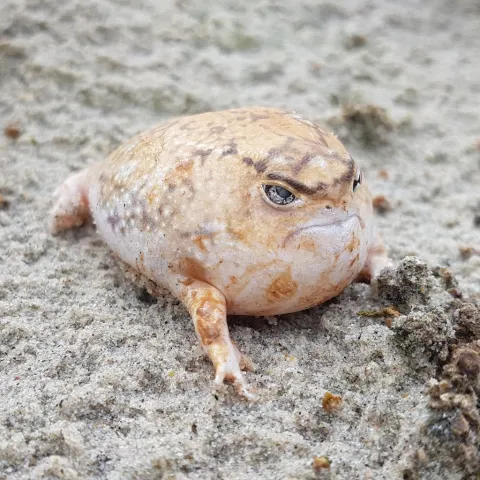
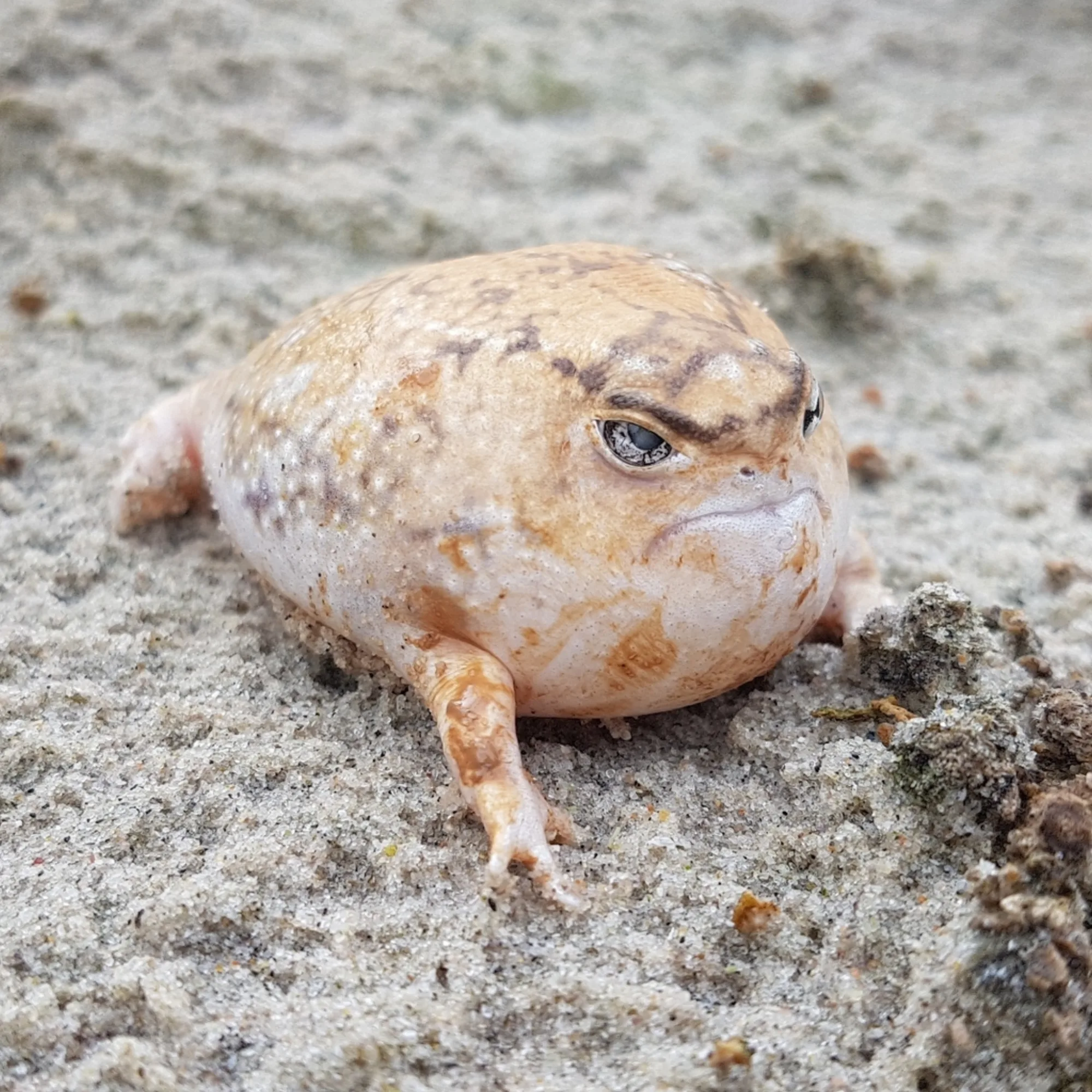
Plump and yellowish-brown, the Desert Rain Frog has bulging eyes, a short snout and small legs. It measures between 4 and 6 centimetres long, and sand often sticks to its skin. Its short limbs cannot propel it in leaps, so it walks across the sand. A high-pitched squeak can signal that the frog feels threatened.
The frog lives on the western coast of South Africa and Namibia, mostly in a strip of land about 10 kilometres wide. Its habitat lies between the sea and the dunes, where loose sand is swept by strong winds. Rainfall is sparse, but fog brings moisture to the dry dunes. Plants suited to dry conditions grow here, and a variety of flowers appears in spring. The frog shelters underground through dry periods and can absorb water through its skin.
Nocturnal by habit, it spends the day in a burrow dug 10 to 20 centimetres deep, where the sand is moist. On clear or foggy nights, it emerges and wanders over the dunes, sometimes leaving distinctive tracks near dung. It probably eats moths, beetles and insect larvae there, and is also known to eat ants. During the breeding season, between June and October, males emerge at night and call with a distinctive squeak. Females lay 12 to 40 eggs, which develop in a burrow, with an adult remaining near the nest. Froglets hatch ready to move and hunt, without a free-living tadpole stage. Habitat loss from mining, road construction, settlement and tourism threatens the species. Mining companies have tried to restore habitat, but there is no evidence that the frogs have returned to restored areas.
Written from the English Wikipedia article Desert rain frog (CC BY-SA 4.0).
- Records
- 16
- Countries
- 1
- Atlas places
- 1
These are open occurrence records, so they show where people looked for and recorded the Desert Rain Frog as much as where it lives. Cells are up to 25 km across, and every location is generalised to its cell.
Generalised encounter areas, not exact locations. Each shape is a grid cell coloured by how likely the species is there.
- Very likelySouth Africa25 km zone · medium confidence · 16 records · updated 80 days ago
Conservation status not assessed here yet, so every location is generalised to its grid cell.