Barnacle Goose
Branta leucopsis
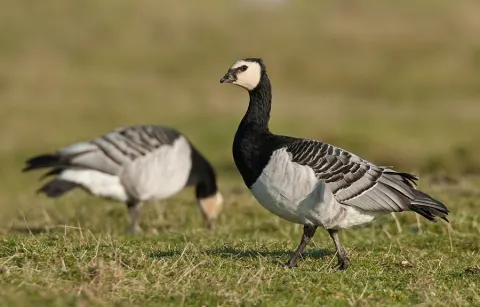
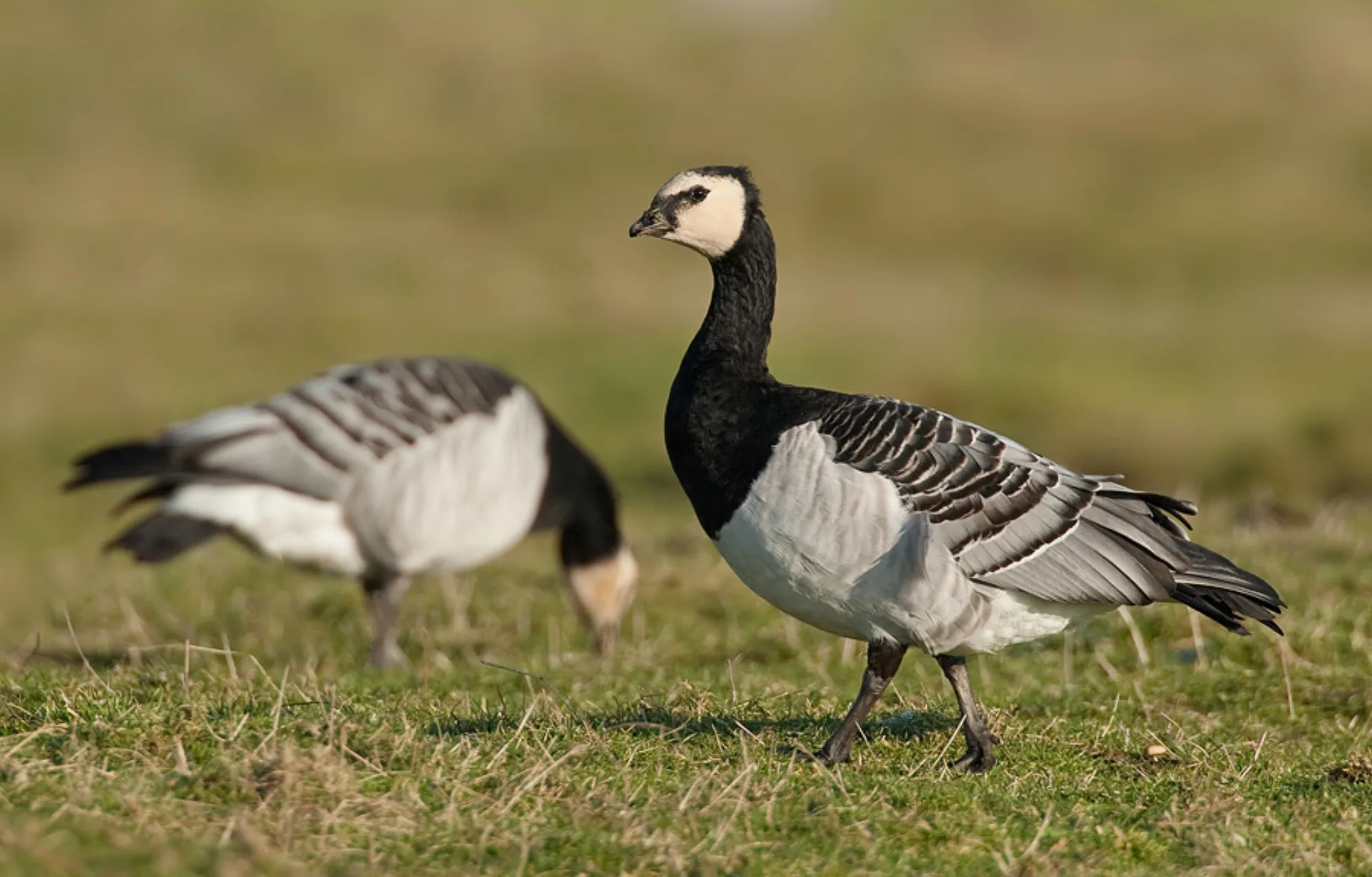
With its white face, black neck and barred silver-grey back, the Barnacle Goose is a distinctive sight. This medium-sized goose has a white belly, black legs and a short black bill. In flight, look for the white V-shaped patch on its rump and the silver-grey beneath its wings. It is smaller than a Canada goose, with a smaller bill, and differs from the similar cackling goose in its grey and white body and more extensive white on the head.
Barnacle Geese breed in eastern Greenland, Svalbard and the Russian Arctic, as well as Iceland and islands and coasts around the Baltic and southern North Sea. Their wintering grounds include western Scotland and Ireland, Solway Firth and the Wadden Sea. Some birds from the Baltic and southern North Sea population stay in or near their breeding range for winter. They nest on little islands or on elevated cliff ledges in the mountains, sometimes up to a kilometre from feeding areas beside lakes and rivers.
Newly hatched goslings follow their parents to feeding areas on their first day, rather than being fed by adults. Those nesting on cliffs must jump down before they can fly, and some die on impact. Arctic foxes take dead or injured goslings and stalk the young as their parents lead them to wetlands. Only 50% of chicks survive their first month. Disease can also take a heavy toll: an outbreak of highly pathogenic avian influenza killed 11,400 birds from the Svalbard population in the 2021/22 winter. Two productive breeding seasons helped that population recover close to its former level by the 2023/24 winter.
Written from the English Wikipedia article Barnacle goose (CC BY-SA 4.0).
- Records
- 245,289
- Countries
- 50
No atlas park has a record of the Barnacle Goose in or around it yet.
These are open occurrence records, so they show where people looked for and recorded the Barnacle Goose as much as where it lives. Cells are up to 25 km across, and every location is generalised to its cell.
Generalised encounter areas, not exact locations. Each shape is a grid cell coloured by how likely the species is there.
- Very likelyNorway25 km zone · high confidence · 74168 records · updated 86 days ago
- Very likelyBelgium25 km zone · high confidence · 39831 records · updated 86 days ago
- Very likelyFinland25 km zone · high confidence · 30759 records · updated 86 days ago
- Very likelyUnited Kingdom25 km zone · high confidence · 26948 records · updated 86 days ago
- Very likelySweden25 km zone · high confidence · 17927 records · updated 86 days ago
- Very likelyNetherlands25 km zone · high confidence · 17497 records · updated 86 days ago
- Very likelyDenmark25 km zone · high confidence · 8030 records · updated 86 days ago
- Very likelySvalbard & Jan Mayen25 km zone · high confidence · 7416 records · updated 86 days ago
- Very likelyGermany25 km zone · high confidence · 6988 records · updated 86 days ago
- Very likelyIceland25 km zone · high confidence · 3476 records · updated 86 days ago
Conservation status not assessed here yet, so every location is generalised to its grid cell.