Cackling Goose
Branta hutchinsii
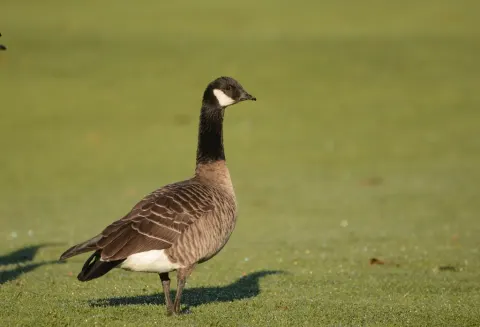
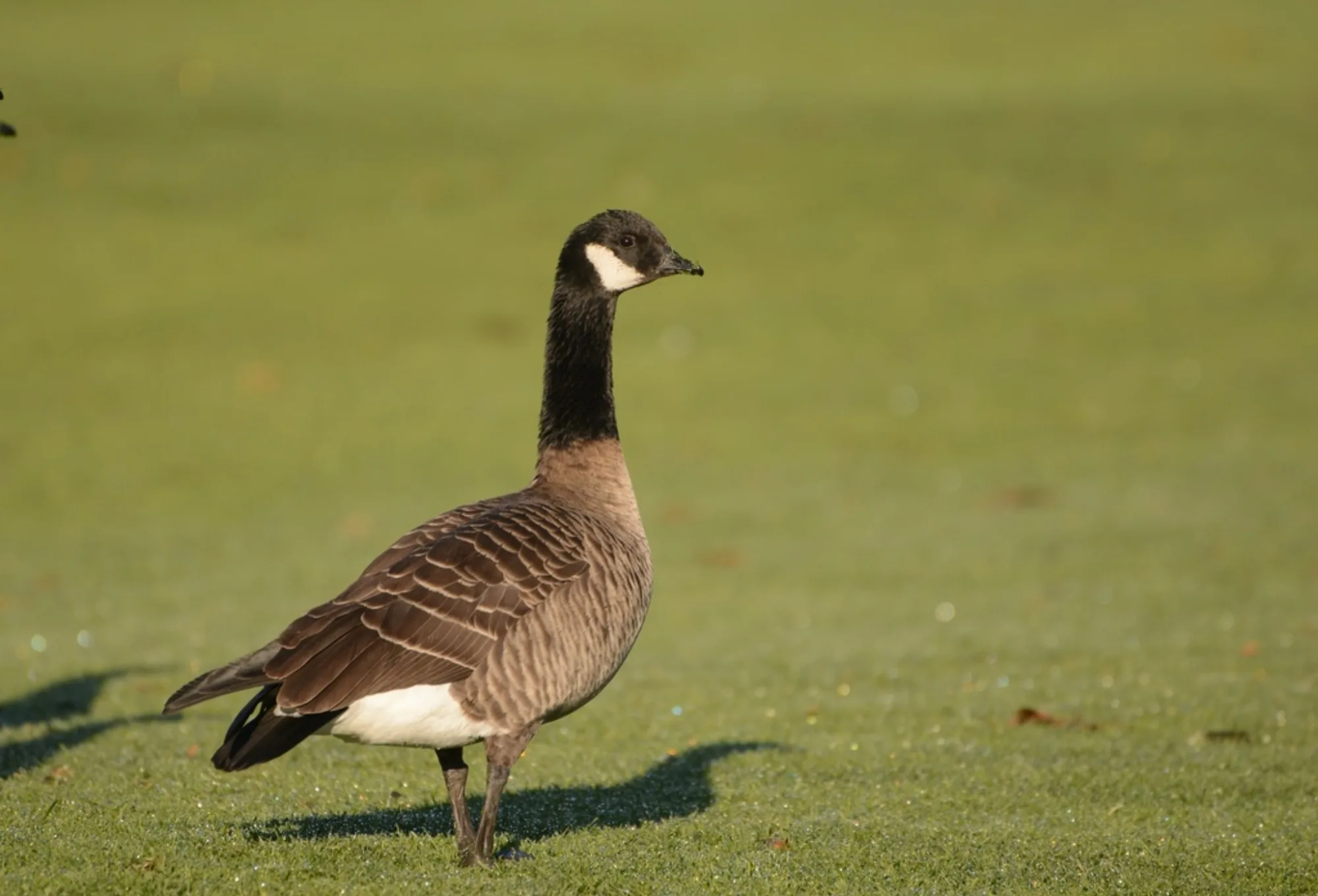
A black head and neck, crossed by a white chinstrap, give the Cackling Goose a distinctive look, though the larger Canada goose and similarly sized barnacle goose share those markings. Size varies among Cackling Geese, and some can be difficult to tell from Canada geese. The smallest weigh 1.4 kg, while another subspecies can reach 3 kg. Females look almost identical to males, but are slightly lighter and have a different voice.
Native to North America, these geese breed across tundra habitats in northern Canada and Alaska. They generally choose a raised spot near water for a nest, lining a shallow hollow with plants and down. Both parents defend the nesting site, sometimes chasing away passing people, and a pair may remain together for life. Adults often escort their young in single file, one leading and the other bringing up the rear. Large flocks fly in a V formation during migration, and the geese spend winter across much of the US, as well as locally in western Canada, the US west coast and northern Mexico. Some also turn up naturally in western Europe and parts of East Asia, while birds have recently been reintroduced to Japan and Siberia.
Cackling Geese eat mainly plants, reaching underwater vegetation by dipping their heads and necks or tipping forward. They also feed in fields on leftover grain, particularly during migration and winter, and take some insects, molluscs and crustaceans. Eggs, nesting females and newly hatched goslings are vulnerable to predators, including foxes, coyotes and, in some regions, cats and dogs. Overhunting and habitat loss caused a serious decline, and although populations have recovered across most of the range, some local populations may still be declining.
Written from the English Wikipedia article Cackling goose (CC BY-SA 4.0).
- Records
- 515,122
- Countries
- 2
- Atlas places
- 3
These are open occurrence records, so they show where people looked for and recorded the Cackling Goose as much as where it lives. Cells are up to 25 km across, and every location is generalised to its cell.
Generalised encounter areas, not exact locations. Each shape is a grid cell coloured by how likely the species is there.
- Very likelyUnited States25 km zone · high confidence · 478891 records · updated 80 days ago
- Very likelyCanada25 km zone · high confidence · 36231 records · updated 80 days ago
Conservation status not assessed here yet, so every location is generalised to its grid cell.