Canada Goose
Branta canadensis
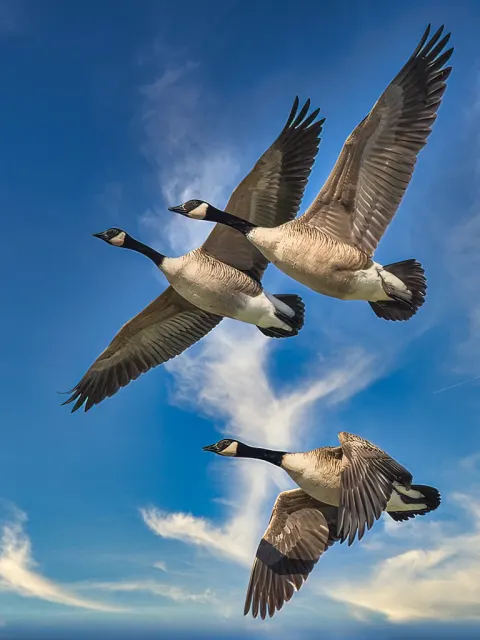
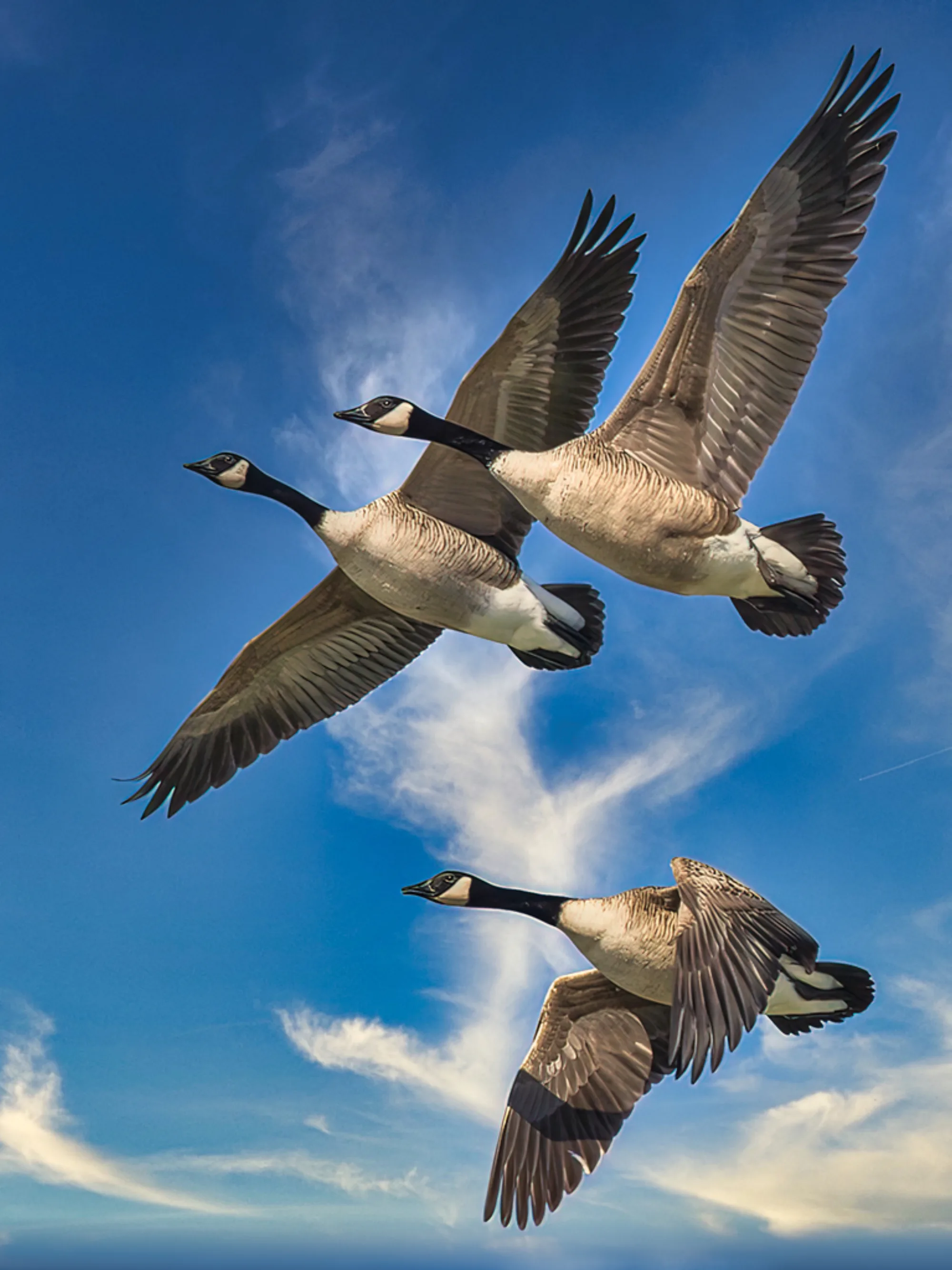
A black head and neck, white cheeks and a white chin mark the Canada Goose, a large bird with a brown body. It measures 75 to 110 cm in length, although its subspecies vary widely in size. Smaller Canada Geese can be difficult to tell from cackling geese, which have shorter necks and smaller bills. Listen for the honking calls of birds flying overhead, sometimes in large V-shaped groups.
Native to the Arctic and temperate parts of North America, the goose breeds across Canada and the northern United States. It often stays close to fresh water, but also uses brackish marshes, estuaries and lagoons. Parks, cultivated land and other places altered by people can provide food and breeding habitat. It has also been introduced to places including the United Kingdom, Ireland, New Zealand and Japan. Many migrate, though some populations remain in the same area year-round. On land, the birds graze on grasses and eat available grains; in water, they feed on aquatic plants and algae.
Pairs usually stay together for life and nest near water, often on raised ground. The female lays two to nine eggs, and both parents defend the nest. Newly hatched goslings can walk, swim and find food, and their parents may lead them in a line. Adults hiss and may chase or attack animals that approach their young. Hunting and habitat loss caused a serious decline in the native range in the past, and geese are still hunted and culled. Eggs and goslings face predators including foxes, gulls and bears, while eagles can also kill adults.
Written from the English Wikipedia article Canada goose (CC BY-SA 4.0).
- Records
- 7,561,359
- Countries
- 50
No atlas park has a record of the Canada Goose in or around it yet.
These are open occurrence records, so they show where people looked for and recorded the Canada Goose as much as where it lives. Cells are up to 25 km across, and every location is generalised to its cell.
Generalised encounter areas, not exact locations. Each shape is a grid cell coloured by how likely the species is there.
- Very likelyUnited States25 km zone · high confidence · 5950937 records · updated 86 days ago
- Very likelyCanada25 km zone · high confidence · 1392531 records · updated 86 days ago
- Very likelyUnited Kingdom25 km zone · high confidence · 79011 records · updated 86 days ago
- Very likelyNorway25 km zone · high confidence · 39981 records · updated today
- Very likelyBelgium25 km zone · high confidence · 27737 records · updated today
- Very likelyFrance25 km zone · high confidence · 13897 records · updated today
- Very likelyNew Zealand25 km zone · high confidence · 12345 records · updated today
- Very likelyGermany25 km zone · high confidence · 12006 records · updated today
- Very likelyFinland25 km zone · high confidence · 11418 records · updated today
- Very likelyNetherlands25 km zone · high confidence · 6355 records · updated today
Conservation status not assessed here yet, so every location is generalised to its grid cell.