Brant Goose
Branta bernicla
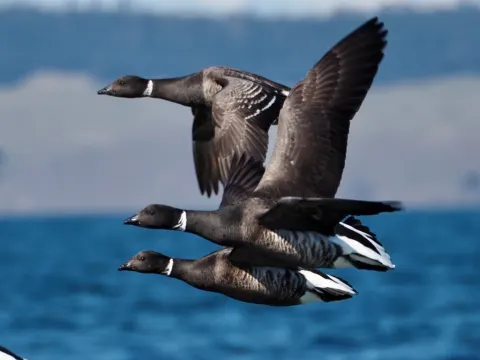
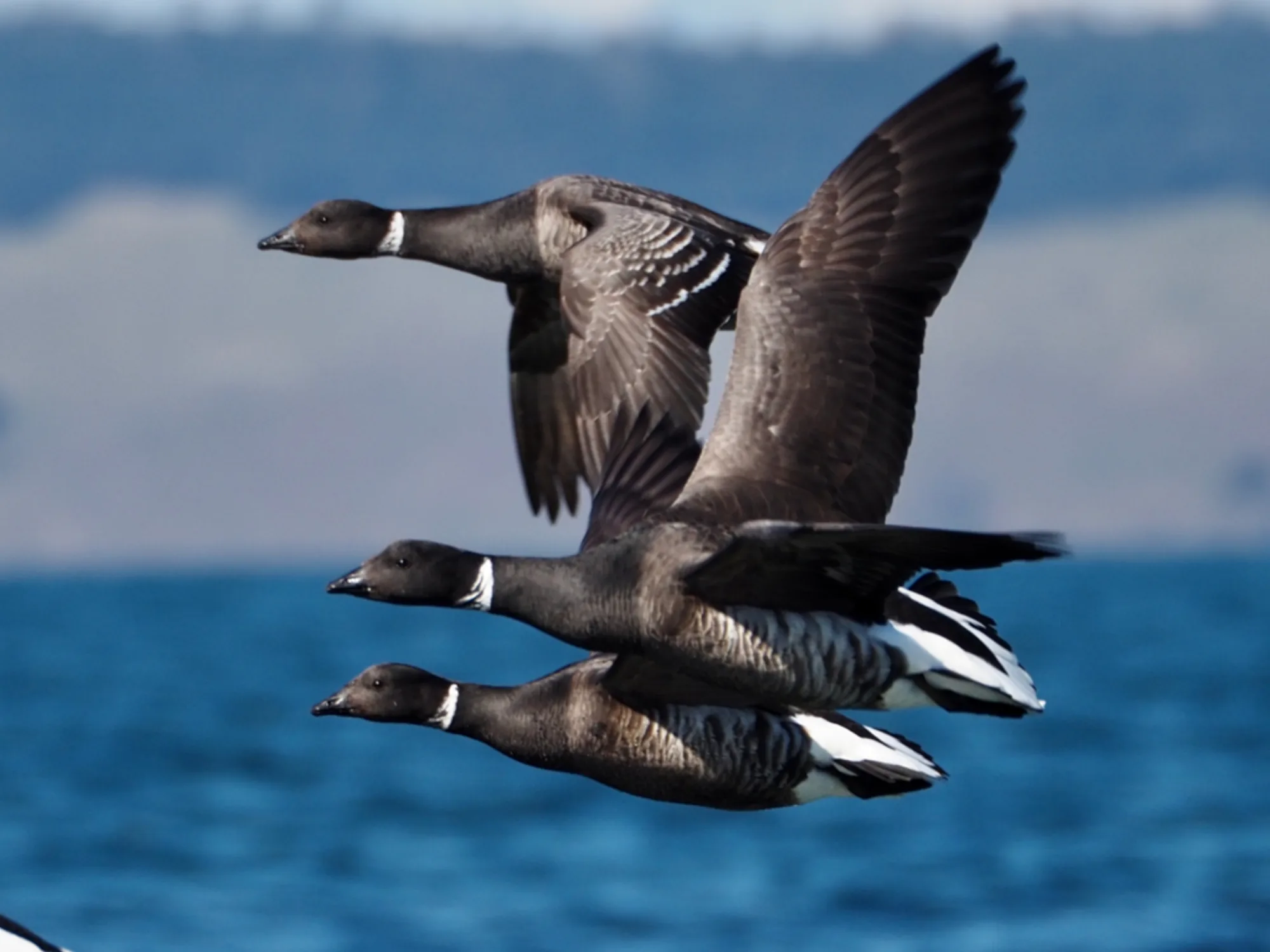
Small and dark, the Brant Goose has a short, stubby bill, a very short black tail and a white patch beneath it. Its head and neck are black, with white patches on the sides of the neck. The dark-bellied form is fairly uniform grey-brown, while the pale-bellied form has a noticeably lighter belly and flanks. The black form has a prominent white flank patch and larger white neck patches that nearly meet as a collar.
These geese breed on high-Arctic tundra and spend winter along temperate coasts. Depending on the form, their breeding grounds extend across parts of Siberia, Canada, Alaska and Greenland. Wintering areas include western Europe, the Atlantic and Pacific coasts of North America, and parts of east Asia. In Ireland, winter visitors can be found at places including Lough Foyle, Strangford Lough and Tralee Bay. On the breeding grounds, they use low-lying, wet coastal tundra for feeding and nesting; the nest is a grass-and-down-lined bowl, often near a small pond.
Brant Geese feed almost entirely on plants, including salt marsh plants, green algae and eelgrass outside the breeding season. They also feed on grass and winter-sown cereals on agricultural land a short distance inland. Pairs stay together for life and defend territories, while families migrate together to their winter range. A clutch contains 3 to 5 eggs, and the young can walk, swim and feed within a day of hatching. Loss of eelgrass has caused severe population declines: a blight in 1931 nearly wiped out the birds on the east coast of North America, while a similar collapse in Ireland in the 1930s also harmed the population.
Written from the English Wikipedia article Brant (goose) (CC BY-SA 4.0).
- Records
- 683,174
- Countries
- 17
- Atlas places
- 1
These are open occurrence records, so they show where people looked for and recorded the Brant Goose as much as where it lives. Cells are up to 25 km across, and every location is generalised to its cell.
Generalised encounter areas, not exact locations. Each shape is a grid cell coloured by how likely the species is there.
- Very likelyUnited States25 km zone · high confidence · 528139 records · updated 80 days ago
- Very likelyUnited Kingdom25 km zone · high confidence · 62826 records · updated 80 days ago
- Very likelyCanada25 km zone · high confidence · 46712 records · updated 80 days ago
- Very likelyFrance25 km zone · high confidence · 11627 records · updated 80 days ago
- Very likelyNetherlands25 km zone · high confidence · 6242 records · updated 80 days ago
- Very likelyIreland25 km zone · high confidence · 6091 records · updated 80 days ago
- Very likelySpain25 km zone · high confidence · 4271 records · updated 80 days ago
- Very likelyDenmark25 km zone · high confidence · 3548 records · updated 80 days ago
- Very likelyBelgium25 km zone · high confidence · 2966 records · updated 80 days ago
- Very likelyNorway25 km zone · high confidence · 2218 records · updated 80 days ago
Conservation status not assessed here yet, so every location is generalised to its grid cell.