Pygmy Three-toed Sloth
Bradypus pygmaeus
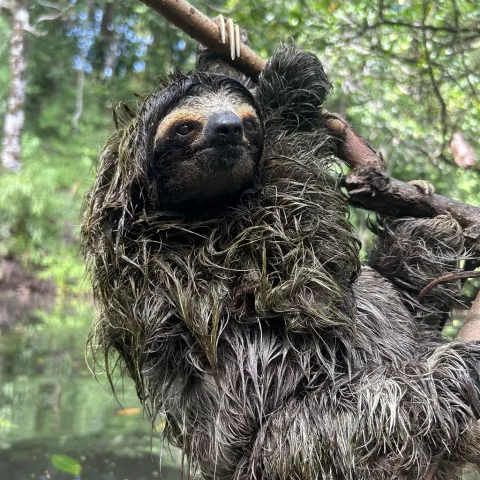
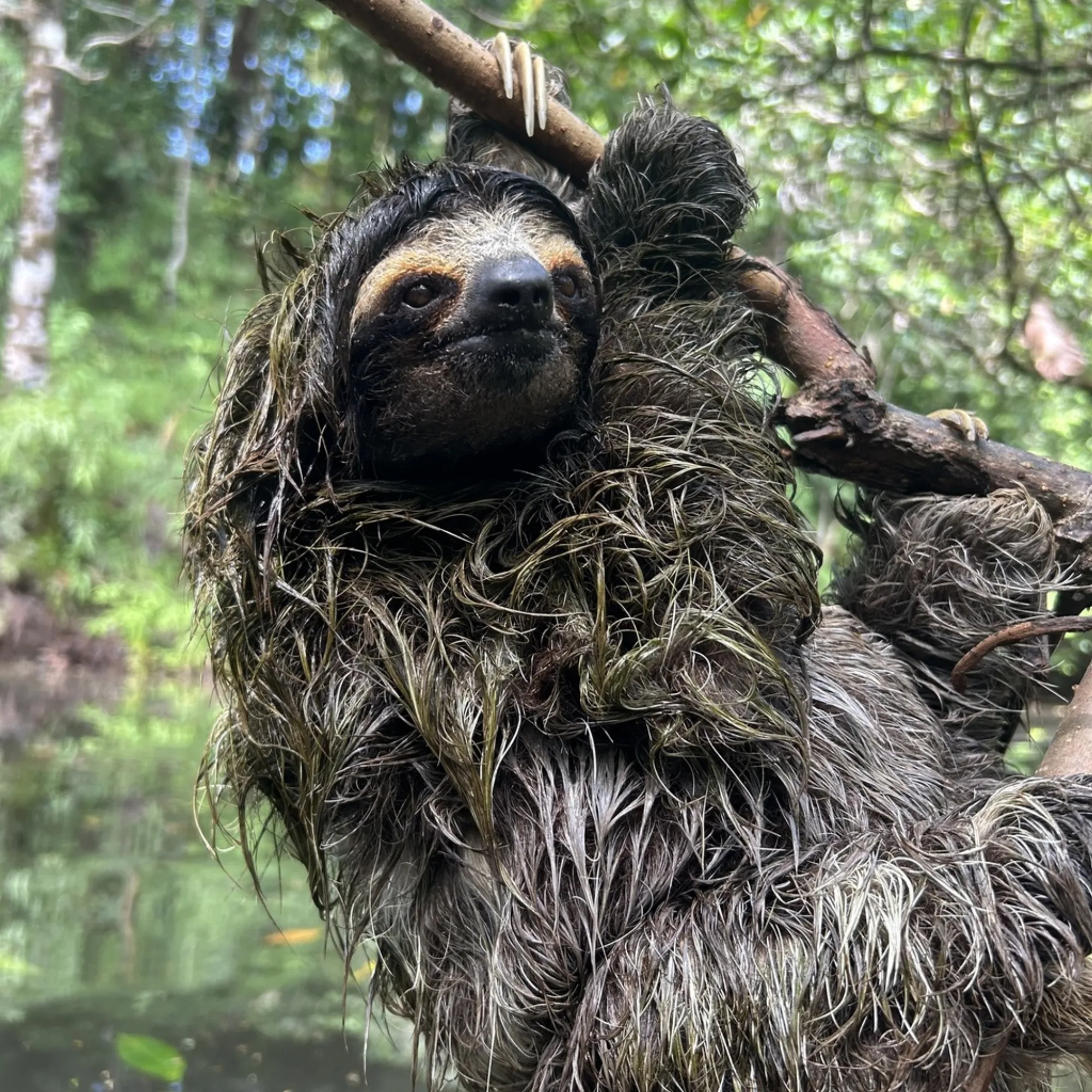
The Pygmy Three-toed Sloth is a small, tree-living animal found only on Isla Escudo de Veraguas, a tiny island off the coast of Panama. It is much smaller than its relatives, weighing between 2.5 and 3.5 kg with a length of 48 to 53 centimetres. This species has tan facial hair and a dark band across its brow. Its long, rough hair forms a hood over its shoulders and crown. Often, the fur looks greenish because it hosts algae, which provides a useful camouflage in the canopy. Each limb ends in three curved claws that allow the sloth to maintain a powerful grip on tree branches.
Living at an extremely slow pace, this sloth might spend 20 hours a day in the trees. It feeds on the leaves of red mangroves, which are coarse and low in nutrients. While it stays high in the canopy for most of the week, it descends once every seven days to defecate on the forest floor. Although once thought to live only in coastal mangroves, many individuals have been found further inland. Estimates of the total population vary, ranging from 500 to 1500, with some counts going as high as 3200.
While predators do not seem to be a major concern, this island specialist faces several other dangers. Human settlement and the harvesting of timber can lead to the degradation of its limited habitat. Disease and natural causes also impact the population. Additionally, recent studies suggest the species has suffered from a decline in genetic variability. Because its entire world is restricted to an area of just 4.3 square kilometres, these threats to its environment are particularly serious.
Written from the English Wikipedia article Pygmy three-toed sloth (CC BY-SA 4.0).
- Records
- 2
- Countries
- 1
- Atlas places
- 0
These are open occurrence records, so they show where people looked for and recorded the Pygmy Three-toed Sloth as much as where it lives. Cells are up to 25 km across, and every location is generalised to its cell.
Generalised encounter areas, not exact locations. Each shape is a grid cell coloured by how likely the species is there.
- Very likelyPanama50 km zone · medium confidence · 2 records · updated 4 days ago