Common Lancehead
Bothrops atrox
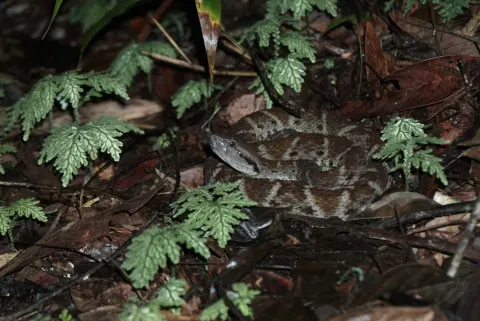
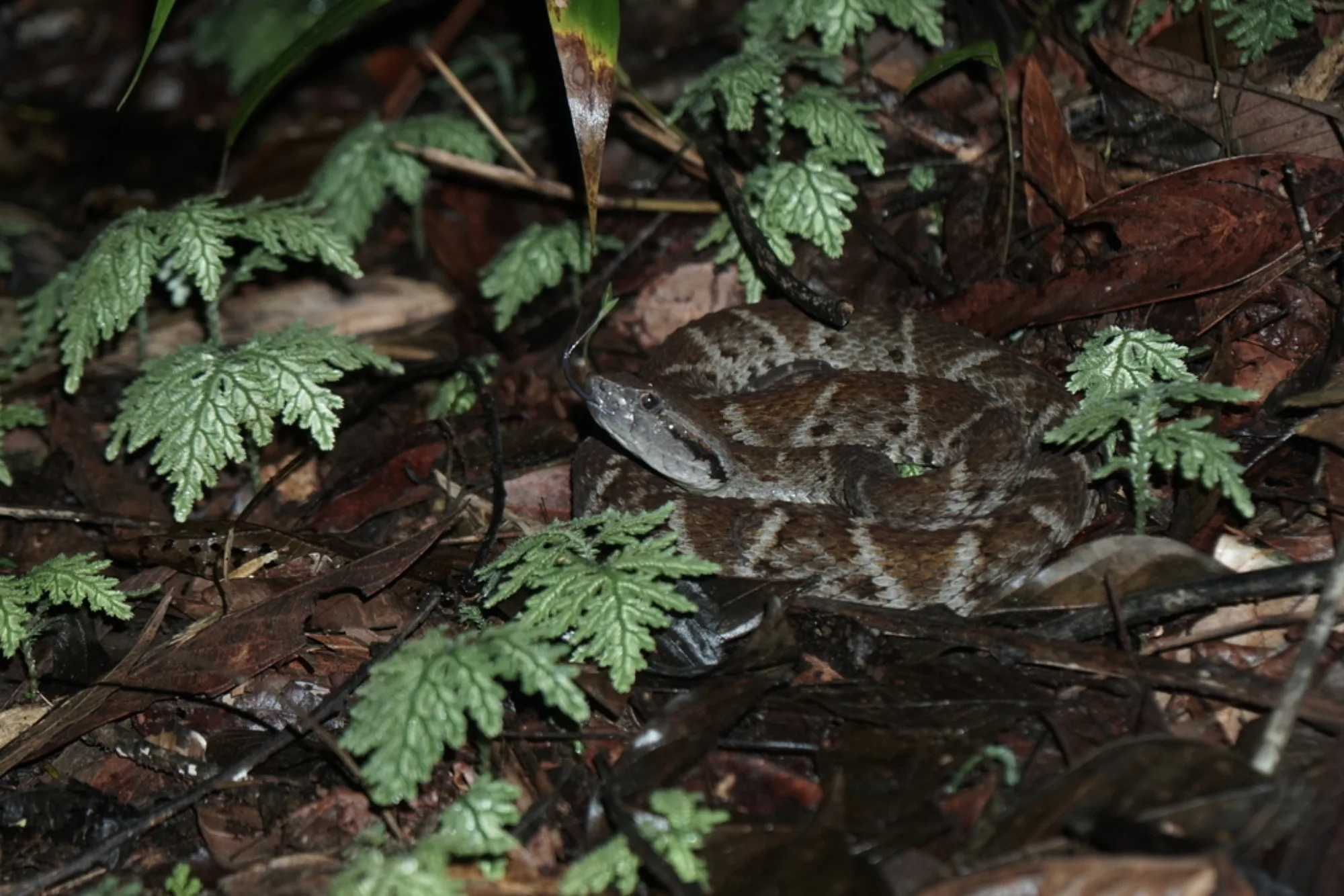
Across the tropical lowlands east of the Andes, the Common Lancehead moves through a range that includes northern South America, Panama and Trinidad. This highly venomous pit viper is a moderately heavy-bodied snake, with adults usually measuring 75 to 125 cm in total length. Its colour can be olive, brown, tan, grey or yellow, and occasionally rusty. Rectangular or trapezoidal blotches typically run along the body, sometimes joining across the back to form bands. These markings vary in contrast and can be almost absent, while a stripe usually runs from behind the eye towards the mouth.
In Trinidad, it favours wet forest from sea level to 940 m. It generally stays on the ground, but swims well and can climb trees to reach prey. Usually active at night, it can also forage during the day, and may lie camouflaged for hours. The snake is easily agitated and can strike at high speed. Small mammals and birds make up much of its diet, alongside a varied menu that includes frogs, lizards, fish and tarantulas. After striking larger prey, it releases the animal and follows its scent.
Adults breed throughout the year, and females give birth to live young. In equatorial regions, gestation lasts about three to four months and a litter averages 60 young. Newborns are about 30 cm long, with brighter colours than adults and yellow or beige tails. Rainforest destruction is mentioned across its range, although the account does not identify a specific threat to the snake itself.
Written from the English Wikipedia article Bothrops atrox (CC BY-SA 4.0).
- Records
- 340
- Countries
- 10
- Atlas places
- 6
These are open occurrence records, so they show where people looked for and recorded the Common Lancehead as much as where it lives. Cells are up to 25 km across, and every location is generalised to its cell.
Generalised encounter areas, not exact locations. Each shape is a grid cell coloured by how likely the species is there.
- Very likelyPeru25 km zone · medium confidence · 93 records · updated 80 days ago
- Very likelyBrazil25 km zone · medium confidence · 90 records · updated 80 days ago
- Very likelyTrinidad & Tobago25 km zone · medium confidence · 33 records · updated 80 days ago
- Very likelyFrench Guiana25 km zone · medium confidence · 28 records · updated 80 days ago
- Very likelyColombia25 km zone · medium confidence · 25 records · updated 80 days ago
- Very likelyGuyana25 km zone · medium confidence · 22 records · updated 80 days ago
- Very likelySuriname25 km zone · medium confidence · 20 records · updated 80 days ago
- Very likelyEcuador25 km zone · medium confidence · 17 records · updated 80 days ago
- Very likelyBolivia25 km zone · medium confidence · 12 records · updated 80 days ago
- UncommonVenezuela25 km zone · low confidence · 0 records · updated 80 days ago
Conservation status not assessed here yet, so every location is generalised to its grid cell.