Eyelash Viper
Bothriechis schlegelii
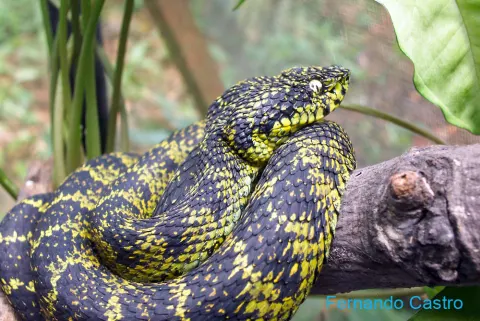
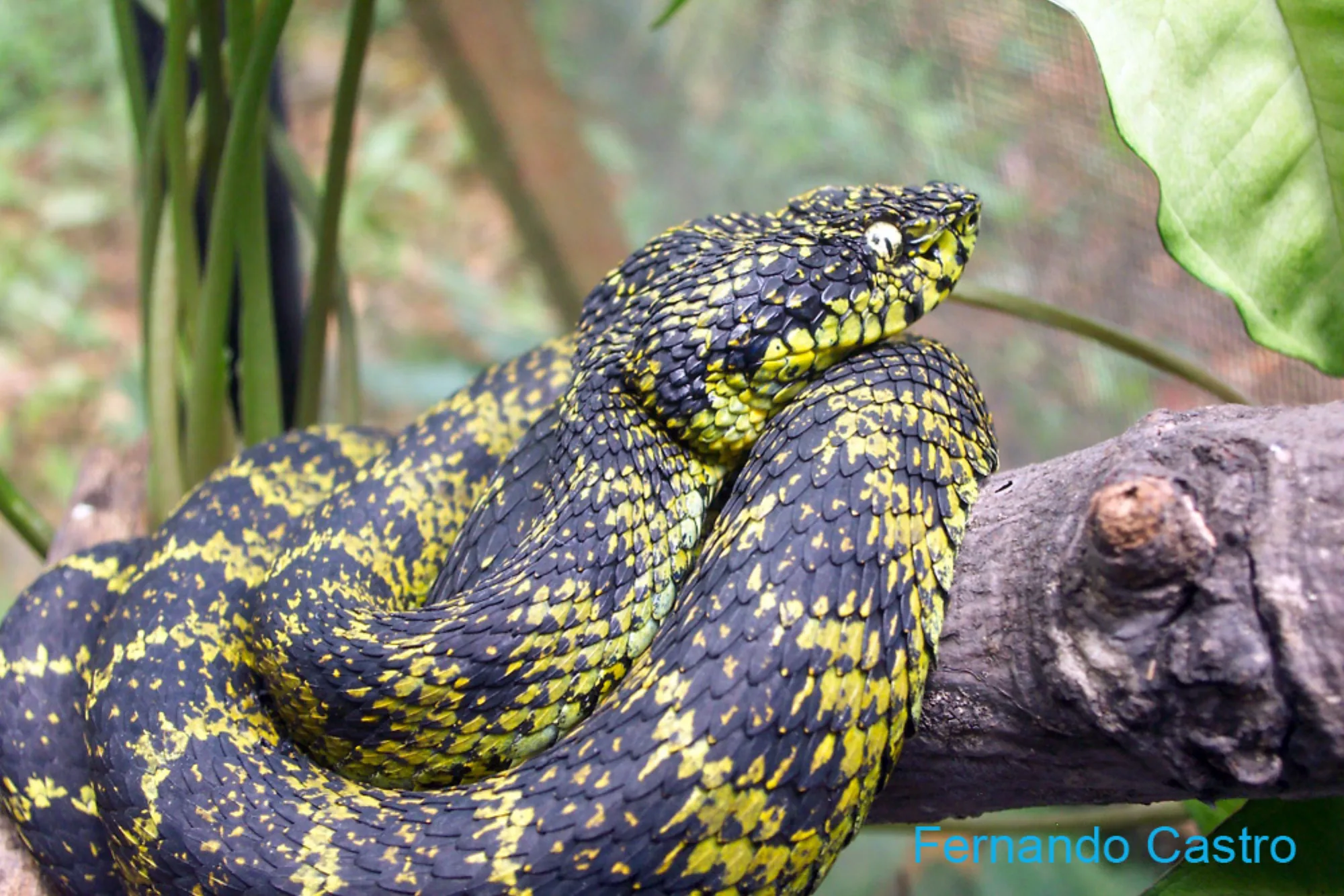
Above its eyes, the Eyelash Viper carries the raised scales that give it its name, resembling a fringe of lashes. This relatively small pit viper has a wide, triangular head, vertical pupils and a body covered largely in raised scales. Adults measure 55 to 82 cm; females tend to be longer, and their lengths vary more than those of males. Its colours vary widely, and the eye scales may help break up its outline among the foliage where it hides.
Native to Colombia, the snake occurs mainly in highland regions. It spends almost all its life in trees, using a strong tail to hold on to branches. It often rests in a tight coil during the day, then becomes active after dark and waits for small animals to pass. Its prey includes rodents, bats, frogs, hummingbirds and lizards, and occasionally fish. Some individuals return to chosen ambush sites each year around the spring bird migration. Young vipers in particular may wriggle their tails like worms to draw frogs or lizards within striking distance. The snake is not known for aggression towards people and is likely to avoid larger creatures, though it will strike if repeatedly harassed.
In warm environments, breeding takes place throughout the year. The eggs hatch inside the female after roughly six months, and a typical brood contains 2 to 20 live young. The young measure 15 to 20 cm and look much like the adults. Deforestation for timber, agriculture and urban growth threatens the snake's habitat, although it can also live in secondary forests and on coffee and banana plantations.
Written from the English Wikipedia article Bothriechis schlegelii (CC BY-SA 4.0).
- Records
- 54
- Countries
- 4
No atlas park has a record of the Eyelash Viper in or around it yet.
These are open occurrence records, so they show where people looked for and recorded the Eyelash Viper as much as where it lives. Cells are up to 25 km across, and every location is generalised to its cell.
Generalised encounter areas, not exact locations. Each shape is a grid cell coloured by how likely the species is there.
- Very likelyColombia25 km zone · medium confidence · 16 records · updated 80 days ago
- Very likelyHonduras25 km zone · medium confidence · 16 records · updated 80 days ago
- Very likelyCosta Rica25 km zone · medium confidence · 13 records · updated 80 days ago
- Very likelyPanama25 km zone · medium confidence · 9 records · updated 80 days ago
Conservation status not assessed here yet, so every location is generalised to its grid cell.