Eurasian Bittern
Botaurus stellaris
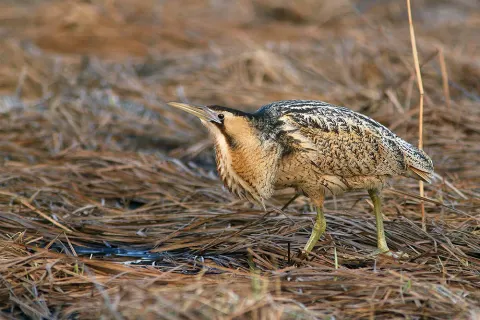
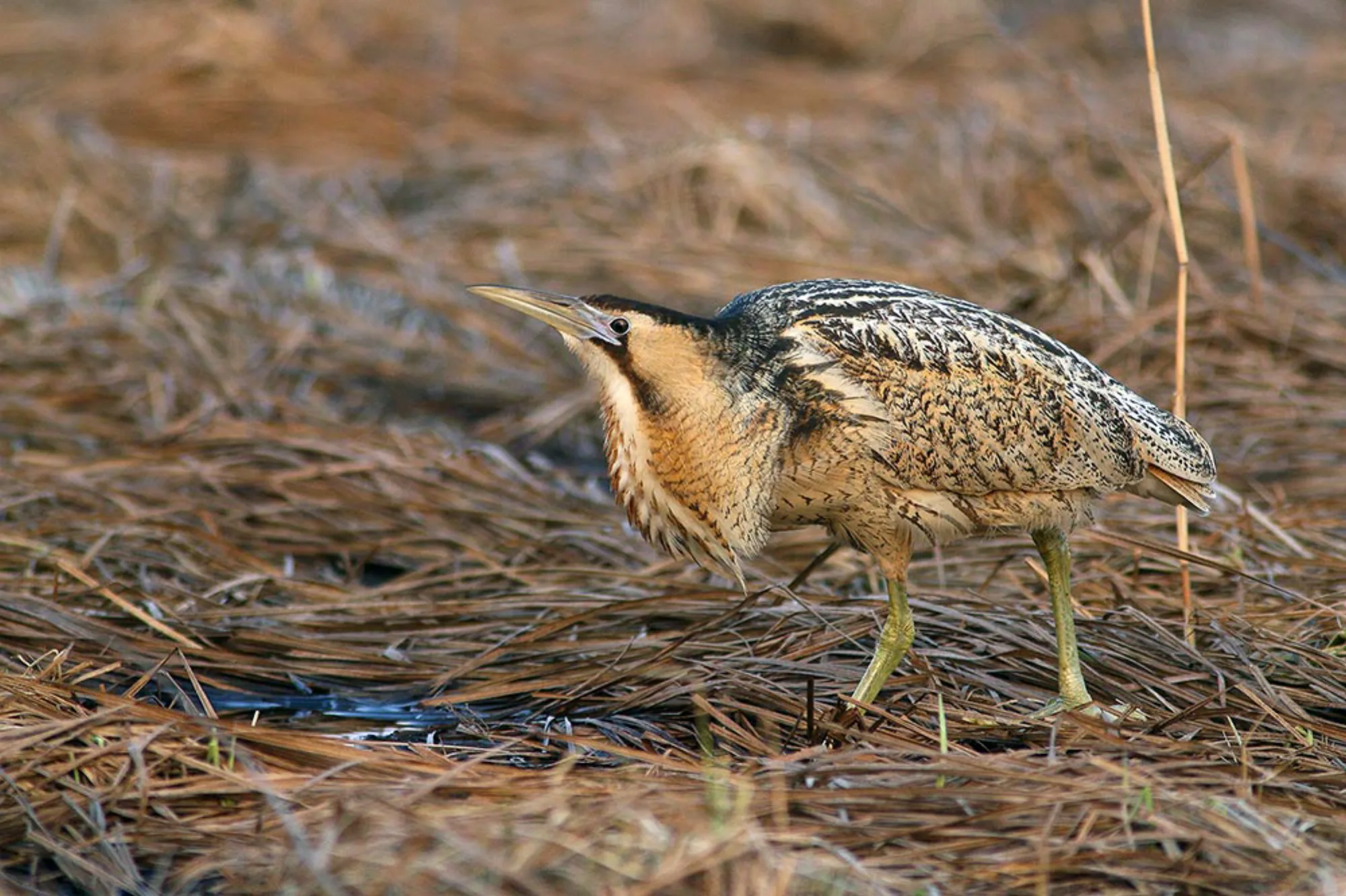
Hidden among reeds, the Eurasian Bittern is a thickset heron with pale buffy-brown plumage patterned with dark streaks and bars. It measures 69 to 81 cm long, with broad, rounded wings visible in flight. More often heard than seen, the male gives a deep booming call in the breeding season, audible up to five kilometres away on a calm night. Usually solitary, the bird moves slowly through vegetation or stands still above water, watching for prey. If disturbed, it often freezes with its bill pointing upwards, blending into the reeds.
Its range stretches across parts of Europe, North Africa and Asia, with a separate population in southern Africa. Reed beds and swamps are favoured habitats, along with lakes, lagoons and slow rivers edged by thick vegetation. Some populations remain in the same areas year-round, while many northern birds move to warmer regions. Outside the breeding season, they also visit places including rice fields, flooded ground and marshes. Most active at dawn and dusk, bitterns hunt in shallow water along reed margins, taking fish, small mammals, amphibians, insects and other prey.
The female builds a nest among standing reeds, using reeds, sedges and grass stalks to make a platform close to water. She incubates four to six eggs and raises the chicks alone; they leave the nest after about two weeks and can swim among the reeds. Destruction of reed beds, along with drainage and disturbance of wetlands, threatens the species. The southern African population has declined sharply as wetlands have degraded, while some local populations elsewhere are also at risk.
Written from the English Wikipedia article Eurasian bittern (CC BY-SA 4.0).
- Records
- 74,283
- Countries
- 33
No atlas park has a record of the Eurasian Bittern in or around it yet.
These are open occurrence records, so they show where people looked for and recorded the Eurasian Bittern as much as where it lives. Cells are up to 25 km across, and every location is generalised to its cell.
Generalised encounter areas, not exact locations. Each shape is a grid cell coloured by how likely the species is there.
- Very likelyUnited Kingdom25 km zone · high confidence · 23947 records · updated 80 days ago
- Very likelyBelgium25 km zone · high confidence · 14480 records · updated 80 days ago
- Very likelyDenmark25 km zone · high confidence · 6508 records · updated 80 days ago
- Very likelyFrance25 km zone · high confidence · 5519 records · updated 80 days ago
- Very likelyNetherlands25 km zone · high confidence · 3867 records · updated 80 days ago
- Very likelyPoland25 km zone · high confidence · 3666 records · updated 80 days ago
- Very likelyFinland25 km zone · high confidence · 3390 records · updated 80 days ago
- Very likelyChina25 km zone · high confidence · 1928 records · updated 80 days ago
- Very likelySweden25 km zone · high confidence · 1631 records · updated 80 days ago
- Very likelySpain25 km zone · high confidence · 1334 records · updated 80 days ago
Conservation status not assessed here yet, so every location is generalised to its grid cell.