American Bittern
Botaurus lentiginosus
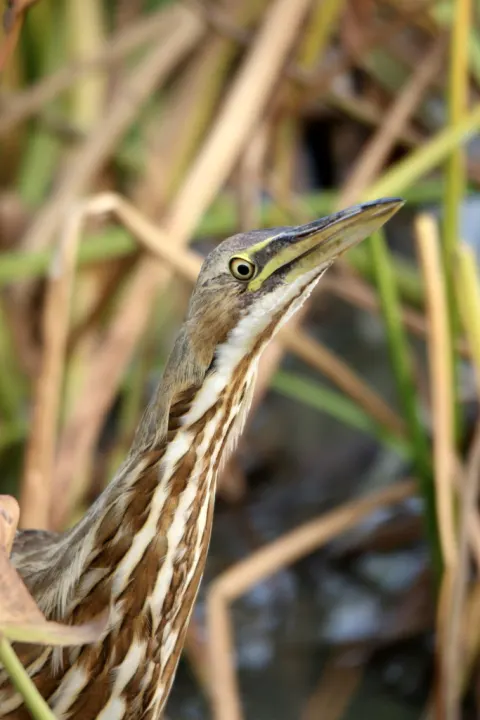
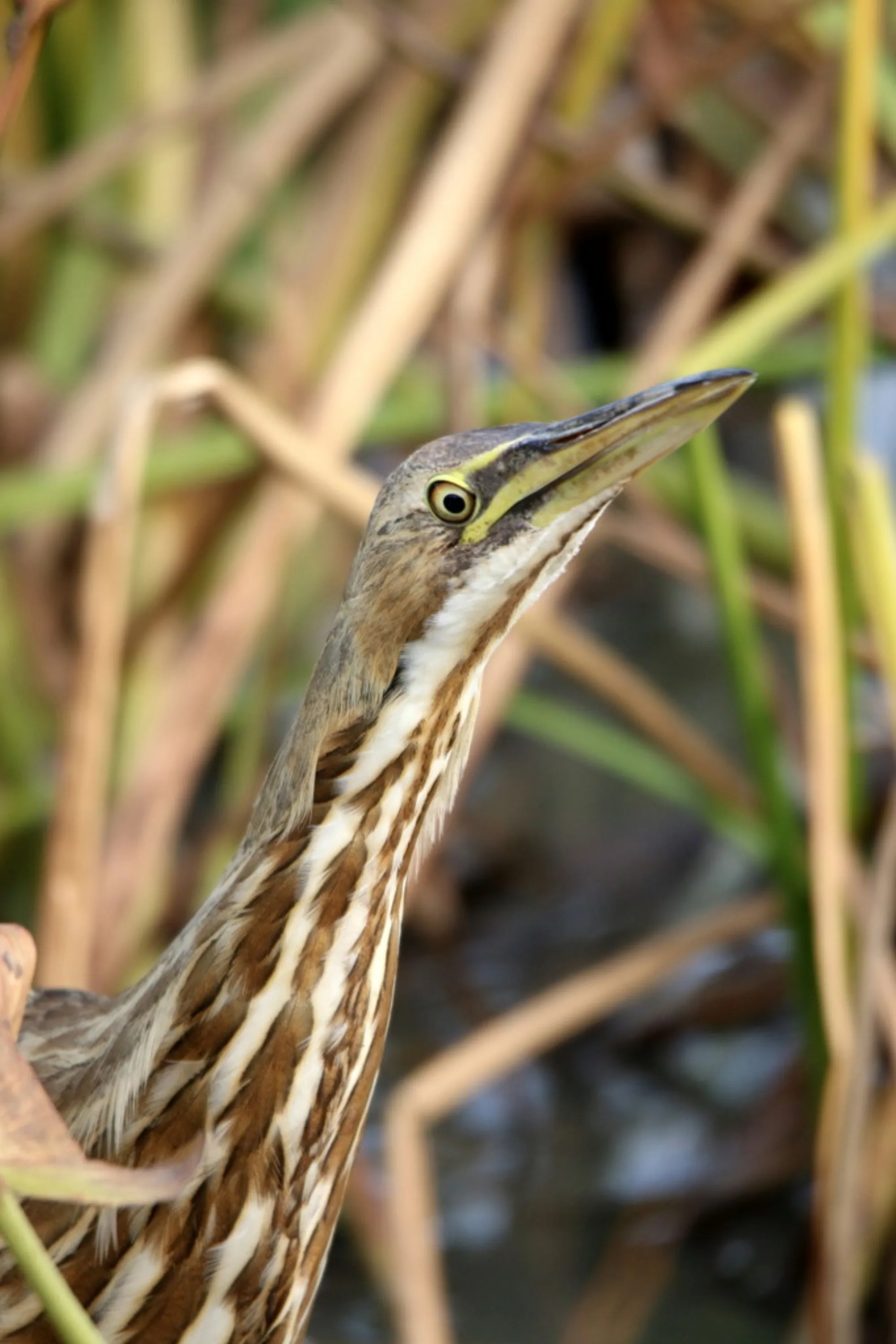
A loud, booming call can give away an American Bittern long before the bird itself comes into view. This large, chunky member of the heron family is brown and well camouflaged, with speckled plumage and a striped effect on its breast and belly. Look for a chestnut-brown crown, a dark patch along the side of the neck, and a long yellowish-green bill. It measures 58 to 85 cm in length, with a wingspan of 92 to 115 cm. Usually solitary and difficult to observe, it may freeze with its bill pointing upwards when it senses it has been seen.
American Bitterns breed across southern Canada and much of the United States, and possibly in central Mexico. In autumn they migrate south, spending the winter around the Gulf Coast, in Florida's Everglades, the Caribbean and Mexico. They favour bogs, marshes and densely vegetated edges of shallow lakes and ponds, in fresh, brackish or saline water. They also sometimes feed in open wet meadows and pastures. Most active at dusk and mainly nocturnal, a bittern hunts by walking stealthily through shallow water and vegetation, or waits motionless for prey. Fish make up most of its diet, alongside amphibians, reptiles, small mammals, crustaceans and insects.
In marsh vegetation, the female builds a rough nest above the water while the male guards it. She incubates up to about six eggs, and the chicks leave the nest at about two weeks, becoming fully fledged at six to seven weeks. Numbers are declining in many parts of the range as habitat is lost, particularly in the south, where chemical contamination and human development reduce suitable habitat.
Written from the English Wikipedia article American bittern (CC BY-SA 4.0).
- Records
- 224,785
- Countries
- 2
- Atlas places
- 3
These are open occurrence records, so they show where people looked for and recorded the American Bittern as much as where it lives. Cells are up to 25 km across, and every location is generalised to its cell.
Generalised encounter areas, not exact locations. Each shape is a grid cell coloured by how likely the species is there.
- Very likelyUnited States25 km zone · high confidence · 156144 records · updated 80 days ago
- Very likelyCanada25 km zone · high confidence · 68641 records · updated 80 days ago
Conservation status not assessed here yet, so every location is generalised to its grid cell.