Nilgai
Boselaphus tragocamelus
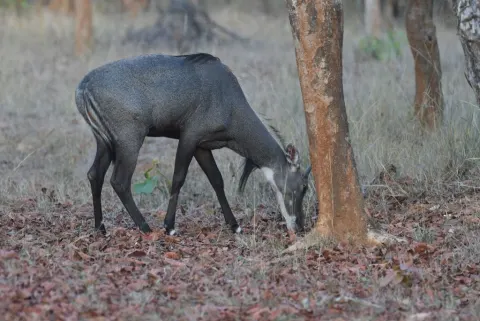
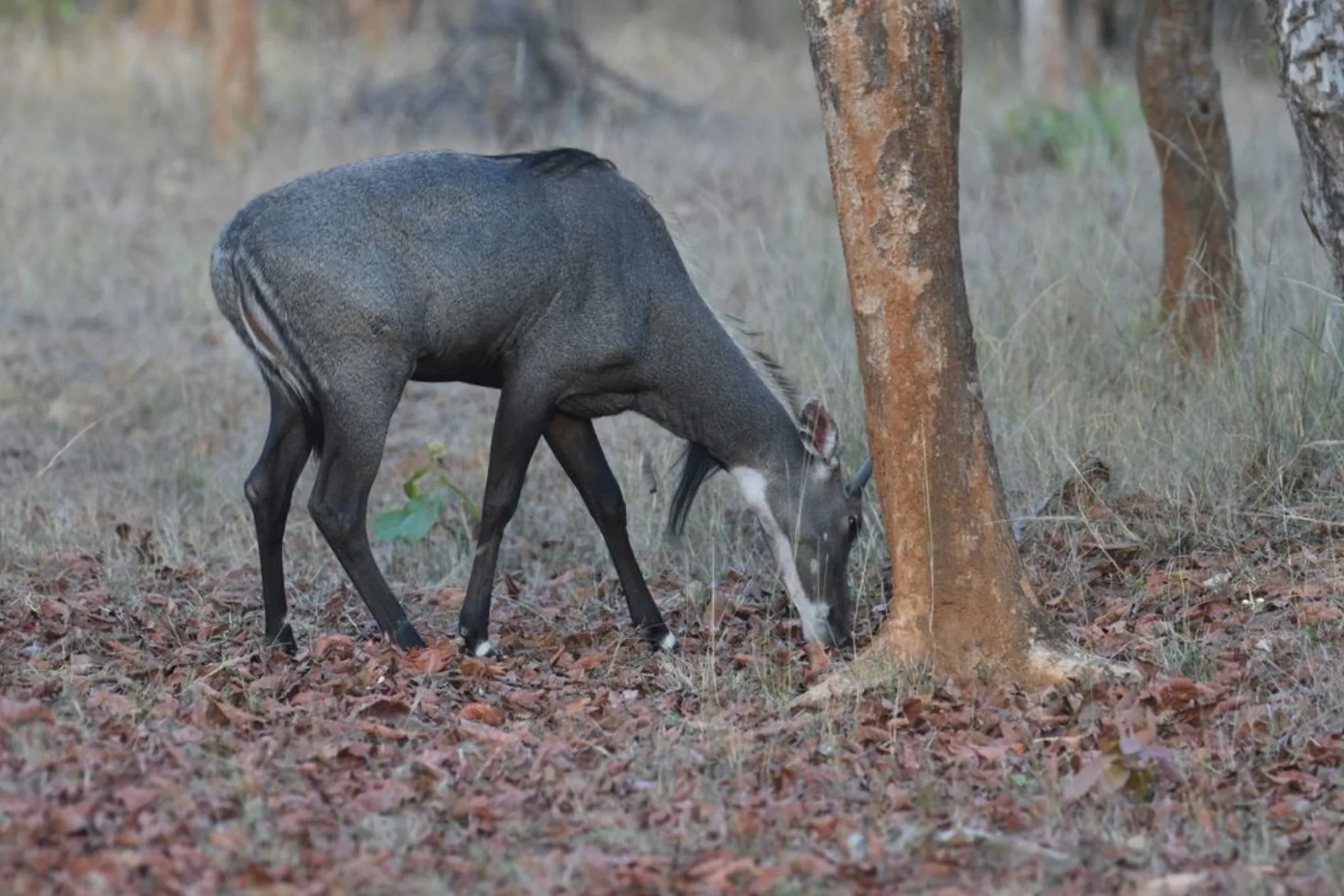
Asia’s largest antelope, the Nilgai cuts a sturdy figure on thin legs, with a sloping back and a deep neck. Look for the white throat patch, white facial spots and short crest of hair along the neck. Females and young are orange to tawny, while adult males are typically bluish grey. Males carry straight horns, and the occasional female has them too. The species is widespread across northern India, with major populations also found in Nepal and border areas of Pakistan. It favours grassy plains and scrub forests with short bushes and scattered trees, and often ventures onto agricultural land. Dense woodland is seldom its choice.
Active mainly during the day, Nilgai feed at several times from dawn through the evening. They eat grasses and herbs, as well as woody plants in India’s dry tropical forests. They can go for long periods without water, although they may leave their territory if its water sources dry up. Groups are usually small, and females and young generally mix little with males outside the mating season. A female may be seen with young calves, while males also form groups of their own. Breeding peaks vary by location, and after eight to nine months of gestation, a female gives birth to one calf, twins or occasionally triplets. Calves remain hidden for their first few weeks.
In India, tigers, wolves, striped hyenas and leopards prey on Nilgai, while dholes generally target juveniles. Hunting, deforestation and habitat degradation caused steep declines in Nepal and Pakistan during the 20th century. In parts of India, crop damage has led to demands for culling, and authorities have allowed the animals to be killed in some areas.
Written from the English Wikipedia article Nilgai (CC BY-SA 4.0).
- Records
- 384
- Countries
- 4
- Atlas places
- 6
These are open occurrence records, so they show where people looked for and recorded the Nilgai as much as where it lives. Cells are up to 25 km across, and every location is generalised to its cell.
Generalised encounter areas, not exact locations. Each shape is a grid cell coloured by how likely the species is there.
- Very likelyIndia25 km zone · medium confidence · 313 records · updated 80 days ago
- Very likelyUnited States25 km zone · medium confidence · 66 records · updated 80 days ago
- LikelyGermany25 km zone · medium confidence · 3 records · updated 80 days ago
- PossibleNepal25 km zone · medium confidence · 2 records · updated 80 days ago
Conservation status not assessed here yet, so every location is generalised to its grid cell.