Kouprey
Bos sauveli
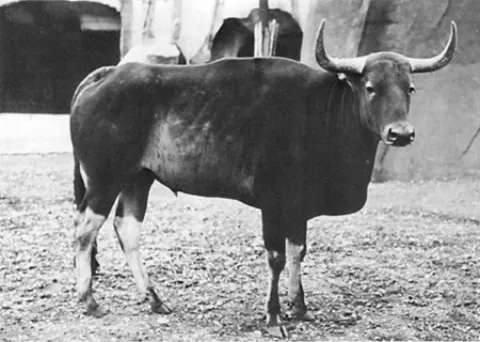
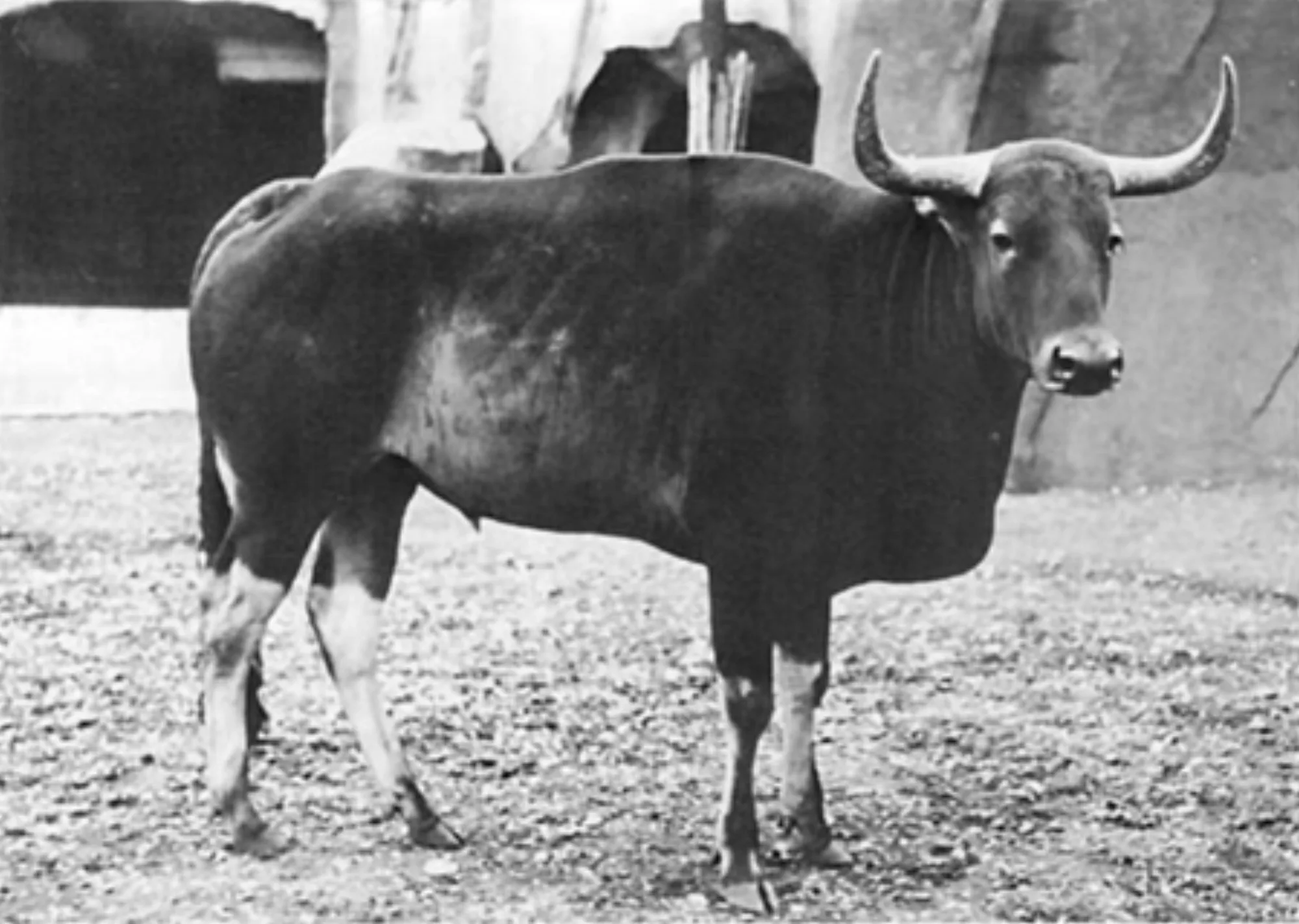
With a light build and sweeping horns, the Kouprey is a wild ox from the forests of Southeast Asia. It stands 1.7 to 1.9 m at the shoulder and has white lower legs marked by a dark stripe down the front of each foreleg. Cows become grey or brownish grey as they mature, while bulls grow darker and can eventually become entirely dark brown. A bull's horns spread outwards before curving forward and up, often fraying at the tips; a cow's horns spiral upwards in a lyre-like shape. The last confirmed sighting of a wild Kouprey was in 1969, and the species may be extinct.
Its former range extended from eastern Thailand and southern Laos to northern Cambodia and the western edge of Vietnam. Its habitat was a mixture of open grassland and forest, with grassy clearings, waterholes and salt licks. A mature cow leads the herd, which includes females and calves and sometimes bulls. Nervous and quick to flee when approached, Kouprey feed in the early morning and late afternoon, retreating into denser forest around midday. Their recorded food includes grasses and some browse, with mineral soil as a supplement. Each cow has one calf, born from December to February, and stays away from the herd with it for its first month.
Hunting for meat, horns and skulls has placed pressure on the species, as has trophy hunting. War and political conflict have contributed to its decline through habitat destruction and poaching, while disrupting conservation and research. Snares remain a potential danger to any Kouprey still surviving.
Written from the English Wikipedia article Kouprey (CC BY-SA 4.0).
No atlas park has a record of the Kouprey in or around it yet.
These are open occurrence records, so they show where people looked for and recorded the Kouprey as much as where it lives. Cells are up to 25 km across, and every location is generalised to its cell.
No encounter zones yet
Where and when you can expect to see Kouprey is calculated from observation density. No zones have been computed for this species yet.