Yak
Bos mutus
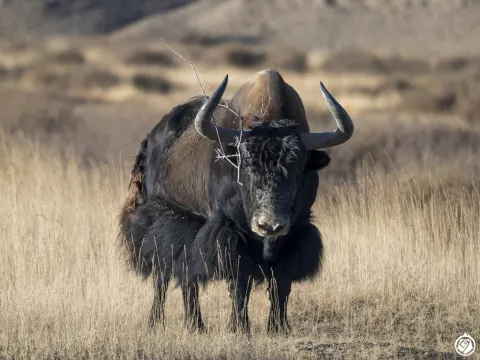
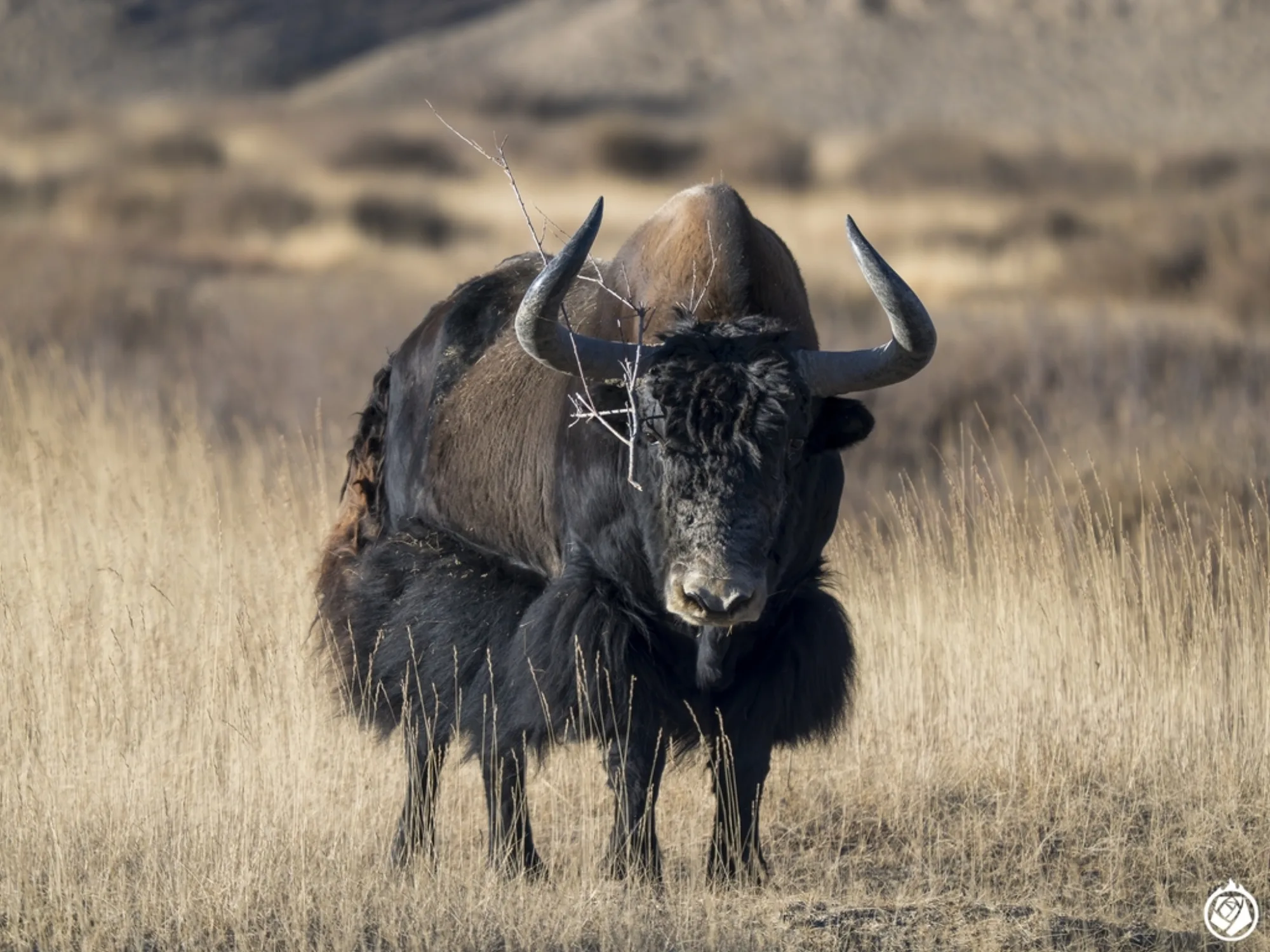
Built for cold uplands, the wild Yak (Bos mutus) is a large bovine with a bulky frame, sturdy legs and long, shaggy hair. Its coat is usually black or dark brown, with a grey muzzle and a long, horse-like tail. In males, the thick undercoat can form a skirt that reaches the ground. Adults stand about 160 to 205 cm at the shoulder, and females are considerably smaller than males. Golden-brown wild yaks have also been reported.
Today, wild yaks occur mainly in northern Tibet and western Qinghai, with their range reaching southernmost Xinjiang and Ladakh in India. They were rediscovered in Humla, Nepal, in 2014. Their habitat is mostly treeless mountain and plateau country between 3,000 and 5,500 m, and they are most common on alpine tundra with a thick cover of grasses and sedges. These plants make up much of their diet, supplemented by smaller amounts of herbs, shrubs and mosses; they have also been reported eating lichen.
Wild yaks live in herds that can number several hundred, though many groups are much smaller. Most herd members are females and their young, while other males may live alone or in small groups. Groups move to lower altitudes in winter, and yaks generally avoid people, sometimes fleeing long distances when approached. A single calf is born in spring after summer mating, and females typically give birth every other year. Poaching is the most serious threat, particularly for the more solitary males, while disturbance by livestock and interbreeding with them are also common.
Written from the English Wikipedia article Wild yak (CC BY-SA 4.0).
- Records
- 0
- Countries
- 1
No atlas park has a record of the Yak in or around it yet.
These are open occurrence records, so they show where people looked for and recorded the Yak as much as where it lives. Cells are up to 25 km across, and every location is generalised to its cell.
Generalised encounter areas, not exact locations. Each shape is a grid cell coloured by how likely the species is there.
- Very likelyChina25 km zone · low confidence · 0 records · updated 80 days ago
Conservation status not assessed here yet, so every location is generalised to its grid cell.