Banteng
Bos javanicus
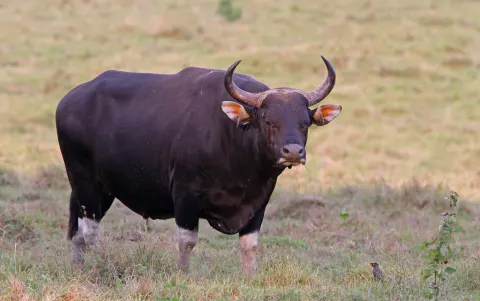
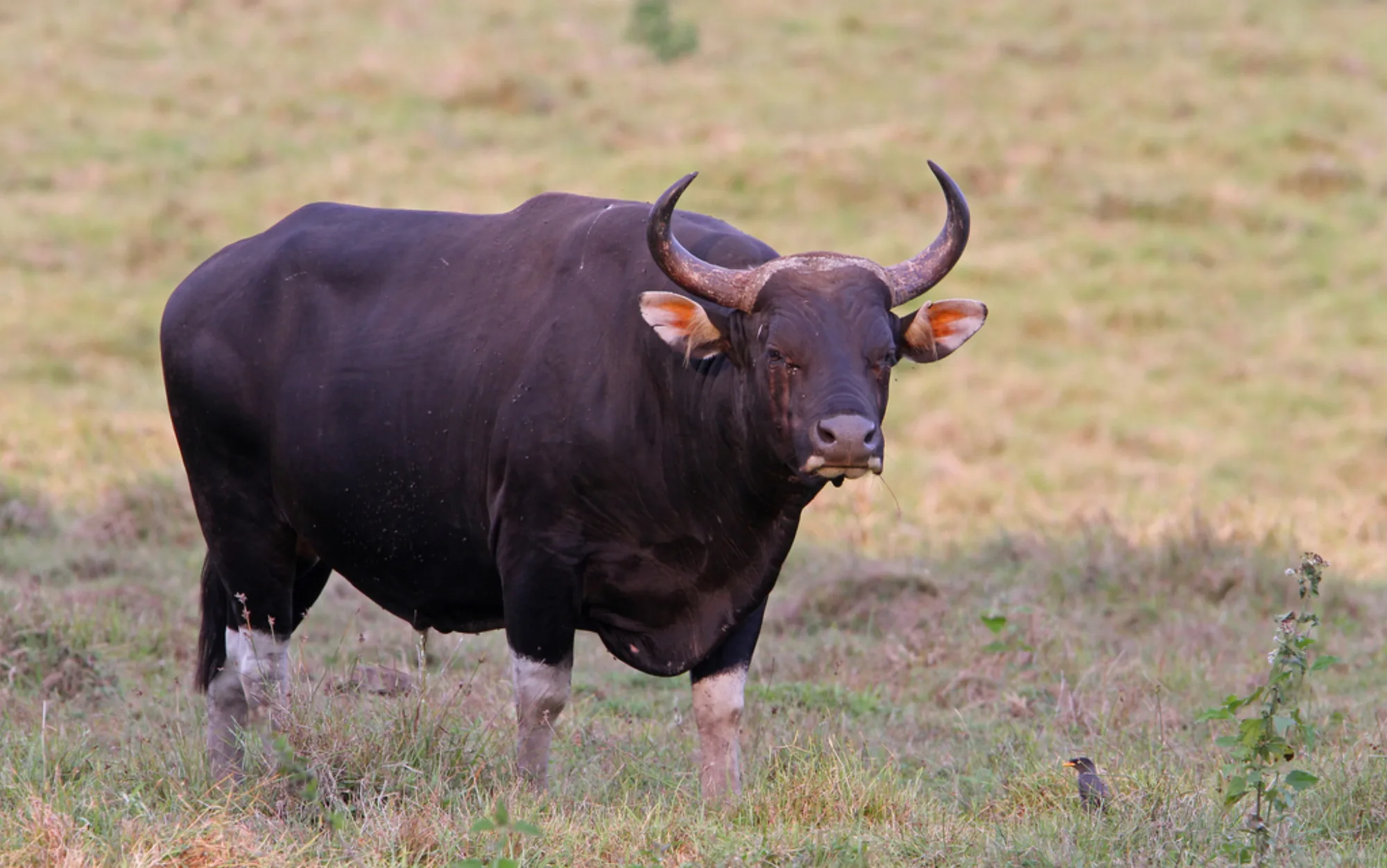
Across Southeast Asia, the Banteng is a wild bovine with a pale rump patch and white lower legs. Bulls are generally dark brown to black and more heavily built than cows, which are usually pale brown or chestnut red. Both sexes have horns: those of cows curve tightly inward, while a bull's sweep upwards and slightly forwards. Females and young also have a dark line along the back.
The largest wild populations occur in Java and Cambodia, and possibly in Borneo, Viet Nam and Thailand. Banteng use a range of landscapes, from open deciduous and semi-evergreen forests to grasslands and abandoned farms. Timid and alert, they can be difficult to approach, and retreat into dense forest to rest and shelter. They are active by day and night, with more night-time activity where people are often present. Herds usually contain a single bull alongside cows and young, although older males form small groups of their own. At night, banteng forage in open areas, eating grasses, shoots, leaves, flowers and fruit, with breaks to rest and ruminate. They drink regularly when water is available, but can go without it for several days during drought. A single calf is born after a gestation of nearly 285 days, and young may suckle for as long as 16 months.
Wild banteng face poaching for their horns and meat, as well as for sport and traditional remedies, alongside habitat loss, fragmentation and disease. Many populations are small and isolated, while wild banteng are now largely confined to protected areas.
Written from the English Wikipedia article Banteng (CC BY-SA 4.0).
- Records
- 1,084
- Countries
- 2
No atlas park has a record of the Banteng in or around it yet.
These are open occurrence records, so they show where people looked for and recorded the Banteng as much as where it lives. Cells are up to 25 km across, and every location is generalised to its cell.
Generalised encounter areas, not exact locations. Each shape is a grid cell coloured by how likely the species is there.
- Very likelyAustralia25 km zone · high confidence · 1084 records · updated 80 days ago
- PossibleCambodia25 km zone · low confidence · 0 records · updated 80 days ago
Conservation status not assessed here yet, so every location is generalised to its grid cell.