Yak
Bos grunniens
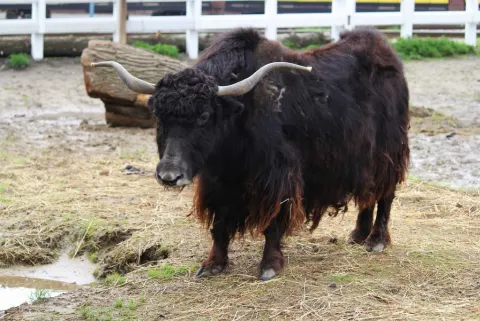
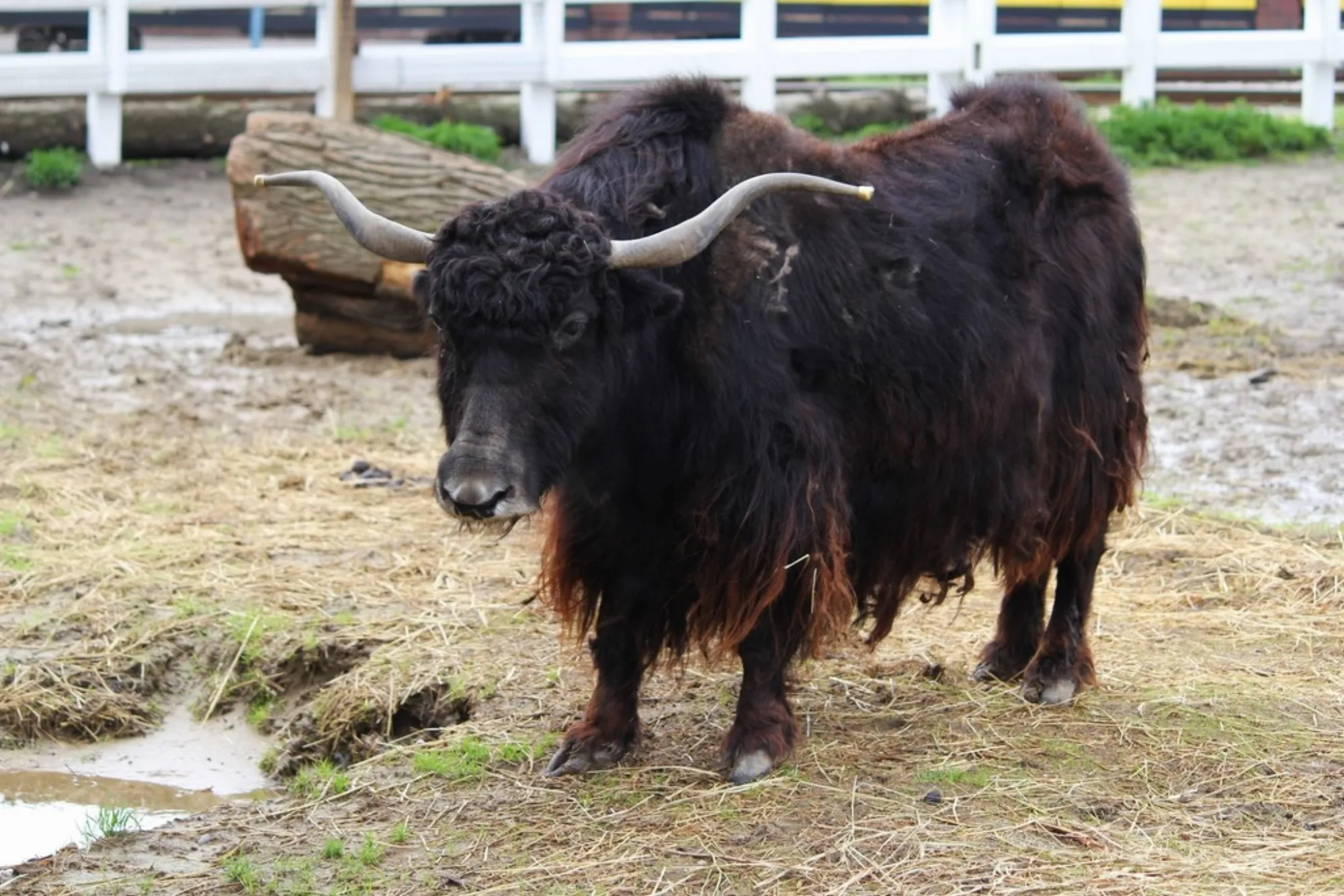
Shaggy hair hanging below the belly and a pronounced shoulder hump give the Yak (Bos grunniens) its distinctive outline. This heavily built domesticated Asian cattle species has sturdy legs, small ears and smooth, generally dark horns. Its long coat has a dense woolly underlayer that helps insulate it from the cold, and in bulls the hair can form a skirt reaching the ground. Domestic animals come in a range of colours, including white, grey and brown, sometimes with rusty brown and cream patches. Both sexes grunt and squeak, sounds a traveller might hear from a herd.
Yaks occur across the Himalayan region, the Tibetan Plateau, Tajikistan and the Pamir Mountains, and northwards to Mongolia and Siberia. They are adapted to high altitudes, including the cold of the high, treeless Tibetan Plateau, where their dried droppings are an important fuel. Farmers and traders use them to carry goods across mountain passes, and yaks also accompany climbing and trekking expeditions. They graze on plants, while their wild ancestors fed mainly on grasses and sedges, alongside some herbs and dwarf shrubs. Away from the summer breeding season, many bulls roam in small groups apart from the larger herds; as the season approaches, they may fight for dominance.
A cow gives birth to a single calf in a secluded place, usually between May and June. Within roughly ten minutes of birth, the calf is able to walk, and soon joins the herd again with its mother. Females typically give birth every other year, though a good food supply can allow more frequent births. Heat and a lack of grazing can put yaks at risk: they are prone to heat exhaustion above about 15 °C, and cannot survive a journey through barren country without access to grass.
Written from the English Wikipedia article Yak (CC BY-SA 4.0).
- Records
- 991
- Countries
- 7
- Atlas places
- 4
These are open occurrence records, so they show where people looked for and recorded the Yak as much as where it lives. Cells are up to 25 km across, and every location is generalised to its cell.
Generalised encounter areas, not exact locations. Each shape is a grid cell coloured by how likely the species is there.
- Very likelyChina25 km zone · medium confidence · 851 records · updated 80 days ago
- LikelyRussia25 km zone · medium confidence · 75 records · updated 80 days ago
- PossibleMongolia25 km zone · medium confidence · 30 records · updated 80 days ago
- PossibleIndia25 km zone · medium confidence · 22 records · updated 80 days ago
- PossibleNepal25 km zone · medium confidence · 13 records · updated 80 days ago
- UncommonKazakhstan25 km zone · low confidence · 0 records · updated 80 days ago
- RareBhutan25 km zone · low confidence · 0 records · updated 80 days ago
Conservation status not assessed here yet, so every location is generalised to its grid cell.