Gaur
Bos gaurus
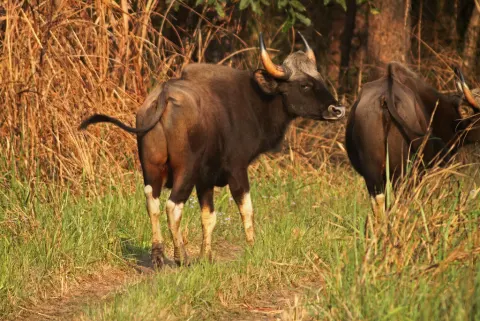
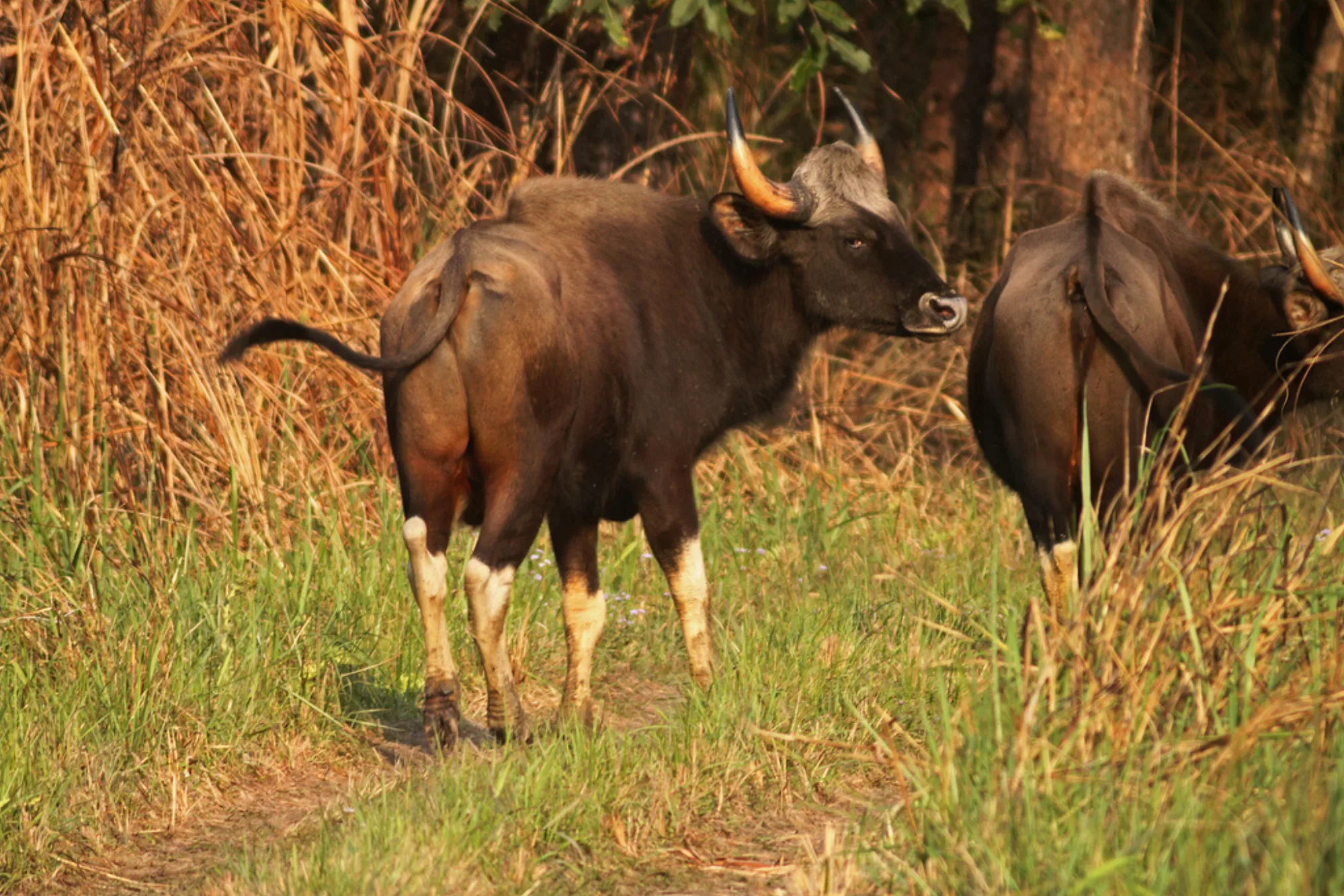
Heavy shoulders and a dark coat make the Gaur a striking animal to encounter. The largest wild cattle species, Bos gaurus has a ridge along its back, large ears and horns that curve upwards in both sexes. Adult males are dark brown, becoming almost black in old age, while females and young bulls are paler. The muzzle is pale, and the lower legs are white or tan. Its range across the Indian subcontinent and Southeast Asia is now fragmented. In southern India, the Western Ghats and nearby hills remain a stronghold; several herds also persist in Vietnam's Cát Tiên National Park and neighbouring forests. Gaur favour extensive, relatively undisturbed forest with water and plentiful vegetation, often in hilly country. They occur in evergreen, semi-evergreen and moist deciduous forests, as well as deciduous forest at their edges.
Undisturbed herds are generally active by day, but human activity can make them largely nocturnal. During the dry season, herds gather in small areas, then disperse into the hills when the monsoon arrives. An older female leads the herd, while adult males may live alone. Gaur spend much of their day feeding, taking grasses, herbs, shoots, flowers and fruit, with a strong preference for leaves. They rest beneath large trees during the hottest hours. Breeding takes place throughout the year, usually peaking between December and June; females normally have one calf, which is generally weaned after seven to 12 months. Tigers can kill adults, and herds may circle their calves when confronted by one. Poaching for trade threatens Gaur in Laos and Thailand, while hunting for food also affects them in Laos. Conversion of low-lying land to cropland and pasture has reduced available habitat.
Written from the English Wikipedia article Gaur (CC BY-SA 4.0).
- Records
- 412
- Countries
- 5
- Atlas places
- 10
These are open occurrence records, so they show where people looked for and recorded the Gaur as much as where it lives. Cells are up to 25 km across, and every location is generalised to its cell.
Generalised encounter areas, not exact locations. Each shape is a grid cell coloured by how likely the species is there.
- Very likelyIndia25 km zone · medium confidence · 374 records · updated 80 days ago
- Very likelyThailand25 km zone · medium confidence · 33 records · updated 80 days ago
- LikelyVietnam25 km zone · medium confidence · 4 records · updated 80 days ago
- PossibleNepal25 km zone · medium confidence · 1 record · updated 80 days ago
- RareCambodia25 km zone · low confidence · 0 records · updated 80 days ago
Conservation status not assessed here yet, so every location is generalised to its grid cell.