Gaur
Bos frontalis
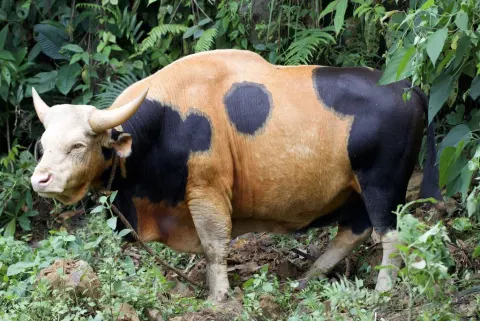
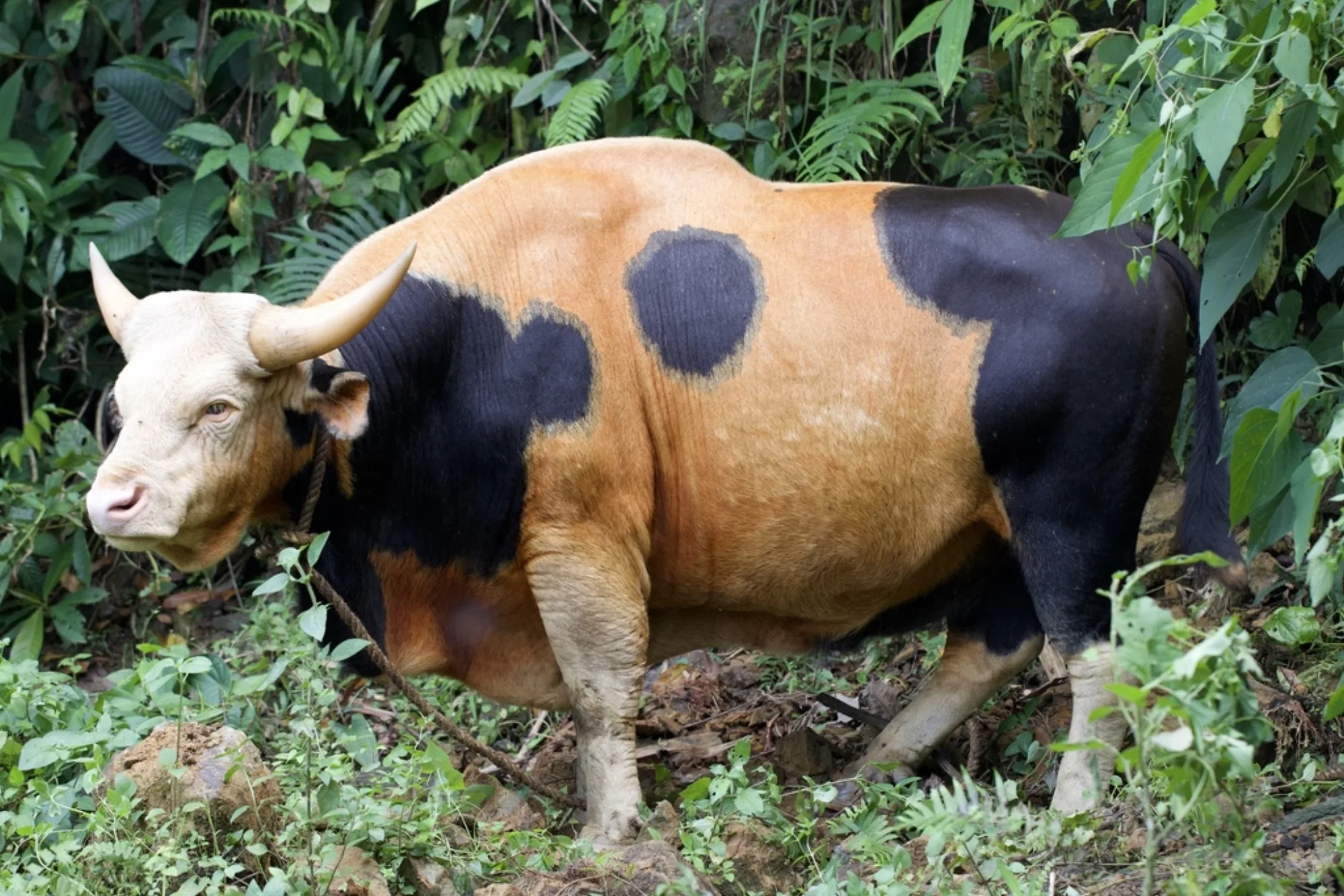
Known as gayal or mithun, Bos frontalis is a large, semi-domesticated cattle animal found in the Himalayan foothills, primarily in Northeast India. Gaur is identified as the maternal ancestor of domestic mithun. Gayals are smaller than gaur, with shorter legs in proportion to their bodies and a less developed ridge along the back. Both sexes have a blackish-brown head and body, with white or yellowish lower legs. Their thick, massive horns extend almost straight out from the sides of the head and curve upwards at the tips. Females are much smaller than bulls, while some domesticated animals have patches of different colours or are entirely white.
Across the southern Eastern Himalayas, gayals live in Northeast India, Bangladesh, Myanmar, Bhutan and Yunnan in China. Their range extends from 300 to 5,000 m above sea level, and they favour undisturbed forest on hilly terrain, with streams, ponds, lakes and plentiful shrubs, trees, bamboo and coarse grasses. Salt licks also draw them. In India, several ethnic groups keep semi-domesticated gayals in forested hills, while in northern Myanmar they occur in Kachin State.
Traditionally, owners have let these semi-wild animals roam and forage in forests, returning of their own accord and receiving supplementary care. Their foraging and manure help enrich the soil, and they also aid seed dispersal. Today, owners increasingly use fences to keep them out of crop fields, where farmers may shoot them or their owners may face fines for damage. Some owners also call their animals back to pasture or barns each night, partly because dholes prey on livestock, especially calves.
Written from the English Wikipedia article Gayal (CC BY-SA 4.0).
- Records
- 4
- Countries
- 1
No atlas park has a record of the Gaur in or around it yet.
These are open occurrence records, so they show where people looked for and recorded the Gaur as much as where it lives. Cells are up to 25 km across, and every location is generalised to its cell.
Generalised encounter areas, not exact locations. Each shape is a grid cell coloured by how likely the species is there.
- Very likelyIndia25 km zone · medium confidence · 4 records · updated 80 days ago
Conservation status not assessed here yet, so every location is generalised to its grid cell.