Cedar Waxwing
Bombycilla cedrorum
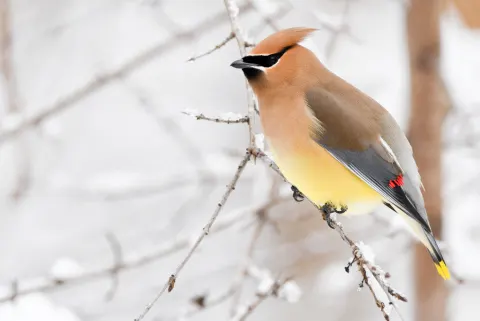
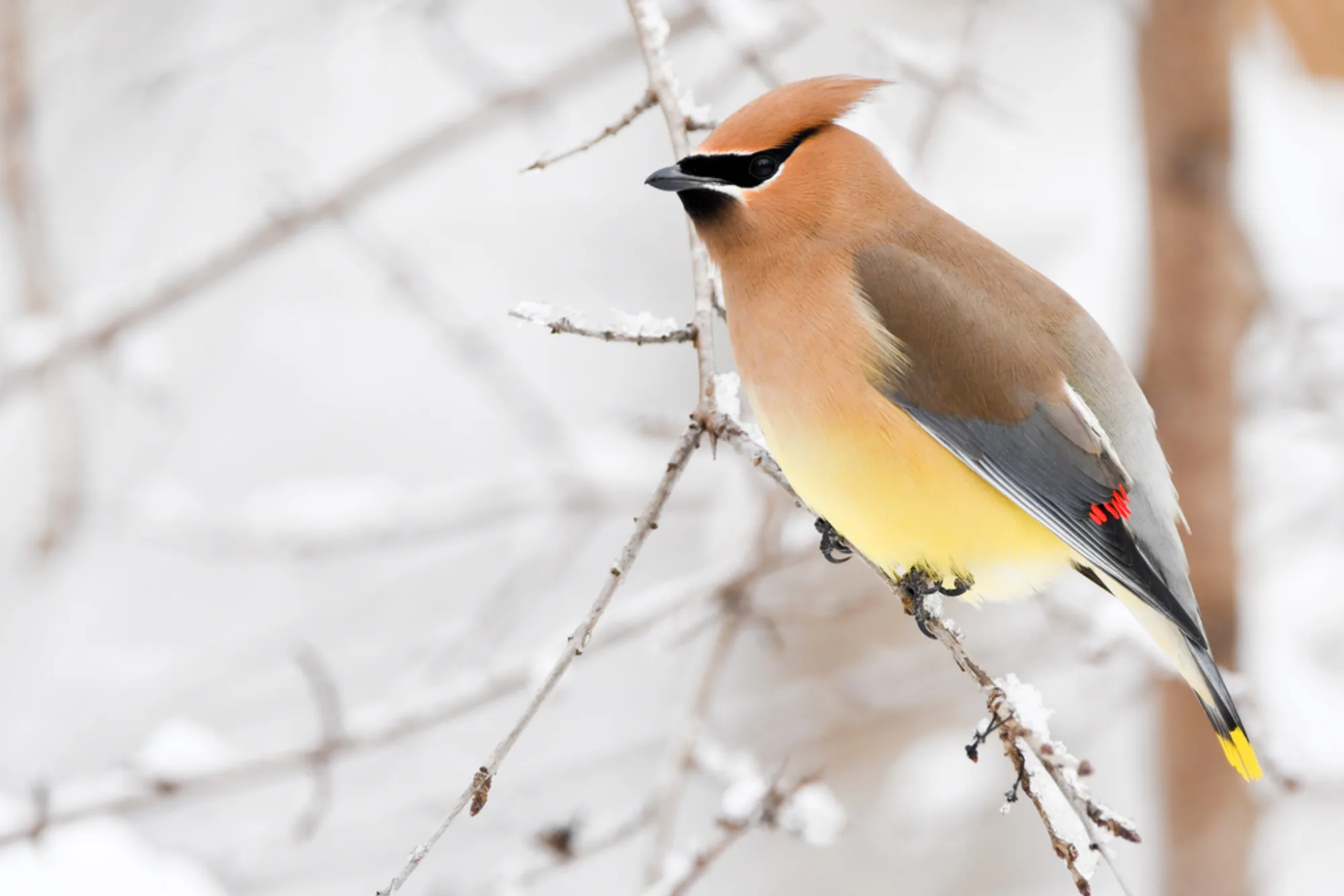
A soft crest, a black mask edged in white and tiny red, wax-like droplets on the wings make the Cedar Waxwing a distinctive sight. This medium-sized bird is mainly brown, grey and yellow, with a pale yellow belly and a short, square-tipped tail that is usually yellow or orange. Males and females look alike, while young birds have streaks on the throat and flanks and often lack the adults' mask. Listen for high whistles and buzzy trills, especially when a flock is flying.
Native to North and Central America, cedar waxwings breed in open woodland in southern Canada and spend winter from the southern half of the United States through Central America to northwestern South America. Look for them in fruiting trees at woodland edges, particularly where berries and water are close by. They also visit orchards and gardens, and favour parks with well-spaced trees and a nearby water source. Sociable throughout the year, they travel in flocks and move in search of berries, sometimes gathering by the hundreds outside the breeding season.
Berries and sugary fruit are eaten year-round, while insects become an important food during breeding. Birds sometimes line up on a twig and pass berries from beak to beak. From late spring into late summer, pairs raise one or two broods in a loose cup nest of grass and twigs, with both parents feeding the young. After hatching, the young spend about 14 to 18 days in the nest before leaving. Cedar waxwings sometimes collide with windows or are hit by cars while feeding beside roads.
Written from the English Wikipedia article Cedar waxwing (CC BY-SA 4.0).
- Records
- 2,225,164
- Countries
- 2
- Atlas places
- 3
These are open occurrence records, so they show where people looked for and recorded the Cedar Waxwing as much as where it lives. Cells are up to 25 km across, and every location is generalised to its cell.
Generalised encounter areas, not exact locations. Each shape is a grid cell coloured by how likely the species is there.
- Very likelyUnited States25 km zone · high confidence · 1793577 records · updated 81 days ago
- Very likelyCanada25 km zone · high confidence · 431587 records · updated 81 days ago
Conservation status not assessed here yet, so every location is generalised to its grid cell.